I just finished reading Mike Brown's How I Killed Pluto and Why it had it Coming, and it was a fantastic read. It got me thinking of so many things; scientific progress and history, how the public perceives scientific ideas, becoming entrenched in a way of thinking, distress over change, and how so much of education seems to be storing data in memory rather than learning algorithms (and man for some reason I've really been connecting with my inner computer scientist lately) are just some of the highlights. It's amazing how much depth there is to the trivial or technical classification details of a rock out there past Neptune. There's one more aspect of the book that I loved, Mike Brown's humanity in his love for his wife, his daughter, and the sky, but I think I'll write about that in detail later.
I remember when Pluto was reclassified. Many jokingly consoled forlorn Pluto, kicked out of the planet club by the big boys. After reading the book I find it odd, why did no one talk about Eris (the Kuiper belt object actually larger than Pluto which theoretically could have been the tenth planet)? Why did no one bring up Charon, Pluto's moon which is almost as large as Pluto? Why did no one discuss what exactly it meant to be a planet, and how exciting it was that we were learning more about our solar system in finding so much out there in a whole new asteroid belt out beyond the gas giants, the aforementioned Kuiper belt?
I've groused before on this blog about the dreadful way mathematics is taught, perhaps it's time to get some of that ire up for science as well. One thing the book made clear is that we all learned that the planets are Mercury, Venus, Earth, Mars, Jupiter, Saturn, Uranus, Neptune, and (as we learned at least) Pluto. Did any of us ever learn what a planet is? I think the 'Pluto controversy' pretty clearly indicates no, we didn't. If we had we would have always found Pluto's planethood a little odd.
Pluto's moon doesn't orbit around it, they orbit around each other. Pluto's orbit is eccentric from the other planets. Pluto is smaller than many planet's moons, including Earth's. To kids and creatives that might make Pluto mysterious and fascinating (it did to Mike Brown as a child), but to scientists and logical thinkers it seems misplaced in the solar system. And indeed it was.
But no one really seemed to feel that way. We all sort of felt bad for Pluto, and some people might have even been upset. I think there's two major components why. The first is, as I alluded to, the way we learn science. The next is our unwillingness to accept change.
Thinking about the Pluto controversy I am brought to worry that we are often taught 'the way things are'. Mike Brown talks about trying to get students out of the mindset of, "Give me the answers I need to know for the test". The unfortunate implication is that something gets them into this mindset in the first place. Standardized testing is a convenient and popular target for modern problems in education, but I'd feel remiss if I didn't mention that of necessity it requires students to memorize and later regurgitate facts, and testing any deeper thought processes is at the very least much more difficult.
I read a NYT article that talked about why teaching the difference between fact and opinion like we currently do in schools is morally perilous, as well as simply fundamentally misguided. It points out interesting ideas, like how teaching children that facts are provable and true causes them to equate truth with provability, even though they're very different things. I think a focus on 'facts' in science class also carries a dogmatic implication for young students. Science is always true because we collected evidence for our ideas. Here's where the distress comes up; Pluto no longer being a planet means facts can change as our understanding does.
And that opens up a whole new can of worms in our minds. It forces introspection and meta-cognition, in which sadly most of us are loath to participate. It creates a crisis of certainty, because after all if Pluto being a planet isn't true what other tidbits we learned might not be true? Doubt is, unfortunately, scary to many. We're unwilling to change our thinking, to update our knowledge, to print retractions or errata for our memories. This is why teachings of humility are so important. They allow us to maintain our sense of self and identity even when we're forced to change our thinking, context, or experience.
A great idea that came together for me when I read The Island of Knowledge is that science must necessarily be the least sure of itself of all human endeavors or reservoirs of understanding. It must be forever willing to except new evidence or observation which proves previous ideas wrong, and moreover perhaps must forever be seeking these out. No less than the well known and liked Neil DeGrasse Tyson recently said in a podcast I listened to that the greatest problem is always dogmatism, because it ends a conversation and makes learning from others difficult or impossible. Let's take this to heart, accept that Pluto should never have been a planet, and rejoice in the fascinating newly unfolding mysteries of that Kuiper belt.
Showing posts with label complexity. Show all posts
Showing posts with label complexity. Show all posts
Saturday, October 1, 2016

Monday, June 1, 2015
Are We Ready for Post Scarcity? Part 2
It's easy to romanticize scarcity when looking to address the problems that arise as it fades from the eyes of humankind. Recent bouts in popular culture of "paleo-nostalgia" show us just how absurd our longing for "the good old days" can get. But the good old days were never as good as we pretend they were. The fifties had Jim Crow laws. Pre-industrial society was awash in the filth of both the horses that pulled carriages and the humans that rode in them. Why I should have to point out the scourges of humanity in medieval, bronze age, or stone age days is beyond me, but I'll mention crusades and inquisitions, the slavery that built the pyramids, and war among rival tribes of cave men just to be safe.
I bring this up because it's important to note that I'm not advocating we avoid creating a post scarcity world. Precisely the opposite, I want to acknowledge that we're in the middle of doing so, and embrace the change. To do that though, we need to be wary and accepting of the consequences. Some of those may be unimaginable and have to be addressed as they come. Others are more predictable, especially when we consider history.
I mentioned the abundance of food in part one. Now consider farming, the production of that food. Farming is remarkably different in the modern world, and it's so efficient that we can produce so much food that our primary concerns don't regard abundance. We take abundance of food for granted, instead seeking better quality and solutions for what to do with the excess. This has come at a price, though.
The great depression featured, "Farming communities and rural areas suffer[ing] as crop prices fell by approximately 60%." (wikipedia, citing three other sources) The abundance and efficiency of farming is so staggering that only through heavy subsidies is agriculture profitable today. These subsidies are so severe that Lawrence Lessig in his book Republic, Lost titles his chapter on government farming subsidies, "Why don't we have free markets?" We recoil at the realization that government is deciding what food gets grown, and yet this might be important and beneficial to society, since we all like to eat. Surely subsidizing agriculture is better than milk being spilled into gutters while thousands only a few hundred miles away starved, a characteristic image of the depression?
Food is one thing, it's physical and tangible. We're all familiar with it and easily understand what it means. Information is quite another, yet it's the next thing whose scarcity is being obliterated. Personal computing and the internet have done a pretty good job already, once again changing the problems from availability to find-ability of information of high enough quality and relevance.
What have humans done with this? We haven't become a society of well read polyglots that understand the conflicts between relativity and quantum mechanics as we might hope. We're very well entertained, though. Entertainment is just a form of information, after all. A textbook has roughly the same form as a storybook. With Netflix, Hulu, & Youtube, for videos alone we can spend our entire day being entertained for probably not quite $100 a month.
This doesn't (necessarily) mean we're stupid or shallow, though. Many of the most popular shows are sharply written character and political dramas like House of Cards, Mad Men, Breaking Bad, and Game of Thrones. The recent revival of Carl Sagan's Cosmos series did well. It could be argued more people are writing than ever before thanks to blogging sites like what you're reading now and maybe even social media.
OK, I'll admit I might not be buying the idea that the lack of scarcity in entertainment is improving us as a people either, but on the other hand I'm not going to dismiss it outright. A stronger example might be video games. The juggernaut game Minecraft is almost exclusively a creative tool rather than a traditional game. Gaming has a strong community of "modding," or learning some basic (or in some cases extremely complex) programming tools used in a game to create a variant of that game. These variants span anything between the original game with a failure message changed from, "You died." to "Thanks, Obama!" to entirely new games built on the same graphics and gameplay engine.
In both food and entertainment we do see demand for quality now that availability is so high. People grow from just being happy to have something to eat to wanting something that is organic, gluten-free, or maybe even something actually important. People start paying attention to what their food is over whether or not it's there. Likewise in entertainment we are demanding quality more and more. We are seeking entertainment that we can, as Kevin Spacey says, "engage with...with a passion and an intimacy that a blockbuster movie could only dream of."
Bertrand Russell writes in his essay In Praise of Idleness about the odd disconnect that exists between our valuation of production and consumption. While we admire productivity we don't highly value consumption. Those who earn money have prestige, but not those eager to spend it. He points out the oddity of this, particularly when we only earn money is by others' spending of it. "We think too much of production, and too little of consumption. One result is that we attach too little importance to enjoyment and simple happiness, and that we do not judge production by the pleasure that it gives to the consumer."
Russell also alludes to the caste and class scaffolds that these attitudes seem to stem from. He even goes so far to argue that the traditional work ethic arose largely as a tool of slave-owners and autocrats to keep their populations content with their tyrannical rule. If this is starting to sound like Marxist thinking to you then you're actually very clever. A serious point of departure I must take to this essay is his praise given to the (only ten years old at the time of writing) Russian revolution and newly formed USSR.
We all know how that experiment turned out, so how can I possibly be suggesting that going at it again is a going to be a good thing? The short answer is that I'm not. I am arguing that an economy with abundance for humanity requiring very little input of labor from humanity is on the horizon, or even just finishing its arrival and is starting to settle in. One of my great concerns is the way this could create a dictatorship masquerading as efforts to provide equally for all men like existed in communist Russia. I'll delve into this a little more in part 3.
Saturday, February 28, 2015
Technology, cheating, and the Augmented Mind
As a student I've been taking plenty of tests lately. My university has a pretty good testing system and convenient testing centers and I'm a pretty good test taker so none of this really bothers me, but I have found the testing center policies interesting. The fact that I have to remove my hat before going in is one. Recently they've also disallowed the wearing of a wristwatch, almost certainly in response to the new smart-watch technology coming out. While this is the right thing to do, it does indicate a need for much grander changes in both the way we do things as well as our thinking, probably especially in education. Changes we are woefully unprepared for.
Let's consider the testing center again, perhaps as if you were the director of these. We made the change for smart-watches so that they won't be used for cheating. What will we do if Google Glass, or a similar project where data is displayed on a pair of glasses worn by the user, takes off and starts showing up? If that technology becomes integrated into people's prescription lenses? What about if those smart watches become smart tattoos? What about when students start having direct neural interfaces integrating computers into the brain? These problems are coming, and I think we can quickly see there's no easy solution, and maybe no solution at all to make a our current testing systems compatible with the existence of these technologies.
As my neuroscience teacher put it, most testing today is a simple demonstration of declarative memory. This is to say tests usually require a simple recalling of facts, figures, or other basic knowledge. However, the need for this to be done in the human brain is dwindling. Facts can be more easily stored, more quickly recalled, and more reliably maintained in computer systems than in nervous tissue. Why would we keep using cerebral circuits (that weren't really designed to do this in the first place) when we can use electronic ones? The go to example is memorizing phone numbers, something many of us remember doing before technology made it an exercise in pointless exertion of energy.
Lest you think this is the pie in the sky omphaloskepsis of a futurist and science fiction fan, let me relay a story I heard from one parent. He wanted to have his daughter writing letters, and specifically to do so using some specific vocabulary. Shortly after he heard his daughter speaking out loud while alone in her room writing the letter. Listening closer he realized she was using the voice recognition feature of the tablet/smartphone to simply ask for the spelling of the appropriate words. This was much to his disappointment, as he was expecting her to look the words up when writing them and learn the definition along with the spelling. That's how big a change something as simple as voice recognition is making.
A future where traditional testing is pointless seems on the horizon. How education will or even can deal with this is unclear. The problem with leaving our traditional testing is that other methods require more work to evaluate, and usually are less objective which can be a big problem for admissions tests like the MCAT. The only solution I've thought of is an increase in internships and apprentice work, but whether or not this is feasible is unclear. I know the major reason the radiology or medical laboratory programs at my school can't admit more than about 40% of applicant students is because they only have so many slots for clinical rotations available. It could be damaging to the economy to have the influx of cheap or free labor that having five interns or apprentices to every one trained employee might mean. The problem is a big one, and sadly I haven't seen it given all that much attention. Let's hope for and work toward that changing sometime soon.
Thursday, October 2, 2014
Expressing Curiosity in Science
As a student of the sciences, mostly physics and recently medicine, I often will get caught in discussions of 'what is science?' as in a recent lab class. I often resist engaging in these because I feel they too often are trying to promote idealized views of this particular human endeavor. The humanity of the enterprise is forgotten in trying to give it good PR. Most recently I did have one thought on the subject that seemed of value though: science is one expression of the curiosity of mankind (and remember man in this context is gender neutral).
We have an interesting relationship with curiosity. The most well known phrase in regards to the subject is, "Curiosity killed the cat." I like to use the snappy rejoinder, "Well we better try to satisfy curiosity before that psycho goes off killing small animals to get their jollies then," but I recognize that the implication the phrase carries is to take caution with exploration and intuition. As should be obvious to the reader at this point I don't agree with this mentality, but that said it's never wise to throw caution to the wind entirely and we should certainly ensure that our actions properly reflect the correct balance of our desire to know something and other desires, such as comfort, safety, and community.
I still think that on balance curiosity is a virtue. I believe in the freedom of information, an understandable order and structure underlying the universe at large, and that challenges to one's thoughts and beliefs will eventually improve them if faced head on and not ignored. Curiosity lets us promote and explore these things. Consider what the opposite of curiosity might be. A quick look in the thesaurus brings up disinterest, indifference, perhaps even apathy. Does anyone really want to be with people or build a society with these qualities?
Science is one way in which we express our curiosity. It's perhaps the simplest, being based on straightforward observation of a community. Laws and theories are only useful in as much they can make verifiable predictions and only believable in as much as they are supported by data and experiment. This does make science somewhat limited in scope as most will recognize that there exist things that simply can't be proven one way or the other, but the pragmatic and skeptical mentality is a powerful tool for any thinker.
Science is of course a human enterprise, though. This expression of our curiosity is subject to the same forces that might make a desire for self improvement into greed or a longing for love and community into exclusion. Having guiding principles in a great human venture never means we follow them perfectly, or if it does it probably means we're losing sight of other virtues. The guiding virtues of science - observation, falsifiability and testability, and of course curiosity - will indeed help us in our endeavors to become virtuous.
Friday, January 17, 2014
Your Moral Earth's Magnetic Field
I've heard people talk about how important their moral compass is to them. What this means can be something different to any different person, but one definition that I think matches most people's conception is, "a natural feeling that makes people know what is right and wrong and how they should behave." Are the natural feelings we have really what should make us know what's right and wrong?
Doing what's natural may not be a terrible basis for morality, but it's not a good one either. We have a number of pack animal and cooperative instincts that guide us toward some caring and concern for our fellow man (and remember man is gender neutral in this context). These also create an aversion toward malice in many contexts, which is also good. Our instincts don't stop with these, 'love your neighbor' drives though.
Being a pack animal leads to a set of instincts, and while some of those are positive like what's stated above others are decidedly negative. It leads to a tribalism, probably due to competition with other packs. We protect our own, but those who aren't are own are usually fair targets for whatever we can dish out. This is why looking at history we only seem to have been fighting against racism, sexism, or similar discrimination for about a century or two, and to some even that's being quite generous. There's also significant drives to personal status and individual gain. We want the pack to be strong, but we also want to be the head of the pack (or at least be very secure about our position in it) and there's a good chance we're willing to trade the good of our group for a high position in it, too. This is why children throw tantrums, politicians and important businessman are as willing to admit mistakes as they are to part with teeth, and people gossip about the shortcomings of acquaintances.
This leads me back to the idea of a moral compass. Truthfully, I think it's a good analogy as long as we remember one thing: a compass doesn't operate in a vacuum. A compass is a magnetized needle set on a spindle (or sometimes in other ways, such as suspended in a liquid). It points to the north because it aligns itself with the Earth's magnetic field. In morality, this leads to the question that might be much more important than how is your moral compass, but what is your moral Earth's magnetic field.
What things external to ourselves help us understand what is moral and what is not? Is it divine scripture? Public opinion and associated feelings of dignity or shame? Articulate and interesting discussions on ethics? All of these have flaws which must be examined and guarded against and all have certain merits as well. Compasses can be disrupted by anything that produces strong magnetic fields, like high electrical current. Precise navigation may also require an adjustment between magnetic north and 'true north' since the Earth's magnetic poles aren't perfectly aligned with her north and south poles. Just like a compass will not point true in a lightning storm or around power lines we should learn where our moral compass may fail to point us true and why if we want to stay true to our moral north wherever we go.
Thursday, November 21, 2013
Sadly, the porn must flow 2 : Technical Considerations
So I've gone over the conceptual problems with a government mandated ISP based pornography filtering system and given an overview of how these systems might work. One of the problems with this kind of legislation, however, is that there are numerous technical considerations. Much like the recent SOPA bill, a pornography filtering requirement could possibly work out to be a government mandate to restructure how the internet works in the service of a specific special interest.
On the surface this seems like an overreaction, porn filters already exist so how difficult would it be for these to be implemented broadly by ISPs rather than requiring users to implement them personally. It's not, though, as scalability isn't simple. There's a reason why programs have run locally on personal machines for years but only now can be served out from a remote location to hundreds of thousands of users. There's a reason enterprise servers are different from personal computers.
Still, though, it's certainly doable. It would take a lot of work, though, and skilled programmers, network engineers, and system administrators don't work for free. That means forcing this to happen at the ISP level will be expensive. A government mandate means everyone's prices will go up. Think about if a similar resolution were to be passed for gasoline, electricity, or food. People would rightfully be incensed that either they're being forced to pay more for a service they don't want or are already using from a provider they trust and have established a good relationship.
Also, people don't often think about what their ISP is doing with their internet traffic. Usually that's because it's assumed that they shouldn't be doing anything with it apart from passing it on to the intended recipient. That's not the case, though. Your ISP is watching you, much like Google, Facebook, or other online advertising companies are and like these they plan to sell information about your habits to interested parties for some extra cash. They're also watching you as a favor to their friends in the entertainment industries to make sure that you don't "copy or share a movie, television show, or song improperly." The more I find out about the ISP industry, the less I trust them.
Knowing this we're likely to see two things happen should any sort of legislation pass from this petition: First, pornography filtering will be put in place, but thanks to a grant from the pornography industry to ISPs will make this laughably easy to circumvent. There could possibly be a sort of 'protection money' situation where ISPs block the pornography sites that don't pay up to be on their list of sites that aren't too 'extreme or hardcore.' Second, the system will be implemented with little thought to protecting those that want to avoid pornography, but as a great excuse to further other goals for the ISP.
I mentioned encrypted traffic in my last post and how this can create a problem for porn filtering systems. My feelings about ISPs give me every reason to believe that they would be happy to use porn filtering mandates to try to subvert users' efforts that are trying to remain anonymous and gain a modicum of privacy while online (such as when using a VPN service like ProXPN to hide traffic from the ISP, or connecting to a Tor node to remain anonymous). This way they could continue collecting information about you and your habits to sell to advertisers or make sure you fall in line with the entertainment industry's demands. They'd also have the power to brand anyone trying to get around these restrictions on the service they're paying for with a 'scarlet P' by saying that they had opted in to the internet with pornographic access plan.
Going back to the phrase from the petition, "Parents and individuals have to go to great lengths to install Internet filters that often don't weed out all porn," I'm not really certain what these 'great lengths' are. Installing a free program like K9 web protection on your computer, or an app on your cell phone like this web filter? Admittedly my preferred solution, OpenDNS, is a little technical but even then you don't even need to sign up and they'll still provide straight forward instructions like these on their website. Why do we feel it necessary to have the government partner with our ISPs to do this for us? If staying safe from pornography is important to us shouldn't we be willing to put an iota of effort into doing it in a way we understand and are in control of?
This leads me back to one of my original points: naivete. I recently watched a documentary on prohibition and one thing that was pointed out was that once the prohibition amendment had passed the prohibitionists had thought they'd won the war on alcohol. Anyone with a smattering of US history knows that wasn't the case, and a tacit law saying porn is to be avoided won't make it any less desired or sought after. We'll be handing over a good degree of power over our lives, remember the internet is only becoming more and more important to who we are, in exchange for avoiding something like an hour a week, at most, to install, configure, and maintain a filtering solution that fits our personal needs.
I'm writing a novel this month for National Novel Writing Month in the tradition of cyberpunk. One characteristic of the cyberpunk genre is that it features technology not as an enabling force that brings about Utopian lives for mankind, but instead becomes a force for control and oppression. There's hints of this in my novel, but one of the themes is also supposed to be that this happens because people give up their rights, their strength, and their power to others because they think it's too hard to develop the technical skills necessary to understand the systems they use. Society has fallen back into being controlled by a few select elite, but this time we chose it because math, programming, physics, engineering, and computing are hard and we'd rather enjoy ourselves while someone else did those complicated things. This petition is a sad reminder that the bleak future I'm writing should be fiction, but might not be someday.
Wednesday, November 20, 2013
Sadly, The Porn Must Flow
There's been a white house petition going around lately that I've been saddened to see many friends of mine supporting. The petition is promoting a measure similar to one that was proposed a while back in the UK, that internet service providers be required to block pornography by default. I remember hearing this news back then and thinking of it as an oddity of British politics, and feeling thankful that we weren't foolish enough and that the American spirit had principles of liberty well enough ingrained that we wouldn't support something similar here in the US. Sadly, it seems I'm being proven wrong.
I'm no lover of pornography. Well, I mean, I'm a normal red-blooded heterosexual male so there's the obvious vulgar desire to check it out, but I do avoid it and would counsel anyone to do the same. I actually block pornography on my home network using OpenDNS, which has proved to be a fantastic solution. Make no mistake, my objection is not pro-porn, I object on the grounds that what we'll lose if we try this will be greater than any gains.
So what do we have to lose, except our pornography? The fact that this question needs to be asked is part of what saddens me. It bespeaks a naivete in our society that borders on, if not diving all the way into, a dangerous area. Pornography is very hard to define. Any reasonable person will admit that not all nudity is pornographic. Once this is acknowledged the waters immediately muddle quite a bit. Some might try to avoid this difficulty by saying that our efforts only need to filter out 'the worst kinds of porn' or 'extreme and hardcore pornography' but that only pushes that very hazy line back in hopes that it will reach an area where enough people feel shameful about being on the wrong side of it that they avoid being anywhere near it.
That approach doesn't help when we're talking about electronic content filtering. Our computers, networking routers, or servers aren't like our parents that can look at us and tell when we think something might not be right and ask us in a stern voice if we're really making the correct decision right now. The petition states as one of its concerns that, "Parents and individuals have to go to great lengths to install Internet filters that often don't weed out all porn." I'll get to the first part (oh believe you me I'll get to it), but let's look at the worry that they "don't weed out all porn." Short answer, that's because they can't. Let's get into the two ways to filter pornography (or really anything, the same methods can and are used for your computer's anti-virus): blacklisting, whitelisting and heuristics.
Blacklists are a list that's been built of sites known to be pornographic that are blocked. The obvious flaw with this is that new pornographic sites arise everyday, and there's a delay before these would be added to the blacklist. The less obvious flaw is that it will inevitably be based on the opinions of people making decisions about whether a site is pornographic or not, and your opinion may not agree with the blacklist makers. I'll go into this more after explaining the counterpart to the blacklist, the whitelist.
Whitelists are the inverse of blacklists, building a list of known safe and OK sites that don't contain objectionable material and only allowing a user to visit those sites. It should be fairly apparent that this essentially reduces the internet to barely useful, but then again in certain contexts may be a good solution. Parents installing a whitelisting program on their home computer or network for their children, requiring them to get parental approval before visiting a site, or non-technical users that only use a relatively small amount of web applications (i.e. only visiting facebook, youtube, amazon, and one or two other web applications related to their job). That's not what this petition is about though, and whitelisting would be far too restrictive for an ISP to ever implement for a solution to their customers.
So neither are a good solution for a government mandated ISP pornography filter as they either 'don't weed out all porn' or throw the baby out with the bathwater and cause huge gaps in service in an effort to do so. Again, though, the issue of what porn is comes up. One pornography filter I installed, K9 web protection, was absurdly restrictive for me and blocked sites like facebook and youtube (though admittedly I think this might have been for reasons other than porn). I had to disable these filters while leaving the rest in place. There is some pretty saucy content on these sites, though, and some parents might not want their kids exposed to that. Would you want your ISP to block youtube, since after all you can see videos of girls in bikinis and lingerie or lesbians kissing (albeit that media is often behind youtube's own adult content protections) and then if you wanted to watch a youtube video be forced to tell you ISP to 'turn off their porn blocking' for you? Are you OK with never using facebook since, after all, if an attractive woman who is 'friends' with you posts a picture of her in a bikini or otherwise scantily clad it might as well be porn?
Maybe our final method, heuristics, can help us out. Heuristics will inspect data and websites for specific behaviors, content, or properties and then block it if they meet certain qualifications. Heuristics can easily get false positives, a popular example being filters that scan images for exposed skin or genitals blocking medical journals for having instructional images when examining a disorder. This leads to similar problems as before, either too much is blocked because it might be porn, or not all porn is weeded out. Heuristics also have the problem of requiring much more processing power and access to your information.
The first concern means a huge investment in equipment for ISPs, which will effectively pass on the cost of porn filtering to customers that may not want it. Is it really fair to force people to pay for a service they don't want? The second means it's tricky to impossible for connections that are properly secured to be filtered. It's entirely accurate to say that for an ISP to comply with any law created from this petition they might be within their rights to say, "This traffic is encrypted and has been blocked as possible pornography," when you're accessing your bank or other financial institution's website. Lest you consider this an extreme example of hyperbole to make my point there is precedent for this; the NSA in its data collection efforts collect all encrypted communications they come across despite the fact that they're prohibited from collecting communications from American citizens saying that encrypted communications are essentially by definition unable to be verifiable as between Americans. If you allow the ISP to allow encrypted connections you've approved to connect normally you've short circuited the system, and disabling heuristic filtering for certain approved sites with secure, encrypted connections increases the overhead requiring even more costly processing power.
What can the government and ISPs do to block pornography, then? Well, here's the thing, we still haven't defined what pornography is. The Church of Jesus Christ of Latter Day Saints actually provides what I believe is a very accurate definition in their manual True to the Faith, "Pornography is any material depicting or describing the human body or sexual conduct in a way that arouses sexual feelings." The question here is, how do we know what arouses sexual feelings? To some a painting such as the Venus de Milo might seem sexual, while to others it might not. Pornography, like so much involved with sexuality, is a deeply personal thing, and as such is hard to define, let alone regulate, effectively. Regarding pornography Justice Potter Stewart famously couldn't give a definition other than "I know it when I see it." (and, interestingly, the film referred to in the case where he said that was not, according to him, obscene). We may know indecent content when we see it, but computers don't so any hope of creating a computer system that will block all that out for us is doomed to fail.
Tuesday, September 3, 2013
Choosing Style & Convenience Over Principles
Consider which of the following philosophies you agree with more:
Our choice in technology tends to be surprisingly shallow when we consider the depth of the effect technology has on us. We decide based on what looks nice, has the coolest features, or sometimes (usually if we're a little more informed) runs well and has the most processing power. For something that is so rapidly changing the way we interact, work, and quite arguably think this seems like pretty arbitrary criteria. Will it cause me to seek large amounts of less intimate relationships more efficiently? Will I ponder issues less in favor of looking up a quick and easy answer from a third party source in the most sleek and stylish way? These are the kind of questions we're asking, when we could be asking ourselves questions like, "Will I be engaging in and contributing to a infrastructure that promotes openness and individual freedom?"
If I may be candid for a moment let me admit my smug tech nerd ways. I used to be a little annoyed, mostly due to the immaturity one has early in life that others know different things than you do, when people didn't know how a computer's file system worked, the difference between a program and a text file, or why they couldn't get on the internet. I'm quickly becoming less annoyed by these people, but that annoyance is being replaced by fear.
I'm afraid because I know that market forces drive technology, and it's terrifying to see the market choose flashy, easy, and restrictive items over empowering items that might make them work a little harder. I'm afraid because working in tech support I've seen just how helpless people are when their technology breaks, how helpless many people are when it comes to fixing their technological problems, and how earnestly industry is working to make sure that problems may come up less at the expense of being fixable without being invited into a company's inner circle to error codes and access controls. I worry about living in a world where a relatively small conglomerate of programmers, advertisers, and businessmen are making sweeping decisions on how people live their lives, and the people are relatively powerless to and even uninterested in changing that.
Many are afraid of the effect technology is having on the human psyche and sociological structures. It's easy to blame the technology for this, but I feel that's misguided. If our minds or societies are becoming corrupted it's not thanks to the internet, smartphones, or video games. It's because we're using these poorly. And why wouldn't we if most of us don't know how they work at all, and only know what they do as the company making it presents that to us?
Studying mathematics and physics where most modern research is done with the aid of computers I'm perhaps blessed to have been taught in a tradition that specifically points out where computers are helpful and where our own intellect should be applied. Questions of what's computable and what isn't are addressed directly, as well as questions of the best way to compute that which we would indeed like to compute.
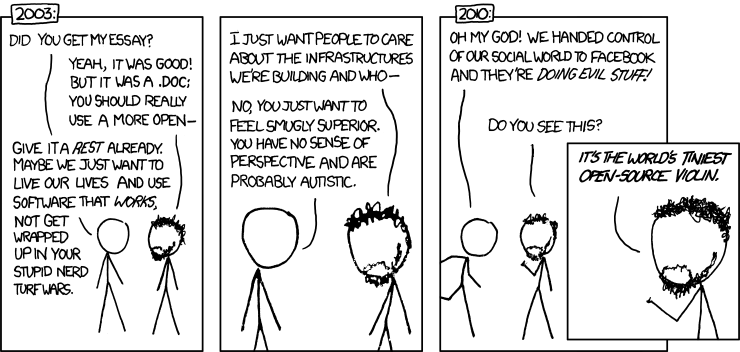
I worry a lot about my tone here. As I recently found out when reading a book on obesity, it's sadly easy to dismiss those presenting information and ideas about something as, "Oh, they're one of those type of people. That explains why they would say that." It would be so easy to end up being that "smugly superior" guy who'll criticize folk for having different views on technology or not knowing as much as he does about computers. As the comic below illustrates thouygh, sooner or later we'll be uncomfortable with how the technology we use works, and if unless we develop the appropriate infrastructure we'll be unable to change it.

A central authority will control every aspect possible.or
As much as possible will be made available in its entirety for public inspection and involvement.With that in mind consider this: are you more willing to use Apple or Linux computers? I know, I know "It just works." "I'm not a 'techie,' and don't want to have to deal with all that complicated stuff" "The way the little book opens is just so cute." I've heard it all before. I recognize that Apple has abstracted more of the functions for the user and produced very powerful, stable, efficient (though you wouldn't know if from their pricing) technology solutions, but you're missing the point. I don't want to talk about Apple per se. I want to talk about the choices we make, especially in technology.
Our choice in technology tends to be surprisingly shallow when we consider the depth of the effect technology has on us. We decide based on what looks nice, has the coolest features, or sometimes (usually if we're a little more informed) runs well and has the most processing power. For something that is so rapidly changing the way we interact, work, and quite arguably think this seems like pretty arbitrary criteria. Will it cause me to seek large amounts of less intimate relationships more efficiently? Will I ponder issues less in favor of looking up a quick and easy answer from a third party source in the most sleek and stylish way? These are the kind of questions we're asking, when we could be asking ourselves questions like, "Will I be engaging in and contributing to a infrastructure that promotes openness and individual freedom?"
If I may be candid for a moment let me admit my smug tech nerd ways. I used to be a little annoyed, mostly due to the immaturity one has early in life that others know different things than you do, when people didn't know how a computer's file system worked, the difference between a program and a text file, or why they couldn't get on the internet. I'm quickly becoming less annoyed by these people, but that annoyance is being replaced by fear.
I'm afraid because I know that market forces drive technology, and it's terrifying to see the market choose flashy, easy, and restrictive items over empowering items that might make them work a little harder. I'm afraid because working in tech support I've seen just how helpless people are when their technology breaks, how helpless many people are when it comes to fixing their technological problems, and how earnestly industry is working to make sure that problems may come up less at the expense of being fixable without being invited into a company's inner circle to error codes and access controls. I worry about living in a world where a relatively small conglomerate of programmers, advertisers, and businessmen are making sweeping decisions on how people live their lives, and the people are relatively powerless to and even uninterested in changing that.
Many are afraid of the effect technology is having on the human psyche and sociological structures. It's easy to blame the technology for this, but I feel that's misguided. If our minds or societies are becoming corrupted it's not thanks to the internet, smartphones, or video games. It's because we're using these poorly. And why wouldn't we if most of us don't know how they work at all, and only know what they do as the company making it presents that to us?
Studying mathematics and physics where most modern research is done with the aid of computers I'm perhaps blessed to have been taught in a tradition that specifically points out where computers are helpful and where our own intellect should be applied. Questions of what's computable and what isn't are addressed directly, as well as questions of the best way to compute that which we would indeed like to compute.
I worry a lot about my tone here. As I recently found out when reading a book on obesity, it's sadly easy to dismiss those presenting information and ideas about something as, "Oh, they're one of those type of people. That explains why they would say that." It would be so easy to end up being that "smugly superior" guy who'll criticize folk for having different views on technology or not knowing as much as he does about computers. As the comic below illustrates thouygh, sooner or later we'll be uncomfortable with how the technology we use works, and if unless we develop the appropriate infrastructure we'll be unable to change it.
Wednesday, March 27, 2013
A Personal Oddity of Emotional Expression
I'm a scientist. I'm not a poet, an artist, writer, or orator. Well, I think there's a pretty convincing case to be made that mathematics and seeing the beauty of nature in the laws that govern it have artistic merit, I'm at least an amateur writer (I have, like I suspect many do, a few beginnings to books, short stories, or articles), and am actually a pretty decent public speaker (though maybe not anymore, I haven't really done any public speaking for quite a while), but I'm speaking here to my outlook on the world and my communication with others and a scientific outlook has strongly influenced these aspects of who I am. There's two things that I find especially influenced by this background; objectivity and concern for clarity.
I explain that so I can explain this, it's very difficult and a little odd for me to tell my wife I love her. Not because I don't, I'm madly in love with her. Not because I think there's anything wrong or strange about it either, but because it's so hard to know what I'm saying. Often when we are sitting in our apartment together I let those words, "I love you," sum things up, hoping that my feelings are transmitted correctly. In other moments though, when I want to expound on what that means, on the way I'm excited by her beautiful form, the softening spark in me of her amazing smile, the joy I take in her fun personality, or the deep passion when I notice how well read and thoughtful she is, I don't know what to say.
One thing is I feel like I've said it all before, and I hate repetition. Rather, perhaps, I know that expressing something in a new way is more powerful than repeating something you've heard before. Heard enough times anything can seem clichéd. How many different ways are there to say, "You're beautiful and I'm very attracted to you," though? I have a fairly formidable vocabulary, but still there are only so many synonyms for beautiful, happy, and love that one can use meaningfully.
Often, and bear with me through the cheesiness of this statement, words seem inadequate. I can tell how I'm feeling, but how do I express that? And moreover, when I feel something so powerfully, how do I express that with equal power? If I'm to be clear in communicating my feelings, what do I do when I feel something which seems more potent than the words I've been using. Moments where recognition of all her glorious beauty flares up in a way that I guess I've felt before, but certainly feels new and exhilarating surely can't be expressed in a simple, "You're so pretty/beautiful/stunning/gorgeous/sexy," when I've already said that many times before, ¿can they?
I've mentioned before that I have a certain emotional austerity. That doesn't mean I don't feel strongly, I do. It does mean I usually hold off on expressing what I feel, and moreover that when I do I try to strengthen what I say about those feelings in an alloy of emotion, thought, reason, possibly evidence, and probably sources. I can't really do that when I express my love for my wife. I know it's my subjective experience, I know that it's the way I feel, heck I even have an idea of some of the neurochemistry and cerebral circuitry that's powering and processing it, but still my love is real, and I want to let her know that. I'm learning a lot as I learn how to say it.
Tuesday, March 5, 2013
Taxes and Taxation
I recently did my taxes and have also been reading The Federalist Papers and have been thinking a lot about taxation lately. One thing that always strikes me at tax time is the labyrinthine extensiveness of the tax code. I'm terrified of filing next year, trying to figure out how I'll file after getting married, having an HSA, and who knows what else is still to come. The complexity of the tax code is always what has struck me as the most immoral thing about it.
In The Federalist Papers Alexander Hamilton said, "The genius of the people will ill brook the inquisitive and peremptory spirit of excise laws." (emphasis added) We are living a world of privacy concerns. We watch our internet service providers eavesdrop on their customers at the behest of the entertainment industry or for advertising profit, the web services we use constantly collect that details of how we're using them, we keep devices in our pockets which may upload our exact location throughout our day, and we're told to be careful about grocery store discount cards as they can easily lead our eating habits getting sold to an insurance company to raise our rates. In this world of shrinking privacy our government should be working to protect what we have left, but instead we see it complacent and then at tax time bold faced enough to ask and expect us to answer a slew of questions about our investments, medical bills, work location, housing, and 'anything else you might have missed.'
An uncle of mine that prepares taxes has said that he would be unable to do so without the aid of computers. The fact that we have created such a situation is ludicrous. I have more than one uncle who makes pretty decent money preparing people's taxes, so let me make one thing very clear: I don't think there's inherent corruption in the tax preparation industry. There's competition, people concern themselves with following the law, and try to be honest. That said, I don't think it should exist. The fact that the layman cannot pay those who govern him without going through an entity that's insinuated itself through great deal of study and hard work is unnerving. I don't want a people that separated from their government, especially regarding something affects them so directly. This can only be done through an exceedingly simple tax code, far from what we have now where only one who devotes his life to understanding the tax code or is wealthy enough to hire someone who does will get the benefits of it.
This country was founded on many things, but one of them was "no taxation without representation." We believed so strongly that we deserved a say in how and why governments take money from us that we fought for that right. Has the American spirit dwindled to a point where we accept taxes as an inevitability, overseen by some arcane power that we can only glimpse through the eyes of a few initiated elite among us?
Thursday, October 4, 2012
What Makes a Great Debate?
The first presidential debate happened last night. I've recently uncomfortably found myself to be a political junkie and have been catching up on it, reading the news about it, and in general enjoying the excitement. There is one thing I'm noticing during all the hubbub; the current debate format isn't good.
I read one analysis that said the debate seemed undisciplined, and seemed to bemoan with Mr. Lehrer the loss of the final section for discussion. This doesn't really bother me. Perhaps it's because the nebulous sounding topic "governance" seems a little less interesting than the rest of the debate topics, but I feel it's because the discussion seemed fruitful and intelligent. Cutting off the speakers to cram in some extra talking points would have diminished what the audience was able to glean. The article I read also said the debate was too specific, with things like Simpson-Bowles plans and Dodd-Frank bills, but I disagree. This disagreement actually has a very fundamental basis.
Politics often seems watered down to triviality these days. Our "sound-byte society," short attention spans, and internet meme making abstracts out deeper understanding of complex issues, and issues like the role of government, economics, and law are deeply complex. I'm glad the candidates got plenty of time to go back and forth in explaining their ideas, getting into details and nuances that usually get lost in "let's move on to the next topic."
The Lincoln-Douglas debates were three hours a piece, each candidate getting a total of 90 minutes (split into 60 and 30 minute periods for whoever went first). Now, candidates typically have 2 minutes going back and forth until the moderator wants to move on to the next topic. You can say a lot in two minutes, but I don't think you should have to. There are many things which require some time to explain the nuance (and I've now used the word twice within as many paragraphs, but I just find it so appropriate that I'm OK with this generally inadvisable writing practice).
Perhaps I'm informed by a scientific background, how many scientific theories would have ever gotten off the ground if some theoretical Einstein Bohr debates had only allowed the scientists to speak for a few minutes at a time? None of the important mathematical formulations could have been presented, the evidence and experimental methods of testing would be reduced to barely challengeable data tossed into the fray, and ultimately the question of how our world works would be answered not by who had the most complete and consistent ideas but who was more pithy and charismatic. I worry that's what's happening in how a great and powerful nation is being led.
Subscribe to:
Posts (Atom)