I just finished reading Mike Brown's How I Killed Pluto and Why it had it Coming, and it was a fantastic read. It got me thinking of so many things; scientific progress and history, how the public perceives scientific ideas, becoming entrenched in a way of thinking, distress over change, and how so much of education seems to be storing data in memory rather than learning algorithms (and man for some reason I've really been connecting with my inner computer scientist lately) are just some of the highlights. It's amazing how much depth there is to the trivial or technical classification details of a rock out there past Neptune. There's one more aspect of the book that I loved, Mike Brown's humanity in his love for his wife, his daughter, and the sky, but I think I'll write about that in detail later.
I remember when Pluto was reclassified. Many jokingly consoled forlorn Pluto, kicked out of the planet club by the big boys. After reading the book I find it odd, why did no one talk about Eris (the Kuiper belt object actually larger than Pluto which theoretically could have been the tenth planet)? Why did no one bring up Charon, Pluto's moon which is almost as large as Pluto? Why did no one discuss what exactly it meant to be a planet, and how exciting it was that we were learning more about our solar system in finding so much out there in a whole new asteroid belt out beyond the gas giants, the aforementioned Kuiper belt?
I've groused before on this blog about the dreadful way mathematics is taught, perhaps it's time to get some of that ire up for science as well. One thing the book made clear is that we all learned that the planets are Mercury, Venus, Earth, Mars, Jupiter, Saturn, Uranus, Neptune, and (as we learned at least) Pluto. Did any of us ever learn what a planet is? I think the 'Pluto controversy' pretty clearly indicates no, we didn't. If we had we would have always found Pluto's planethood a little odd.
Pluto's moon doesn't orbit around it, they orbit around each other. Pluto's orbit is eccentric from the other planets. Pluto is smaller than many planet's moons, including Earth's. To kids and creatives that might make Pluto mysterious and fascinating (it did to Mike Brown as a child), but to scientists and logical thinkers it seems misplaced in the solar system. And indeed it was.
But no one really seemed to feel that way. We all sort of felt bad for Pluto, and some people might have even been upset. I think there's two major components why. The first is, as I alluded to, the way we learn science. The next is our unwillingness to accept change.
Thinking about the Pluto controversy I am brought to worry that we are often taught 'the way things are'. Mike Brown talks about trying to get students out of the mindset of, "Give me the answers I need to know for the test". The unfortunate implication is that something gets them into this mindset in the first place. Standardized testing is a convenient and popular target for modern problems in education, but I'd feel remiss if I didn't mention that of necessity it requires students to memorize and later regurgitate facts, and testing any deeper thought processes is at the very least much more difficult.
I read a NYT article that talked about why teaching the difference between fact and opinion like we currently do in schools is morally perilous, as well as simply fundamentally misguided. It points out interesting ideas, like how teaching children that facts are provable and true causes them to equate truth with provability, even though they're very different things. I think a focus on 'facts' in science class also carries a dogmatic implication for young students. Science is always true because we collected evidence for our ideas. Here's where the distress comes up; Pluto no longer being a planet means facts can change as our understanding does.
And that opens up a whole new can of worms in our minds. It forces introspection and meta-cognition, in which sadly most of us are loath to participate. It creates a crisis of certainty, because after all if Pluto being a planet isn't true what other tidbits we learned might not be true? Doubt is, unfortunately, scary to many. We're unwilling to change our thinking, to update our knowledge, to print retractions or errata for our memories. This is why teachings of humility are so important. They allow us to maintain our sense of self and identity even when we're forced to change our thinking, context, or experience.
A great idea that came together for me when I read The Island of Knowledge is that science must necessarily be the least sure of itself of all human endeavors or reservoirs of understanding. It must be forever willing to except new evidence or observation which proves previous ideas wrong, and moreover perhaps must forever be seeking these out. No less than the well known and liked Neil DeGrasse Tyson recently said in a podcast I listened to that the greatest problem is always dogmatism, because it ends a conversation and makes learning from others difficult or impossible. Let's take this to heart, accept that Pluto should never have been a planet, and rejoice in the fascinating newly unfolding mysteries of that Kuiper belt.
Showing posts with label learning. Show all posts
Showing posts with label learning. Show all posts
Saturday, October 1, 2016

Friday, September 18, 2015
Crying About Mathematics

This is probably a good example of why US culture is so innumerate (the numerical equivalent to illiterate, a term coined by John Allen Paulos) and inept at scientific thought. This is where we get the reflex of credibility toward the phrases "experts say" or "studies show" or the news stories that butcher or manipulate statistics to serve whatever purpose hits the emotional agenda of the story. I'll be the first to admit (and then probably go on a tirade about the problem for however long you listen plus ten minutes) that our mathematics education is just heinous and obsolete to a point that would be absurd if it weren't so damaging and dangerous. With that said the solution is certainly not to perpetuate the idea that these things are hard, stressful, and just generally unpleasant.
I've written here before about the nobility and importance of mathematics, and this one won't be the last time I do, so perhaps I'm just belaboring an idea, but I'm going to list out some of mathematics' virtues anyway.
- Math is Mind Expanding: Mathematics deals with concepts that can go beyond normal human experience. How often do you work with the infinite? Did you know there were several different sizes of infinity, and that some infinities are larger than others? I had a very serious discussion with some family and friends recently about dimensional figures and the nature of God. I wear a metal Möbius band (a strip that has only one side, yes really) on a necklace that was given to me by my wife.
- Math is Humbling: The humanities are important largely because they teach us to think emotionally, form opinions, and understand the human experience. Math, and the sciences (though perhaps to a lesser degree), teach us to think rationally, examine our ideas, and understand the world around us and, yes, the human experience as well. In mathematics one thing must strictly follow from the last and we must learn to abide by the rules of the operations we're performing. We can form and idea or an opinion just as easily as we can in any humanities class, but then we're told to really look at that, to see if it makes sense in context, and it can become starkly clear when it's not. Humanities often remind us that how we perceive and judge the world around us matters. Mathematics, and the sciences, remind us that the laws of systems (like the universe) don't just bend to our will because we think we have a better idea of how things should be.
- Math Teaches Self Awareness: Like my last point, the requirements within mathematics that we "stay within the lines" as we progress form one thought to the next in our process of proving, computing, or deriving new information means we need to learn to watch our thoughts, and see where they fail to stay consistent with our principles. Learning how we think, how one thought in the mind springs from the last and whether that process is working properly or in need of reform is pretty clearly an invaluable skill that will better society if widespread.
Well, there are systematic problems. Like I said we teach math horribly (in the US at least), especially at the elementary level which means that when children are forming their emotional understandings they learn early that math is something hard and to be feared. It doesn't help that so many who shape the culture are also the worst at mathematics and mathematical thinking. Still, none of these jabs at "that painful and useless old field, math" seem to present solutions or even raise awareness about the problems of media misrepresentation or the need for educational STEM reform.
I've been told that it's about thinking differently, that the jokes are just trying to say, "Oh man, my brain sure doesn't work that way," but mathematicians and scientists aren't sharing Facebook memes about how useless writing and art are. The most I've seen are more along the lines of, "Boy it's really frustrating how misrepresented we are and how poorly understood and distorted our work is when presented for public consumption." Also, I don't really buy that our thinking is all that different. When I tutored mathematics the problem really seemed to be more about attitude. People didn't put effort into learning or doing mathematics because they thought it was hard, boring, or just not important to them. With effort they picked up the concepts just fine, but the attitudes that surround math made them reticent in putting forth that effort.
Math students have often been taught in what one teacher of mine referred to as the GMTED or the "Give Me The Equation, D***it!" mindset. Try to discuss the concepts behind the figures, the real meaning of the numbers and symbols and they shut down and demand you give them a simple formula so they can mechanically plug numbers in. Math education is too often a "human programming" job, using drills, memorization, and routines to create humans that will carry out operations to compute a value. This must change, but can't if people believe that actually thinking about math is something they're incapable of because, "their brain just doesn't work that way."
So I beg of you, respect mathematics. Let's leave behind the antiquated views of math as prima facie unappealing as we leave behind the systems that have made thousands fail to understand the beauty and wisdom it contains. Let's elevate our understanding of ourselves by doing meditative mathematics. Let's elevate our understanding of the universe by understanding the language in which God wrote it. Let's create a society that values this great field of human thought and endeavor that's gifted us the computer, engineering, and so much more. Let's create an intellectualism that, to paraphrase the apocryphal inscription above Plato's Academy, lets none but mathematicians enter; not out of elitism or to exclude readers, writers, artists, and other so-called non-math people but in recognition that a complete philosopher will be mathematician in addition to artist, reader, theologian, writer, and more as he or she embraces all the many worthy areas of endeavor in the vast yet limited expanse of human knowledge.
Monday, June 8, 2015
Are We Ready for Post Scarcity? Part 3
So technology has brought us a new world. The new technologies developed in the 20th and 21st centuries have created a world with changes as drastic as the invention of agriculture over 10 millenia ago. This new world is awe inspiring in its productive capabilities. Like the soviets upon seeing American grocery stores or backyard pools, those of us from the old worlds look in disbelief on the abundance the highly automated modern world offers. Will that disbelief be an awestruck hopeful wonderment, or a horrified cringing at the dystopian nightmare on display?
What becomes of the human being, the individual in the post-scarcity world? While objectively unanswerable, for now, science fiction and current trends can give us an idea. Star Trek provides the most hopeful vision, a humanity that devotes itself to self improvement and growth, bravely venturing out to explore the universe or just starting a small restaurant to share the joy of old family recipes (like Joseph Sisko from DS9). People engage in their passions and become the greatest captains, scientists, or chefs that they can thanks to the freedom from desire and from the struggle for the basic necessities of life. While this optimism is one of the reasons we love Star Trek it doesn't strike us as realistic.
On the other side of the spectrum we see the 'dystopian,' or broken utopia, genre of fiction. The lack of scarcity in information and communication enabled by the internet has made government surveillance and monitoring so easy that the protections for citizens seem to come only from law these days. And that can easily fail, as the victory of the ACLU against ongoing programs of the NSA showed. The NSA's activities have many shouting that, "1984 was not an instruction manual." A conversation from the video game Deus Ex indicates another interesting, and all to realistic, future:
These uncomfortable futures are just fiction, for now, but sadly they seem to strike us as truer to reality. One of the consequences of post-scarcity living is that power can evaporate. It can also become much more concentrated. Abuses by law enforcement that were once prevented by their sheer infeasibility now need laws in place to protect citizens (the supreme court decision on GPS tracking is a good example of this to add to the NSA's recent abuses of power). However when laws are needed the question inevitably arises of who will write them.
The genius of American government is the idea of the powerful individual, that every citizen has strength enough to make their voice resonate in the halls of power. The idea has caught on so strongly that it's easy to forgot how revolutionary and unthinkable this idea would be only 500 or so years ago when monarchs were the norm, and for basically all of human history before that when the strong took what they wanted without regard for whether or not the man they were taking it from cared to give it up.
The same power of technology that can eliminate scarcity could also conceivably eliminate freedom. Corporate influence over lawmakers could barely be necessary if companies like John Deere, Apple, and Comcast continue along their trajectories. Imagine the power the tractor company would hold if they were able to dictate whether or not their machinery were allowed to be repaired or you would just have to buy a new one to continue sowing grain. Consider the power of a company with similar power over electronics and personal computers. All the innovation and creativity in the world doesn't mean a thing if a company controlling the means of distribution for new products and stories can decide to refuse their service.
How can we dilute these powers, without only strengthening centralized government power, and while still providing opportunity and daily bread for the individual? I don't know. I have some ideas, but truly I can't say what I'd really do if I were ruler of the world, or even just the US. What I can say is that no one else really can either. There's a dearth of ideas and solutions floating around out there because we're not addressing the issue.
The idea of a post-scarcity economy and society is so revolutionary that it doesn't sound real. Talking about robotics and computing replacing human beings as the driving force in the economy sounds like science fiction, despite the fact that we continually experience it as reality. The whole issue is so massive and so out there that it's not addressed seriously in politics, and rarely in thoughtful conversation. If this continues we'll find ourselves in a world clinging to obsolete social mores and struggling to make them fit in the modern world. We can't let that happen, so let's think about getting ready for post-scarcity.
What becomes of the human being, the individual in the post-scarcity world? While objectively unanswerable, for now, science fiction and current trends can give us an idea. Star Trek provides the most hopeful vision, a humanity that devotes itself to self improvement and growth, bravely venturing out to explore the universe or just starting a small restaurant to share the joy of old family recipes (like Joseph Sisko from DS9). People engage in their passions and become the greatest captains, scientists, or chefs that they can thanks to the freedom from desire and from the struggle for the basic necessities of life. While this optimism is one of the reasons we love Star Trek it doesn't strike us as realistic.
On the other side of the spectrum we see the 'dystopian,' or broken utopia, genre of fiction. The lack of scarcity in information and communication enabled by the internet has made government surveillance and monitoring so easy that the protections for citizens seem to come only from law these days. And that can easily fail, as the victory of the ACLU against ongoing programs of the NSA showed. The NSA's activities have many shouting that, "1984 was not an instruction manual." A conversation from the video game Deus Ex indicates another interesting, and all to realistic, future:
JC Denton: Some people just don't understand the dangers of indiscriminate surveillance
Morpheus (an AI system who is 'a prototype for a larger system'): The need to observed and understood was once satisfied by God. Now we can implement the same functionality with data-mining algorithms.
JC Denton: Electronic surveillance hardly inspires reverence. Perhaps fear and obedience, but not reverence.Huxley's Brave New World gives us one vision of a post scarcity world that's also terrifying. People are raised from conception to death to fill a certain role, with much of the population raised to lack mental faculty and drive so that they can be contented with menial jobs. Innovation is suppressed if the rulers decide it doesn't support the economy. The population is essentially drugged into compliance and acceptance of the system that promotes nothing but the status quo ad infinitum. At least everyone has a job, though.
These uncomfortable futures are just fiction, for now, but sadly they seem to strike us as truer to reality. One of the consequences of post-scarcity living is that power can evaporate. It can also become much more concentrated. Abuses by law enforcement that were once prevented by their sheer infeasibility now need laws in place to protect citizens (the supreme court decision on GPS tracking is a good example of this to add to the NSA's recent abuses of power). However when laws are needed the question inevitably arises of who will write them.
The genius of American government is the idea of the powerful individual, that every citizen has strength enough to make their voice resonate in the halls of power. The idea has caught on so strongly that it's easy to forgot how revolutionary and unthinkable this idea would be only 500 or so years ago when monarchs were the norm, and for basically all of human history before that when the strong took what they wanted without regard for whether or not the man they were taking it from cared to give it up.
The same power of technology that can eliminate scarcity could also conceivably eliminate freedom. Corporate influence over lawmakers could barely be necessary if companies like John Deere, Apple, and Comcast continue along their trajectories. Imagine the power the tractor company would hold if they were able to dictate whether or not their machinery were allowed to be repaired or you would just have to buy a new one to continue sowing grain. Consider the power of a company with similar power over electronics and personal computers. All the innovation and creativity in the world doesn't mean a thing if a company controlling the means of distribution for new products and stories can decide to refuse their service.
How can we dilute these powers, without only strengthening centralized government power, and while still providing opportunity and daily bread for the individual? I don't know. I have some ideas, but truly I can't say what I'd really do if I were ruler of the world, or even just the US. What I can say is that no one else really can either. There's a dearth of ideas and solutions floating around out there because we're not addressing the issue.
The idea of a post-scarcity economy and society is so revolutionary that it doesn't sound real. Talking about robotics and computing replacing human beings as the driving force in the economy sounds like science fiction, despite the fact that we continually experience it as reality. The whole issue is so massive and so out there that it's not addressed seriously in politics, and rarely in thoughtful conversation. If this continues we'll find ourselves in a world clinging to obsolete social mores and struggling to make them fit in the modern world. We can't let that happen, so let's think about getting ready for post-scarcity.
Saturday, February 28, 2015
Technology, cheating, and the Augmented Mind
As a student I've been taking plenty of tests lately. My university has a pretty good testing system and convenient testing centers and I'm a pretty good test taker so none of this really bothers me, but I have found the testing center policies interesting. The fact that I have to remove my hat before going in is one. Recently they've also disallowed the wearing of a wristwatch, almost certainly in response to the new smart-watch technology coming out. While this is the right thing to do, it does indicate a need for much grander changes in both the way we do things as well as our thinking, probably especially in education. Changes we are woefully unprepared for.
Let's consider the testing center again, perhaps as if you were the director of these. We made the change for smart-watches so that they won't be used for cheating. What will we do if Google Glass, or a similar project where data is displayed on a pair of glasses worn by the user, takes off and starts showing up? If that technology becomes integrated into people's prescription lenses? What about if those smart watches become smart tattoos? What about when students start having direct neural interfaces integrating computers into the brain? These problems are coming, and I think we can quickly see there's no easy solution, and maybe no solution at all to make a our current testing systems compatible with the existence of these technologies.
As my neuroscience teacher put it, most testing today is a simple demonstration of declarative memory. This is to say tests usually require a simple recalling of facts, figures, or other basic knowledge. However, the need for this to be done in the human brain is dwindling. Facts can be more easily stored, more quickly recalled, and more reliably maintained in computer systems than in nervous tissue. Why would we keep using cerebral circuits (that weren't really designed to do this in the first place) when we can use electronic ones? The go to example is memorizing phone numbers, something many of us remember doing before technology made it an exercise in pointless exertion of energy.
Lest you think this is the pie in the sky omphaloskepsis of a futurist and science fiction fan, let me relay a story I heard from one parent. He wanted to have his daughter writing letters, and specifically to do so using some specific vocabulary. Shortly after he heard his daughter speaking out loud while alone in her room writing the letter. Listening closer he realized she was using the voice recognition feature of the tablet/smartphone to simply ask for the spelling of the appropriate words. This was much to his disappointment, as he was expecting her to look the words up when writing them and learn the definition along with the spelling. That's how big a change something as simple as voice recognition is making.
A future where traditional testing is pointless seems on the horizon. How education will or even can deal with this is unclear. The problem with leaving our traditional testing is that other methods require more work to evaluate, and usually are less objective which can be a big problem for admissions tests like the MCAT. The only solution I've thought of is an increase in internships and apprentice work, but whether or not this is feasible is unclear. I know the major reason the radiology or medical laboratory programs at my school can't admit more than about 40% of applicant students is because they only have so many slots for clinical rotations available. It could be damaging to the economy to have the influx of cheap or free labor that having five interns or apprentices to every one trained employee might mean. The problem is a big one, and sadly I haven't seen it given all that much attention. Let's hope for and work toward that changing sometime soon.
Let's consider the testing center again, perhaps as if you were the director of these. We made the change for smart-watches so that they won't be used for cheating. What will we do if Google Glass, or a similar project where data is displayed on a pair of glasses worn by the user, takes off and starts showing up? If that technology becomes integrated into people's prescription lenses? What about if those smart watches become smart tattoos? What about when students start having direct neural interfaces integrating computers into the brain? These problems are coming, and I think we can quickly see there's no easy solution, and maybe no solution at all to make a our current testing systems compatible with the existence of these technologies.
As my neuroscience teacher put it, most testing today is a simple demonstration of declarative memory. This is to say tests usually require a simple recalling of facts, figures, or other basic knowledge. However, the need for this to be done in the human brain is dwindling. Facts can be more easily stored, more quickly recalled, and more reliably maintained in computer systems than in nervous tissue. Why would we keep using cerebral circuits (that weren't really designed to do this in the first place) when we can use electronic ones? The go to example is memorizing phone numbers, something many of us remember doing before technology made it an exercise in pointless exertion of energy.
Lest you think this is the pie in the sky omphaloskepsis of a futurist and science fiction fan, let me relay a story I heard from one parent. He wanted to have his daughter writing letters, and specifically to do so using some specific vocabulary. Shortly after he heard his daughter speaking out loud while alone in her room writing the letter. Listening closer he realized she was using the voice recognition feature of the tablet/smartphone to simply ask for the spelling of the appropriate words. This was much to his disappointment, as he was expecting her to look the words up when writing them and learn the definition along with the spelling. That's how big a change something as simple as voice recognition is making.
A future where traditional testing is pointless seems on the horizon. How education will or even can deal with this is unclear. The problem with leaving our traditional testing is that other methods require more work to evaluate, and usually are less objective which can be a big problem for admissions tests like the MCAT. The only solution I've thought of is an increase in internships and apprentice work, but whether or not this is feasible is unclear. I know the major reason the radiology or medical laboratory programs at my school can't admit more than about 40% of applicant students is because they only have so many slots for clinical rotations available. It could be damaging to the economy to have the influx of cheap or free labor that having five interns or apprentices to every one trained employee might mean. The problem is a big one, and sadly I haven't seen it given all that much attention. Let's hope for and work toward that changing sometime soon.
Friday, February 6, 2015
From an Aspiring Medical Professional
I've always been a scientist. Some of my earliest memories are wanting to use beakers, test tubes, & microscopes in school. My mother tells me that one of my favorite toys as a child was an old radio I was allowed to disassemble and rebuild, being fascinated at how the pieces fit together. I've always seen science as exciting and fun. For most of the time that I understood the concept I've seen it as a noble pursuit as well. "The glory of God is intelligence," I was taught, and science is a rigorous pursuit of understanding.
I've learned since then about the very human nature of this endeavor. Learned things like how Newton's preference for a 'corpuscular' or particle theory of light, rather than the wave theory which works better, probably set back the field of optics a century or two, but few wanted to propose ideas that would dare contradict the great and powerful Newton. I've learned this about religion, philosophy, sports, families, and just about everything else humans do as well, though. These days science may have trouble acknowledging its limitations, but it does good and improves the human condition. And yet the ranks of those who share this view are suffering loses.
This seems mostly in the field of medicinal and health sciences. This rarely used to bother me, but it is more and more lately. Maybe it's because I'm getting older and the issues are closer to affecting me and involving choices I'll have to make. Maybe it's just because things that were more fringe in the past are getting talked about more these days. Maybe it's because part of me agrees that this field of science is a lot more blurry than the physics and mathematics I originally studied, but entering into the field I'm seeing the strength of the science. I'd be remiss not to have mentioned these possibilities in a writing about science, rigor, and emotion, but I don't think they're the reason. At least not the primary one.
I am an aspiring medical professional. I'm going into radiography or clinical laboratory science, depending on which program accepts me and a few other factors. I feel like scientific thinkers, which would include many medical professionals and certainly myself, rarely make effective arguments that would entice someone not scientifically inclined to rethink their ideas. This is likely because anecdotes, emotional pleas, and pithy quips will not change the fundamental forces of nature and therefore aren't the first thing reached for in scientists' mental toolboxes. So it feels odd for me to speak about my emotional and personal reactions in the context of understanding biomedical science, but it may be just what some need to hear.
There always seems to be an edge of accusation toward the medical profession by those that eschew its methods. It's difficult for me to say this as I don't believe it's intentional, but it is the truth. The message is that the medical profession, and therefore medical professionals, is a bumbling ignoramus unwilling to understand the simple truths that should be instinctively understood, a shadowy or scaremongering elite seeking only power and control, or an uncaring power more interested in processing patients to collect their checks than healing them. It may be some combination of the three, but these are the primary narratives with their implications laid bare and made plain.
I believe they are all wrong, but moreover I know they are all insulting. I think this might be why I've been more affected by those who leave the ranks of accepted science for other conceptions of fulfilling medicine. The secret message in those actions, words, and thoughts are that I don't care about my patients. I do care about my patients, and I don't even have any yet. I study hard and ensure I understand the concepts of my classes because I worry about making the wrong call and endangering someone's health. I've listened to opposing views, considered the ideas, and always been unconvinced that those methods and practices would best serve the sick or the healthy. I want to get paid for application of the skills I'm acquiring, sure, but I did when I worked other customer service positions as well and was still driven to serve the client. When I see someone taking medical risks I'm annoyed because so often those risks are unnecessary, and I care about them. So, from an aspiring medical professional, please reexamine your ideas if you're forgoing modern medicine. Please give me and my ilk the benefit of the doubt and some level of trust. We're absolutely doing our best to deserve that much.
I've learned since then about the very human nature of this endeavor. Learned things like how Newton's preference for a 'corpuscular' or particle theory of light, rather than the wave theory which works better, probably set back the field of optics a century or two, but few wanted to propose ideas that would dare contradict the great and powerful Newton. I've learned this about religion, philosophy, sports, families, and just about everything else humans do as well, though. These days science may have trouble acknowledging its limitations, but it does good and improves the human condition. And yet the ranks of those who share this view are suffering loses.
This seems mostly in the field of medicinal and health sciences. This rarely used to bother me, but it is more and more lately. Maybe it's because I'm getting older and the issues are closer to affecting me and involving choices I'll have to make. Maybe it's just because things that were more fringe in the past are getting talked about more these days. Maybe it's because part of me agrees that this field of science is a lot more blurry than the physics and mathematics I originally studied, but entering into the field I'm seeing the strength of the science. I'd be remiss not to have mentioned these possibilities in a writing about science, rigor, and emotion, but I don't think they're the reason. At least not the primary one.
I am an aspiring medical professional. I'm going into radiography or clinical laboratory science, depending on which program accepts me and a few other factors. I feel like scientific thinkers, which would include many medical professionals and certainly myself, rarely make effective arguments that would entice someone not scientifically inclined to rethink their ideas. This is likely because anecdotes, emotional pleas, and pithy quips will not change the fundamental forces of nature and therefore aren't the first thing reached for in scientists' mental toolboxes. So it feels odd for me to speak about my emotional and personal reactions in the context of understanding biomedical science, but it may be just what some need to hear.
There always seems to be an edge of accusation toward the medical profession by those that eschew its methods. It's difficult for me to say this as I don't believe it's intentional, but it is the truth. The message is that the medical profession, and therefore medical professionals, is a bumbling ignoramus unwilling to understand the simple truths that should be instinctively understood, a shadowy or scaremongering elite seeking only power and control, or an uncaring power more interested in processing patients to collect their checks than healing them. It may be some combination of the three, but these are the primary narratives with their implications laid bare and made plain.
I believe they are all wrong, but moreover I know they are all insulting. I think this might be why I've been more affected by those who leave the ranks of accepted science for other conceptions of fulfilling medicine. The secret message in those actions, words, and thoughts are that I don't care about my patients. I do care about my patients, and I don't even have any yet. I study hard and ensure I understand the concepts of my classes because I worry about making the wrong call and endangering someone's health. I've listened to opposing views, considered the ideas, and always been unconvinced that those methods and practices would best serve the sick or the healthy. I want to get paid for application of the skills I'm acquiring, sure, but I did when I worked other customer service positions as well and was still driven to serve the client. When I see someone taking medical risks I'm annoyed because so often those risks are unnecessary, and I care about them. So, from an aspiring medical professional, please reexamine your ideas if you're forgoing modern medicine. Please give me and my ilk the benefit of the doubt and some level of trust. We're absolutely doing our best to deserve that much.
Saturday, December 27, 2014
Thirty Years
Yesterday was my thirtieth birthday. As I leave my thirtieth year of life and enter my thirty-first I reflect on the passed year. Year thirty feels as if I've been a plane that's waited at the gate, taxied up the runway, and taken off for a new destination. Here's the highlights:
- Working at inthinc : I continued my job at inthinc technology solutions for the first part of the year. This time taught me once again the importance of good management. Our last manager was very skilled at keeping the support team of which I was a part happy and feeling valued within the company. During the first part of the year we had no manager and a number of internal conflicts arose within the team as well as numerous difficulties arising from a lack of effective interfacing with the rest of the company. Our new manager, when hired, eventually turned out to make promises like a politician, fail to inform us about and connect us effectively with the rest of the company, and make the talent feel undervalued. I was the third person to leave the team as the burden on our team increased and feelings of valuation decreased. After leaving the company I continued to hear of hardships and found the company was losing money and talent at an alarming rate, though it seems to have stabilized at this point. I have a number of good friends from my time there, but am happy to have gone.
- Returning to University : Leaving inthinc prompted an overall career change. I had noticed that the career trajectory in technical support would take significant time to advance and might not lead to a place I really wanted to be. Looking at what field might be related to my previous scholastic experience in physics I found that radiology is something that would probably take about as much time to train in as it would to advance in my current work, had similar job demands at higher pay, and ultimately would be more fulfilling and interesting. I enrolled at Weber State University and started attending classes. I was reminded how much I appreciated the university atmosphere and learning new material.
- Entering Medicine : Preparing to enter the field of radiography I've been learning about the medical field generally as well. I trained as a phlebotomist and am making arrangements to test for my limited x-ray machine operator's license. I have been fascinated by the challenges and nature of the medical field. There's an intriguing intimacy to healthcare that makes me feel a great deal of responsibility toward patients. I never thought that biochemistry would hold any interest for me but after studying it (in part at least) for a semester I've completely turned the corner and am engaged by protein structures and metabolic pathways. There's clearly a lot to learn and do in this field and I'm eager to continue exploring it in year thirty one of life and beyond.
Thursday, September 25, 2014
Devon's Reading List
I had a cousin visit recently and during our conversations we noticed how I often referred to a handful of books for their valuable insights, information, and wisdom. We decided I should collect a short list of these and so I present below the titles along with a short summary of why they're valuable. Many of these I believe to be 'required reading' for people in certain careers or ventures of life and I'll include that in the description as well.
- The Obesity Myth - Paul Campos : A superb examination of the weight loss industry, culture, & political machine. The book does a great job of bringing to light just how overblown the obesity problem really is and how our current culture surrounding it probably exacerbates the problem much more than it helps (i.e. a main contributor to Americans' weight may be frequent weight cycling due to going on and off diets). Highlights are:
- An examination of how the weight loss industry, politicians, and much of mass media all seem to exhibit thinking patterns found in anorexics and this anorexic viewpoint (including a certain level of revulsion at fat or fatness or an obsession with monitoring our weight and diet) filters in to the public consciousness
- A fascinating cultural analysis of why fat seems to be one of the few remaining acceptable prejudices
- Some horrifying but transfixing investigations of what fat prejudice and mainstream acceptance of the obesity 'epidemic' imply for public and individual health (such as the failure to effectively regulate fen-phen and patients with serious diseases that had trouble getting treatment due to doctors jumping to obesity and diabetes).
- Required reading for : Those in the health field or making public policy, and probably anyone that's struggled with with weight or body image issues which I guess probably means every American.
- Innumeracy - John Allen Paulos : A beautiful explanation of the problems facing mathematics education and awareness in the U.S. The title itself is an excellent commentary on the issue, innumeracy being the numerical equivalent to letters' illiteracy, and the fact that one of those terms is well known and the other, well, probably had to be invented speaks volumes. It's an eye opening work and (though hopefully after reading it you'd feel a little embarrassed to ask) it's written without using any advanced mathematics so those that might need to hear the message the most will still be able to hear it loud and clear. I've written some of my feelings around the subject previously in this blog here and here, so I won't belabor these ideas anymore at this time except to say that this book is a great analysis of the issue with mathematics in modern U.S. culture that I find appalling and everyone else seems comfortable with.
- Required reading for : Anyone going into education, especially elementary education as studies have shown them to be most uncomfortable with math and many of the problems individuals having arising in their early learning experiences. Probably another one with wide enough impact on culture and society that those making public policy require a read as well.
- The Female Brain and The Male Brain - Louann Brizendine : An intriguing description of the physical differences in neural circuits, makeup, and systems between the sexes. I find myself quoting this work probably at least once a week as things like 'Men can't multitask' can finally be part of a deeper conversation through explanations like, 'That's because female brains have a 30% larger corpus callosum (the structure connecting the two hemispheres of the brain) and a higher density of white matter (the structures in the brain representing connections between different nerve cells). Female brains are indeed much more capable of making connections between differing ideas and performing more functions at once as their wiring facilitates that. It also explains why they often see connections between things that men view as separate and unrelated.' Lest you think this may be a work promoting typical gender stereotypes and sexist viewpoints note that Dr. Brizendine in an interview said she wrote the first book, The Female Brain, with the intention of giving men 'brain envy' (an analog to Freud's 'penis envy'). I suspect that didn't occur for most of the male readers, but still I can say after reading the book I have a great deal more respect and regard for the female brain as a powerful processor that, like a CPU and GPU, simply works differently than I'm used to. I've even been known to go so far as to say that after understanding the neurology of both sexes I think the female brain is wildly better suited for the modern day and the male brain has numerous systems and circuitry that were well designed for a world a physical challenges like hunting but are mostly just burdensome in a world where challenges are usually more intellectual or in expressing and communicating with others and a community at large.
- Required reading for : People in or entering long term relationships with the opposite sex, and probably anyone raising children as it provides a wonderful road map of neural development by gender.
- Reality Is Broken - Jane McGonigal : I can describe the central idea of this book as 'video games (or gaming in general) have indeed become sources of very high levels of engagement recently and many people are finding the games in their life more compelling than any other aspect. Far from an indictment of video (or other) games this is a severe indictment of managers, policy makers, teachers, and others to keep up and learn how to make life more fun and fulfilling from the principles of game design." It really is kind of a bold idea now that I think about it, but I also think it's full of truth and power. The book goes into what makes games so compelling in terms that elucidate just how positive and powerful they are, such as a gamer subconsciously saying "Wow, I can actually see the impact and consequences of my actions and how I'm progressing and improving," (Think experience points and level up meters). It also provides some captivating and impressive examples of games used for a positive purpose, my favorites being McGonigal's own Super Better a game with a superhero theme that aids recovery from disease or severe injury (developed by McGonigal after being concussed), and Chore Wars a game that makes doing the household chores more rewarding (a love McGonigal's anecdote about her and her husband having to sneak quietly into the bathroom to scrub the toilet lest the other hear them and swoop in to steal the points for doing so).
- Required reading for : Management and educators. I worked for a little over two years in a call center tech support environment and remember being constantly bewildered at how much improvement McGonigal's principles could make to employee morale, especially in such a statistics driven job. Parents may also benefit greatly from learning a few game design principles to implement in motivating their kids to worthwhile ventures.
- Willpower - Roy F. Baumeister & John Tierney : A recent read that I also found full of wisdom and good advice the subtitle, Rediscovering the Greatest Human Strength, is also a decent summation. The book tells us about the latest research into what willpower is and how it works, as well as some tips on how to develop and use it effectively. While it was an interesting and edifying read for me, the last section of the penultimate chapter and the final chapter really sealed it for me by hearkening to a few of the other books on this list. The part just before the final chapter seemed torn from the pages of Reality is Broken, bringing up how video games actually show how we strive to use willpower in meaningful ways and have the perfect systems to develop it, as gamers' willingness to play a section of a game over and over and master concepts within the game demonstrate. The final chapter was on the greatest intended use of willpower, dieting and weight loss, and while it may just be my bias I did feel much of the chapter indicated the whole venture was misguided. He does even say "never go on a diet" though he seems to be referring more to the idea of 'you should never go on a diet that you can't or don't intend to stay on for the rest of your life.' As one who's always venerated self control I highly recommend this book.
- Required reading for : Parents, teachers, or anyone in childcare though any human being can probably get something of value from this read. I think the lessons about developing willpower are best applied to youth, and possibly most important when considering how to raise a successful child, which is why parents should definitely give this one a read.
Wednesday, August 13, 2014
On Campus
Four years after graduating with a degree in physics I'm returning to school. I've always loved learning. New facts, viewpoints, and skills are a thrill to acquire and I'm ecstatic about the opportunity I'm carving out together with my wife to collect a new bushel of these in the field of radiology. I'm counting down the days until classes start, and have already read the first chapter or two in the books I've bought. I'm excited to be back on the university campus.
The campus, in particular, has turned out to be something I didn't even know I had missed. When I walked around the campus recently to fill out financial aid forms and speak with an academic counselor I took in with glee just being on a college campus. I adored looking over artwork and artifacts displayed in hallways and lobbies of the health professions building. I enjoyed the bustle of the student union and looked over message boards to see if any clubs, bands, or activities would catch my interest.
The college campus is a great reflection of the community made up by a college or university. So much of community is ethereal these days that the physical presence felt on a college campus is refreshing. Being 'at the office' has this too, but so few workspaces also include socialization, recreation, or relaxation spaces in them as well. All is devoted to getting the job done, whereas on campus the goals of creating a positive culture and promoting student interaction also seem very present in the consideration of the buildings and landscapes.
I also love the diversity of a college campus. Diversity often refers to a high degree of heterogeneity in skin colors, sexualities, and other traits with which the human race sadly divides ourselves into factions, but that's not to what I'm referring to here. I love that the art building is on the other side of the student union from the business school. I like knowing the computer science building is across the quad from the mineral museum. I love the diversity of opinion, of interest, of passion, of expertise, or of study represented by having buildings devoted to so many varied pursuits together in one place.
The university experience and the role of post-secondary education is changing rapidly in our society. Online classes are quickly gaining traction and more and more people are realizing that the bachelor's degree often doesn't carry the same value it once did and may not be worth the price tag it often carries. I support this and believe that post-secondary education and career training needs to be more readily available in an assortment of forms (and that high schools need to teach more career training and less academic fluff seemingly only to fill the time until you finally go to college and learn something useful...hopefully, but all of that is a different discussion entirely). That said, I hope there will always be a place for the grand college campus that seems to include a park or two, community message boards and meeting houses, and building after building devoted to disparate intellectual pursuits.
The campus, in particular, has turned out to be something I didn't even know I had missed. When I walked around the campus recently to fill out financial aid forms and speak with an academic counselor I took in with glee just being on a college campus. I adored looking over artwork and artifacts displayed in hallways and lobbies of the health professions building. I enjoyed the bustle of the student union and looked over message boards to see if any clubs, bands, or activities would catch my interest.
The college campus is a great reflection of the community made up by a college or university. So much of community is ethereal these days that the physical presence felt on a college campus is refreshing. Being 'at the office' has this too, but so few workspaces also include socialization, recreation, or relaxation spaces in them as well. All is devoted to getting the job done, whereas on campus the goals of creating a positive culture and promoting student interaction also seem very present in the consideration of the buildings and landscapes.
I also love the diversity of a college campus. Diversity often refers to a high degree of heterogeneity in skin colors, sexualities, and other traits with which the human race sadly divides ourselves into factions, but that's not to what I'm referring to here. I love that the art building is on the other side of the student union from the business school. I like knowing the computer science building is across the quad from the mineral museum. I love the diversity of opinion, of interest, of passion, of expertise, or of study represented by having buildings devoted to so many varied pursuits together in one place.
The university experience and the role of post-secondary education is changing rapidly in our society. Online classes are quickly gaining traction and more and more people are realizing that the bachelor's degree often doesn't carry the same value it once did and may not be worth the price tag it often carries. I support this and believe that post-secondary education and career training needs to be more readily available in an assortment of forms (and that high schools need to teach more career training and less academic fluff seemingly only to fill the time until you finally go to college and learn something useful...hopefully, but all of that is a different discussion entirely). That said, I hope there will always be a place for the grand college campus that seems to include a park or two, community message boards and meeting houses, and building after building devoted to disparate intellectual pursuits.
Monday, September 30, 2013
Imagination and Knowledge
After my last post I decided I want to write another one this month, since I like to cool off and give any readers I might have a break when I go on tears about technology, law, and society. I didn't have a good topic that I wanted to talk about, though, so I asked my wife what she thought I should write on. She provided a one word prompt: imagination. I decided to go with this, but having something so broad I needed to keep looking. A few internet searches later I happened upon some Einstein quotes around, Imagination is more important than knowledge." In that way I have I said to myself, "¿Is it?" and then I realized I had a topic for a post.
I think considering imagination and knowledge more important than one another is actually a little misguided. They're different entities that have different purposes and bring differing benefits to a person or society. It's like saying hammers are more important than saws or potatoes are more important than chairs. And we can often get by with only one. But, these are two forces that gain the greatest power when working together.
Knowledge is a foundation. Knowledge tells us how the world and things in it work, how to do things, and how things are connected. Imagination gives us the capability to see how these facts could be different, improved, or superseded. But using imagination rarely can make a strong impact if we're without the knowledge to back this up. Knowledge lets us reasonably examine the ways in which the things we imagine might play out, so that when we try to put those things we imagine into reality the chance that we're successful is higher.
My love for Star Trek was recently re-kindled by a collection of online reviews of works in the franchise and one thing that's been striking is that one of the most impressive things about the franchise was its ability to imagine the future in a very different yet very reasonable way. Social issues such as race, ethnicity, and sex becoming less important to a team that works together. Also, amazingly, the science of instantaneous point to point transportation, faster than light travel, and futuristic weaponry (though it was changed later, the original meaning of the term "phaser" was "photonic maser" which, while actually redundant since the microwaves a maser produces are made up of photons, points toward the laser which does indeed exist and could be weaponized). Many of the high points of the series' are when this works to add believably and a feeling of reality to the impossible,and failures of the series often occur thanks to imagination being backed up by too little knowledge.
I think considering imagination and knowledge more important than one another is actually a little misguided. They're different entities that have different purposes and bring differing benefits to a person or society. It's like saying hammers are more important than saws or potatoes are more important than chairs. And we can often get by with only one. But, these are two forces that gain the greatest power when working together.
Knowledge is a foundation. Knowledge tells us how the world and things in it work, how to do things, and how things are connected. Imagination gives us the capability to see how these facts could be different, improved, or superseded. But using imagination rarely can make a strong impact if we're without the knowledge to back this up. Knowledge lets us reasonably examine the ways in which the things we imagine might play out, so that when we try to put those things we imagine into reality the chance that we're successful is higher.
My love for Star Trek was recently re-kindled by a collection of online reviews of works in the franchise and one thing that's been striking is that one of the most impressive things about the franchise was its ability to imagine the future in a very different yet very reasonable way. Social issues such as race, ethnicity, and sex becoming less important to a team that works together. Also, amazingly, the science of instantaneous point to point transportation, faster than light travel, and futuristic weaponry (though it was changed later, the original meaning of the term "phaser" was "photonic maser" which, while actually redundant since the microwaves a maser produces are made up of photons, points toward the laser which does indeed exist and could be weaponized). Many of the high points of the series' are when this works to add believably and a feeling of reality to the impossible,and failures of the series often occur thanks to imagination being backed up by too little knowledge.
Tuesday, September 3, 2013
Choosing Style & Convenience Over Principles
Consider which of the following philosophies you agree with more:
Our choice in technology tends to be surprisingly shallow when we consider the depth of the effect technology has on us. We decide based on what looks nice, has the coolest features, or sometimes (usually if we're a little more informed) runs well and has the most processing power. For something that is so rapidly changing the way we interact, work, and quite arguably think this seems like pretty arbitrary criteria. Will it cause me to seek large amounts of less intimate relationships more efficiently? Will I ponder issues less in favor of looking up a quick and easy answer from a third party source in the most sleek and stylish way? These are the kind of questions we're asking, when we could be asking ourselves questions like, "Will I be engaging in and contributing to a infrastructure that promotes openness and individual freedom?"
If I may be candid for a moment let me admit my smug tech nerd ways. I used to be a little annoyed, mostly due to the immaturity one has early in life that others know different things than you do, when people didn't know how a computer's file system worked, the difference between a program and a text file, or why they couldn't get on the internet. I'm quickly becoming less annoyed by these people, but that annoyance is being replaced by fear.
I'm afraid because I know that market forces drive technology, and it's terrifying to see the market choose flashy, easy, and restrictive items over empowering items that might make them work a little harder. I'm afraid because working in tech support I've seen just how helpless people are when their technology breaks, how helpless many people are when it comes to fixing their technological problems, and how earnestly industry is working to make sure that problems may come up less at the expense of being fixable without being invited into a company's inner circle to error codes and access controls. I worry about living in a world where a relatively small conglomerate of programmers, advertisers, and businessmen are making sweeping decisions on how people live their lives, and the people are relatively powerless to and even uninterested in changing that.
Many are afraid of the effect technology is having on the human psyche and sociological structures. It's easy to blame the technology for this, but I feel that's misguided. If our minds or societies are becoming corrupted it's not thanks to the internet, smartphones, or video games. It's because we're using these poorly. And why wouldn't we if most of us don't know how they work at all, and only know what they do as the company making it presents that to us?
Studying mathematics and physics where most modern research is done with the aid of computers I'm perhaps blessed to have been taught in a tradition that specifically points out where computers are helpful and where our own intellect should be applied. Questions of what's computable and what isn't are addressed directly, as well as questions of the best way to compute that which we would indeed like to compute.
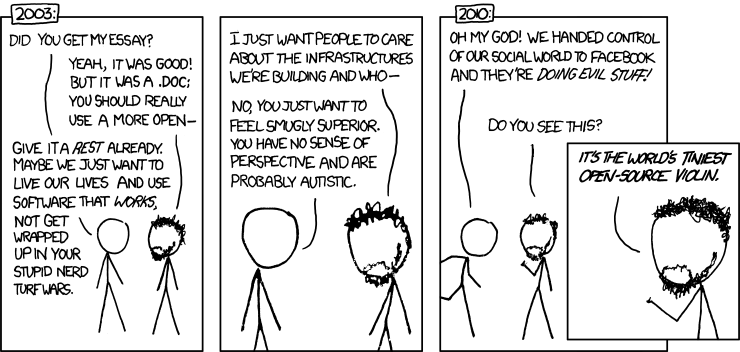
I worry a lot about my tone here. As I recently found out when reading a book on obesity, it's sadly easy to dismiss those presenting information and ideas about something as, "Oh, they're one of those type of people. That explains why they would say that." It would be so easy to end up being that "smugly superior" guy who'll criticize folk for having different views on technology or not knowing as much as he does about computers. As the comic below illustrates thouygh, sooner or later we'll be uncomfortable with how the technology we use works, and if unless we develop the appropriate infrastructure we'll be unable to change it.

A central authority will control every aspect possible.or
As much as possible will be made available in its entirety for public inspection and involvement.With that in mind consider this: are you more willing to use Apple or Linux computers? I know, I know "It just works." "I'm not a 'techie,' and don't want to have to deal with all that complicated stuff" "The way the little book opens is just so cute." I've heard it all before. I recognize that Apple has abstracted more of the functions for the user and produced very powerful, stable, efficient (though you wouldn't know if from their pricing) technology solutions, but you're missing the point. I don't want to talk about Apple per se. I want to talk about the choices we make, especially in technology.
Our choice in technology tends to be surprisingly shallow when we consider the depth of the effect technology has on us. We decide based on what looks nice, has the coolest features, or sometimes (usually if we're a little more informed) runs well and has the most processing power. For something that is so rapidly changing the way we interact, work, and quite arguably think this seems like pretty arbitrary criteria. Will it cause me to seek large amounts of less intimate relationships more efficiently? Will I ponder issues less in favor of looking up a quick and easy answer from a third party source in the most sleek and stylish way? These are the kind of questions we're asking, when we could be asking ourselves questions like, "Will I be engaging in and contributing to a infrastructure that promotes openness and individual freedom?"
If I may be candid for a moment let me admit my smug tech nerd ways. I used to be a little annoyed, mostly due to the immaturity one has early in life that others know different things than you do, when people didn't know how a computer's file system worked, the difference between a program and a text file, or why they couldn't get on the internet. I'm quickly becoming less annoyed by these people, but that annoyance is being replaced by fear.
I'm afraid because I know that market forces drive technology, and it's terrifying to see the market choose flashy, easy, and restrictive items over empowering items that might make them work a little harder. I'm afraid because working in tech support I've seen just how helpless people are when their technology breaks, how helpless many people are when it comes to fixing their technological problems, and how earnestly industry is working to make sure that problems may come up less at the expense of being fixable without being invited into a company's inner circle to error codes and access controls. I worry about living in a world where a relatively small conglomerate of programmers, advertisers, and businessmen are making sweeping decisions on how people live their lives, and the people are relatively powerless to and even uninterested in changing that.
Many are afraid of the effect technology is having on the human psyche and sociological structures. It's easy to blame the technology for this, but I feel that's misguided. If our minds or societies are becoming corrupted it's not thanks to the internet, smartphones, or video games. It's because we're using these poorly. And why wouldn't we if most of us don't know how they work at all, and only know what they do as the company making it presents that to us?
Studying mathematics and physics where most modern research is done with the aid of computers I'm perhaps blessed to have been taught in a tradition that specifically points out where computers are helpful and where our own intellect should be applied. Questions of what's computable and what isn't are addressed directly, as well as questions of the best way to compute that which we would indeed like to compute.
I worry a lot about my tone here. As I recently found out when reading a book on obesity, it's sadly easy to dismiss those presenting information and ideas about something as, "Oh, they're one of those type of people. That explains why they would say that." It would be so easy to end up being that "smugly superior" guy who'll criticize folk for having different views on technology or not knowing as much as he does about computers. As the comic below illustrates thouygh, sooner or later we'll be uncomfortable with how the technology we use works, and if unless we develop the appropriate infrastructure we'll be unable to change it.
Monday, December 31, 2012
Ring Out Wild Bells!
Tennyson wrote a great little new year's poem titled Ring Out, Wild Bells. It's a great celebration of the New Year, though it originally seems to have been written as an elegy, and is recited yearly in Sweden for over ten years. It's been put to music and I for one enjoy the tune. I can't get to a new year without thinking of Ring Out, Wild bells, and I'm perfectly fine with that.
I feel like the poem creates a certain sense of spaciousness. Calls "across the snow" to the "wild sky" with bells ringing out brings to our minds visions of vast expanses laid before us. This is a nice feeling to have toward the new year. Thinking of the next 365 days as full of promise and possibility, ready for us to go forth and conquer them.
There's also a sense of release. We're told the year is dying, and to let him die. The bells are called forth to ring away sorrows, vices, and strifes. I can't quite place when it started, but I've been thinking a lot about the idea of impermanence, the acceptance that things don't last forever. I think many of us would increase our happiness is we learned to be more comfortable with the idea that nothing lasts forever. We could also really help to strengthen the values and character in our society, understanding that many things are not innate, not just normal, and if we want something to endure we need to take steps to preserve it.
Leaving behind the lesser parts of ourselves and pushing forth toward a tomorrow with a better us in it. Tennyson's poem inspires to that. My greatest hope most of the time around the new year is that we maintain our desire to better ourselves and the world around us for than the month or two surrounding the celebration, but even if only for a week a two may this great poem inspire you to
I feel like the poem creates a certain sense of spaciousness. Calls "across the snow" to the "wild sky" with bells ringing out brings to our minds visions of vast expanses laid before us. This is a nice feeling to have toward the new year. Thinking of the next 365 days as full of promise and possibility, ready for us to go forth and conquer them.
There's also a sense of release. We're told the year is dying, and to let him die. The bells are called forth to ring away sorrows, vices, and strifes. I can't quite place when it started, but I've been thinking a lot about the idea of impermanence, the acceptance that things don't last forever. I think many of us would increase our happiness is we learned to be more comfortable with the idea that nothing lasts forever. We could also really help to strengthen the values and character in our society, understanding that many things are not innate, not just normal, and if we want something to endure we need to take steps to preserve it.
Leaving behind the lesser parts of ourselves and pushing forth toward a tomorrow with a better us in it. Tennyson's poem inspires to that. My greatest hope most of the time around the new year is that we maintain our desire to better ourselves and the world around us for than the month or two surrounding the celebration, but even if only for a week a two may this great poem inspire you to
Happy New Year, everyone!
Ring out a slowly dying cause, And ancient forms of party strife; Ring in the nobler modes of life, With sweeter manners, purer laws.
Monday, May 28, 2012
Mathematics is a Godly pursuit
I had this thought after tutoring one day and I've been meaning to write on it for a while. Many friends and family of mine will be familiar with my love for mathematics and my feelings of anathema toward the apparently acceptable innumeracy of current American culture at large. While there are numerous arguments on the basis of how useful mathematics is, what a powerful tool it is and how important it is to understand statistics (such as opinion polls or study results) there is another argument to be made. Like we appreciate art, literature, and other humanities for their inherent beauty and the way they open our eyes to new ways of seeing the world, so should we appreciate mathematics similarly.
Mathematics teaches us (or can if taught and learned with aplomb) humility. The superior attitude of some of those capable with numbers may seem to contradict this, but this may emulate from the sad way in which mathematics is taught. An excellent author about mathematics in culture, John Allen Paulos, has often pointed out that math is taught and subsequently perceived as being about computation. He says that this is similar to saying writing is about typing, and reminds me of a professor of mine saying, "To say computer science is about computers is like saying astronomy is about telescopes." I will endeavor to avoid further digression about mathematics education, but will point out that when we tell people that they can find a certain answer following a couple basic steps we should not be surprised when they come to believe that they understand everything.
Mathematics is a harsh mistress. When not teaching algorithms and their application (not a study of algorithms, which is rather enlightening, but instead essentially programming students in a manner shockingly similar to the way a programmer programs a computer to do specific computations), mathematics is about logic. For the few reading that have actually done proofs, I feel this is a core of mathematics. Working through with rigor new knowledge and insights from a handful of basic, known, accepted axioms.
What I learned taking a basic concepts of mathematics class (which with a name like that you may be surprised to learn was a junior level college course) is that this process is unforgiving. One must be utterly cautious and unrelentingly precise. One must avoid at all costs projecting one's desires, feelings, and possibly even intuition onto their work. Instead one must choose to strictly follow what is known and established, to do what the axioms and previously derived theorems allow, and nothing more, and to consider every case and possibility
It is this, that makes me say mathematics is a Godly pursuit. When I say mathematics is godly I mean that it is greater than ourselves. We must be willing to practice humility and recognize laws that are beyond our instincts, hearts, and preconceptions. The laws of mathematics do not bend to our desires because we feel they should. Mathematics isn't a vehicle for our own ideas or agendas, but rather a manner in which we examine how we came to these and whether or not they require additional scrutiny. Mathematics brings us to truth that we discover for ourselves but are independent form who we are. Mathematics is bringing something beyond us and greater than us into ourselves. This is what religion (like mathematics, when it isn't perverted into a degenerate form that is only good for frustrating students or wrongly justifying our preconceptions) does for us as well.
I will end repeating the refrain that mathematics teaches us humility, and this is what makes it at least nigh on divine. To learn and to do mathematics is to seek knowledge and learn how little we know, what the limits are to our knowledge, and how easily we can err. Is not such a pursuit godly?
Mathematics teaches us (or can if taught and learned with aplomb) humility. The superior attitude of some of those capable with numbers may seem to contradict this, but this may emulate from the sad way in which mathematics is taught. An excellent author about mathematics in culture, John Allen Paulos, has often pointed out that math is taught and subsequently perceived as being about computation. He says that this is similar to saying writing is about typing, and reminds me of a professor of mine saying, "To say computer science is about computers is like saying astronomy is about telescopes." I will endeavor to avoid further digression about mathematics education, but will point out that when we tell people that they can find a certain answer following a couple basic steps we should not be surprised when they come to believe that they understand everything.
Mathematics is a harsh mistress. When not teaching algorithms and their application (not a study of algorithms, which is rather enlightening, but instead essentially programming students in a manner shockingly similar to the way a programmer programs a computer to do specific computations), mathematics is about logic. For the few reading that have actually done proofs, I feel this is a core of mathematics. Working through with rigor new knowledge and insights from a handful of basic, known, accepted axioms.
What I learned taking a basic concepts of mathematics class (which with a name like that you may be surprised to learn was a junior level college course) is that this process is unforgiving. One must be utterly cautious and unrelentingly precise. One must avoid at all costs projecting one's desires, feelings, and possibly even intuition onto their work. Instead one must choose to strictly follow what is known and established, to do what the axioms and previously derived theorems allow, and nothing more, and to consider every case and possibility
It is this, that makes me say mathematics is a Godly pursuit. When I say mathematics is godly I mean that it is greater than ourselves. We must be willing to practice humility and recognize laws that are beyond our instincts, hearts, and preconceptions. The laws of mathematics do not bend to our desires because we feel they should. Mathematics isn't a vehicle for our own ideas or agendas, but rather a manner in which we examine how we came to these and whether or not they require additional scrutiny. Mathematics brings us to truth that we discover for ourselves but are independent form who we are. Mathematics is bringing something beyond us and greater than us into ourselves. This is what religion (like mathematics, when it isn't perverted into a degenerate form that is only good for frustrating students or wrongly justifying our preconceptions) does for us as well.
I will end repeating the refrain that mathematics teaches us humility, and this is what makes it at least nigh on divine. To learn and to do mathematics is to seek knowledge and learn how little we know, what the limits are to our knowledge, and how easily we can err. Is not such a pursuit godly?
Friday, August 6, 2010
Blog is still an ugly word
I've been reading over my old posts lately and was particularly struck by my first post where I explain my thoughts on blogging and what I was writing. I guess as I've been blogging (on and off) for over two years now it's probably appropriate that I update my statements on the matter. There's one key thing I've learned which has changed by entire outlook on blogging: the idea that blogs aren't necessarily for others to read.
When I started I frankly didn't know why I was writing a blog. It was just that I had created an account on google's blogger sevice and I decided I might as well try out the whole blogging thing. Over time I've had to figure out why I'm doing this and the best answer doesn't involve anyone else at all. I keep my blog to keep my writing sharp. While reading through these old posts I'm sadly not entirely convinced it's worked. Well, actually I think the writing is quite acceptable, but riddled with typos. On the other hand I may have just learned, from blogging, that proofreading and editing are integral parts of any writing you wish to be presentable.
Blogs are also a great way to organize information, thoughts, and feelings. I keep a separate blog where I record spiritual thoughts and promptings. I don't work with it as much as I might like to, but I've found the tags for a post are ideal for when you want to jot down an idea without a clear picture of how it is to be used. If I want to give a talk, write a paper, or just ponder on a particular subject I can look up and review my previous thoughts on it.
Blogs can work as a personal scratchpad or journal, but they also provide an nice way to share ideas with friends. My original thoughts were that publishing to the internet meant publishing for the world. While a blog is available to the world, it may be meant to be read by only a few friends or family members. That's the direction this blog has taken, and I like that. It's a way to share thoughts with friends, and maybe get their thoughts on some of the same things I've been thinking about. What do you think?
When I started I frankly didn't know why I was writing a blog. It was just that I had created an account on google's blogger sevice and I decided I might as well try out the whole blogging thing. Over time I've had to figure out why I'm doing this and the best answer doesn't involve anyone else at all. I keep my blog to keep my writing sharp. While reading through these old posts I'm sadly not entirely convinced it's worked. Well, actually I think the writing is quite acceptable, but riddled with typos. On the other hand I may have just learned, from blogging, that proofreading and editing are integral parts of any writing you wish to be presentable.
Blogs are also a great way to organize information, thoughts, and feelings. I keep a separate blog where I record spiritual thoughts and promptings. I don't work with it as much as I might like to, but I've found the tags for a post are ideal for when you want to jot down an idea without a clear picture of how it is to be used. If I want to give a talk, write a paper, or just ponder on a particular subject I can look up and review my previous thoughts on it.
Blogs can work as a personal scratchpad or journal, but they also provide an nice way to share ideas with friends. My original thoughts were that publishing to the internet meant publishing for the world. While a blog is available to the world, it may be meant to be read by only a few friends or family members. That's the direction this blog has taken, and I like that. It's a way to share thoughts with friends, and maybe get their thoughts on some of the same things I've been thinking about. What do you think?
Thursday, March 26, 2009
"Why is there always money for war, but not education?"
I see a bumper sticker with the above almost everyday on my walk to school. I can feel myself sympathetic with the sentiment sometimes. I often feel that the sentiment is naive, that of a simpleton, and masquerading as something with important meaning while truly hollow, on the other hand. Thinking about it I've (obviously) decided to write a post on the subject, and actually I came up with an answer:
Because war is expensive, education isn't. Even as a college student who is continually hit with the cost of education-a physics major who often thinks, "Man, I wish the phys. dept. could just replace all this lab equipment with newer, nicer stuff," a student who knows how expensive books are, a student who works extensively with computers and wonders if he'd do well at all without his personal computer-I think the need for money in education is overrated. Good education requires more personal involvement on the part of the teacher and the student. That's the most important factor. Everything else is gravy. Shouldn't we have a financial investment and incentive for teachers do be involved then? Yes. Yes, yes, yes. I'd love it if teachers got paid more, because apart from parents they may have the most important job for society.
Then again, soldiers may have the most important job for society. Soldiers bought us freedom from England with blood, nuclear warheads scared us, but may have also saved us from communists during the cold war, and soldiers, TSA, CIA, NSA, and others from the American war machine that seems to have too much money keep those who would kill us all simply because we don't bow to their beliefs. Moreover, soldiers liberates Auschwitz, and have stopped evil time and time again throughout history.
Guns, planes, bombs, and armour cost money though. Keeping these relevant costs more. Finding a good teacher takes, well frankly luck. Actually, it costs character. If our society doesn't cultivate character, no one is going to take a job trying to impart knowledge to others. This number will fall even farther if the students of our society don't have enough humility (which people of good character should have) to learn, instead persecuting those that would dare try to tell them they need to work harder to understand an unknown piece of the world. No one can do more to bring the character to the students of our society than parents. But most parents worry more about their children being smart, successful, or simply docile than they do about having character.
In a perfect world, we would pay teachers would be millionaires, and armies wouldn't exist because there'd be no need. Aside from religious beliefs, we'll never live in that perfect world and we have to live intelligently, according to what really exists and addressing those needs, in the real world. The real world has evil, danger, and societal problems that make education hard, so sometimes it's easier to pretend we live in a perfect world.
Because war is expensive, education isn't. Even as a college student who is continually hit with the cost of education-a physics major who often thinks, "Man, I wish the phys. dept. could just replace all this lab equipment with newer, nicer stuff," a student who knows how expensive books are, a student who works extensively with computers and wonders if he'd do well at all without his personal computer-I think the need for money in education is overrated. Good education requires more personal involvement on the part of the teacher and the student. That's the most important factor. Everything else is gravy. Shouldn't we have a financial investment and incentive for teachers do be involved then? Yes. Yes, yes, yes. I'd love it if teachers got paid more, because apart from parents they may have the most important job for society.
Then again, soldiers may have the most important job for society. Soldiers bought us freedom from England with blood, nuclear warheads scared us, but may have also saved us from communists during the cold war, and soldiers, TSA, CIA, NSA, and others from the American war machine that seems to have too much money keep those who would kill us all simply because we don't bow to their beliefs. Moreover, soldiers liberates Auschwitz, and have stopped evil time and time again throughout history.
Guns, planes, bombs, and armour cost money though. Keeping these relevant costs more. Finding a good teacher takes, well frankly luck. Actually, it costs character. If our society doesn't cultivate character, no one is going to take a job trying to impart knowledge to others. This number will fall even farther if the students of our society don't have enough humility (which people of good character should have) to learn, instead persecuting those that would dare try to tell them they need to work harder to understand an unknown piece of the world. No one can do more to bring the character to the students of our society than parents. But most parents worry more about their children being smart, successful, or simply docile than they do about having character.
In a perfect world, we would pay teachers would be millionaires, and armies wouldn't exist because there'd be no need. Aside from religious beliefs, we'll never live in that perfect world and we have to live intelligently, according to what really exists and addressing those needs, in the real world. The real world has evil, danger, and societal problems that make education hard, so sometimes it's easier to pretend we live in a perfect world.
Tuesday, February 10, 2009
What I learned from MMORPGs
Not much, since I don' actually play them. I do play video games when I find one I like enough to pull the time and money away from me. I had a thought recently about video game mentalities and paradigms and a major difference between the MMORPG and the kind I've played. The games I've played, mostly shooters and real time strategy, are level by level, outcome oriented games. You start a mission, play through it, and then start another one until you're done with the game. MMORPGs on the other hand only loosely follow this paradigm. Much more important, as I understand, is the in game character you make. You play the game not so much to finish a level and beat the game but to "level up" your character. Curiously, I think this is a great analogy for life and a good paradigm to live by, even if it's not the type of game I've been playing.
My types of games our outwardly oriented. Your focus is on manipulating the world around you: shooting the bad guys, destroying the enemy nuclear facility, stopping the end of the world. While these make for stories and situations I enjoy, it's not a good way to live your life. A wise word of advice is that you should not set goals for yourself based on other's agency (free will). We should be more concerned with carrying out good actions rather than the outcome of our actions. In an MMORPG is a quest is too hard and you can't get it to work out, you can abondanon it and look for other ways to gain experience. So in life we need to understand that if something isn't working out the way we want it to we can look to other things for fulfillment and joy. It is O.K. when things don't work out the way we'd hope.
"Leveling up" is something we could all stand to take a lesson from, too. Returning again to the concept of a PGF and it's derivative we should all be striving for the next level in our own personal growth. Realizing that there's always a higher level that comes with it's own rewards, or developing skills, abilities, and powers are what keep the MMORPG player playing. Likewise, developing our skills, abilities, and knowledge should keep all of us living.
My types of games our outwardly oriented. Your focus is on manipulating the world around you: shooting the bad guys, destroying the enemy nuclear facility, stopping the end of the world. While these make for stories and situations I enjoy, it's not a good way to live your life. A wise word of advice is that you should not set goals for yourself based on other's agency (free will). We should be more concerned with carrying out good actions rather than the outcome of our actions. In an MMORPG is a quest is too hard and you can't get it to work out, you can abondanon it and look for other ways to gain experience. So in life we need to understand that if something isn't working out the way we want it to we can look to other things for fulfillment and joy. It is O.K. when things don't work out the way we'd hope.
"Leveling up" is something we could all stand to take a lesson from, too. Returning again to the concept of a PGF and it's derivative we should all be striving for the next level in our own personal growth. Realizing that there's always a higher level that comes with it's own rewards, or developing skills, abilities, and powers are what keep the MMORPG player playing. Likewise, developing our skills, abilities, and knowledge should keep all of us living.
Subscribe to:
Posts (Atom)