In college I built my own computer. It was a great experience, and I still use that computer 7 years later when writing this. Saying you built your own computer tends to earn a lot of tech savvy points with the average person, but it's really not that hard. A lot's changed since the days of Wozniak's home brew club & the Altair, and these days you can by the parts and put them together without much more difficulty than assembling a piece of Ikea furniture. If you need an upgrade later, you can open your case up & snap a piece in.
This ease is based in no small part on the standardization of the ATX & PCI standards, a set of guidelines for how hardware should be made in such a way as to be compatible with other devices. One thing that's impressed and worried me lately is the dearth of such a standard for cell phones, and the perhaps anemic attempts to create one. It's an unfortunate marker of the way technology has gone from a scientific industry with the goal of empowering individuals and humankind to a consumer industry chasing fashion and trendiness, but I'm getting ahead of myself.
People are talking a lot these days about a little thing a little, 3.5 millimeter thing. Apple decided not to include a headphone jack on their phones, Google is following suit with their latest Pixel, and the creator of the android OS also axed the jack with the Essential Phone. The last one really bugs me, because empowering the tech consumer with more choices is one of the reasons why essential was founded, and yet the most ubiquitous, easy to use, and powerful interface options was deemed unnecessary.
OK, when I started this blog I wanted to stick to bigger issues, things that effect society or even humanity. Why am I letting myself get distracted by the minutia of what's popular in cell phones these days? Well, it's because this is a symptom of a larger, much more insidious cultural disease. Wow, OK that could be overselling it, but as I've mentioned before the choice to go with something stylish or convenient instead of something which creates an empowering infrastructure is perilous.
The Essential phone has some special connectors for accessories. Motorola is making phones with attachable accessories as well, but they go the extra mile of providing a developer kit for independent companies that want to produce these. The highest level of this was the now tragically defunct Project Ara which planned to produce an entirely modular smartphone. It also had the distinction of being the only project I know of that would have released a standard that could be used by any company to produce appropriate components. If the essential accessories or moto mods take off, any other manufacturer that wants to let customers use these will have to license the specifications from essential or Motorola, and that means they probably won't proliferate anytime soon.
And thus we, the consumer, have to be content taking whatever the phone companies decide to give us. Oh, we can shop around a little for more memory here or a better camera there, but the reality is we can't really choose what we want in our phones, or how they work. A handful of tech giants makes those decisions for us. And that's not only true for phones. that's true for social networks, gaming platforms, and more. What's the more? Well, perhaps news organizations, political parties, and advertisements. This is where the insidious cultural disease part comes up. Most people have their phone on them for most of the day in 2017. We can't act like decisions about how that works being made by some team of marketers and engineers rather than individuals is OK and won't siphon away independence and freedom from the individual.
Showing posts with label internet. Show all posts
Showing posts with label internet. Show all posts
Thursday, November 2, 2017

Saturday, October 24, 2015
Trick or Treating: The Last Bastion of Neighborhood Community?
People don't know their neighbors any more. Our interactions are more and more impersonal, mediated by computers. We have fewer and fewer real communities to engage in. They're being replaced by forums and social networking groups. These things aren't as bad as people often make them out to be, but they do present problems. We're cut off from genuine interaction. It's being replaced with a type of self promotion, making it harder and harder to 'be ourselves' and be accepted for who we are. We're exposed to less diversity because we don't spend time with those whose ideas and opinions differ from us. Churches, neighborhood barbecues, and kids playing in the street used to serve these purposes. Most people don't go to church these days, I can't remember the last time I heard about a neighborhood barbecue, and we setup play dates for the kids nowadays. There's one area that still hearkens back to the days of the local community, though.
Trick or treating is a wonderful Halloween tradition that builds a neighborhood. Once a year parents and kids walk around, say hi to their neighbors, show off costumes, and share sweets. What a classic community building activity that is! Families can talk afterward about how cute the kid down the street looked dressed up like a princess, or which families in town gave out the best candy. Finally, a time when a family can discuss their neighbors and how much they enjoyed spending some time with them!
This is an important lesson for our children, too. 364 days a year we tell our kids about 'stranger danger,' but on Halloween they're finally encouraged to meet new people. They're rewarded with candy, given to them in return for wearing an amusing costume and displaying it for thirty seconds at the neighbor's door. This activity will teach them that they don't have to be suspicious and scared of every person they share the world with. They might even learn that many people are kind human beings.
Even this noble tradition is dying out, though. We're learning how to make imitation trick or treating that, like imitation food, is a pale shadow of the real thing that carries little of the original value. Church groups do 'trunk or treats' to make sure families can collect candy with kids while remaining insulated from their neighbors and any community they don't approve of. Trick or treating routes are less and less up and down the street you live on and instead are becoming visits to homes of family friends. Some people in a sickening twisting of the tradition in pursuit of efficiency and increasing returns worthy of a heartless corporation go up into the wealthy areas of town, spurning their own neighbors, because 'they give better candy.'
Let's not become that people. Let's continue to love our neighbors and even learn to enjoy their company. Let's teach our kids to build a community and meet those they share the world with. Let's go trick or treating around our neighborhood this Halloween.
Let's not become that people. Let's continue to love our neighbors and even learn to enjoy their company. Let's teach our kids to build a community and meet those they share the world with. Let's go trick or treating around our neighborhood this Halloween.
Monday, June 8, 2015
Are We Ready for Post Scarcity? Part 3
So technology has brought us a new world. The new technologies developed in the 20th and 21st centuries have created a world with changes as drastic as the invention of agriculture over 10 millenia ago. This new world is awe inspiring in its productive capabilities. Like the soviets upon seeing American grocery stores or backyard pools, those of us from the old worlds look in disbelief on the abundance the highly automated modern world offers. Will that disbelief be an awestruck hopeful wonderment, or a horrified cringing at the dystopian nightmare on display?
What becomes of the human being, the individual in the post-scarcity world? While objectively unanswerable, for now, science fiction and current trends can give us an idea. Star Trek provides the most hopeful vision, a humanity that devotes itself to self improvement and growth, bravely venturing out to explore the universe or just starting a small restaurant to share the joy of old family recipes (like Joseph Sisko from DS9). People engage in their passions and become the greatest captains, scientists, or chefs that they can thanks to the freedom from desire and from the struggle for the basic necessities of life. While this optimism is one of the reasons we love Star Trek it doesn't strike us as realistic.
On the other side of the spectrum we see the 'dystopian,' or broken utopia, genre of fiction. The lack of scarcity in information and communication enabled by the internet has made government surveillance and monitoring so easy that the protections for citizens seem to come only from law these days. And that can easily fail, as the victory of the ACLU against ongoing programs of the NSA showed. The NSA's activities have many shouting that, "1984 was not an instruction manual." A conversation from the video game Deus Ex indicates another interesting, and all to realistic, future:
These uncomfortable futures are just fiction, for now, but sadly they seem to strike us as truer to reality. One of the consequences of post-scarcity living is that power can evaporate. It can also become much more concentrated. Abuses by law enforcement that were once prevented by their sheer infeasibility now need laws in place to protect citizens (the supreme court decision on GPS tracking is a good example of this to add to the NSA's recent abuses of power). However when laws are needed the question inevitably arises of who will write them.
The genius of American government is the idea of the powerful individual, that every citizen has strength enough to make their voice resonate in the halls of power. The idea has caught on so strongly that it's easy to forgot how revolutionary and unthinkable this idea would be only 500 or so years ago when monarchs were the norm, and for basically all of human history before that when the strong took what they wanted without regard for whether or not the man they were taking it from cared to give it up.
The same power of technology that can eliminate scarcity could also conceivably eliminate freedom. Corporate influence over lawmakers could barely be necessary if companies like John Deere, Apple, and Comcast continue along their trajectories. Imagine the power the tractor company would hold if they were able to dictate whether or not their machinery were allowed to be repaired or you would just have to buy a new one to continue sowing grain. Consider the power of a company with similar power over electronics and personal computers. All the innovation and creativity in the world doesn't mean a thing if a company controlling the means of distribution for new products and stories can decide to refuse their service.
How can we dilute these powers, without only strengthening centralized government power, and while still providing opportunity and daily bread for the individual? I don't know. I have some ideas, but truly I can't say what I'd really do if I were ruler of the world, or even just the US. What I can say is that no one else really can either. There's a dearth of ideas and solutions floating around out there because we're not addressing the issue.
The idea of a post-scarcity economy and society is so revolutionary that it doesn't sound real. Talking about robotics and computing replacing human beings as the driving force in the economy sounds like science fiction, despite the fact that we continually experience it as reality. The whole issue is so massive and so out there that it's not addressed seriously in politics, and rarely in thoughtful conversation. If this continues we'll find ourselves in a world clinging to obsolete social mores and struggling to make them fit in the modern world. We can't let that happen, so let's think about getting ready for post-scarcity.
What becomes of the human being, the individual in the post-scarcity world? While objectively unanswerable, for now, science fiction and current trends can give us an idea. Star Trek provides the most hopeful vision, a humanity that devotes itself to self improvement and growth, bravely venturing out to explore the universe or just starting a small restaurant to share the joy of old family recipes (like Joseph Sisko from DS9). People engage in their passions and become the greatest captains, scientists, or chefs that they can thanks to the freedom from desire and from the struggle for the basic necessities of life. While this optimism is one of the reasons we love Star Trek it doesn't strike us as realistic.
On the other side of the spectrum we see the 'dystopian,' or broken utopia, genre of fiction. The lack of scarcity in information and communication enabled by the internet has made government surveillance and monitoring so easy that the protections for citizens seem to come only from law these days. And that can easily fail, as the victory of the ACLU against ongoing programs of the NSA showed. The NSA's activities have many shouting that, "1984 was not an instruction manual." A conversation from the video game Deus Ex indicates another interesting, and all to realistic, future:
JC Denton: Some people just don't understand the dangers of indiscriminate surveillance
Morpheus (an AI system who is 'a prototype for a larger system'): The need to observed and understood was once satisfied by God. Now we can implement the same functionality with data-mining algorithms.
JC Denton: Electronic surveillance hardly inspires reverence. Perhaps fear and obedience, but not reverence.Huxley's Brave New World gives us one vision of a post scarcity world that's also terrifying. People are raised from conception to death to fill a certain role, with much of the population raised to lack mental faculty and drive so that they can be contented with menial jobs. Innovation is suppressed if the rulers decide it doesn't support the economy. The population is essentially drugged into compliance and acceptance of the system that promotes nothing but the status quo ad infinitum. At least everyone has a job, though.
These uncomfortable futures are just fiction, for now, but sadly they seem to strike us as truer to reality. One of the consequences of post-scarcity living is that power can evaporate. It can also become much more concentrated. Abuses by law enforcement that were once prevented by their sheer infeasibility now need laws in place to protect citizens (the supreme court decision on GPS tracking is a good example of this to add to the NSA's recent abuses of power). However when laws are needed the question inevitably arises of who will write them.
The genius of American government is the idea of the powerful individual, that every citizen has strength enough to make their voice resonate in the halls of power. The idea has caught on so strongly that it's easy to forgot how revolutionary and unthinkable this idea would be only 500 or so years ago when monarchs were the norm, and for basically all of human history before that when the strong took what they wanted without regard for whether or not the man they were taking it from cared to give it up.
The same power of technology that can eliminate scarcity could also conceivably eliminate freedom. Corporate influence over lawmakers could barely be necessary if companies like John Deere, Apple, and Comcast continue along their trajectories. Imagine the power the tractor company would hold if they were able to dictate whether or not their machinery were allowed to be repaired or you would just have to buy a new one to continue sowing grain. Consider the power of a company with similar power over electronics and personal computers. All the innovation and creativity in the world doesn't mean a thing if a company controlling the means of distribution for new products and stories can decide to refuse their service.
How can we dilute these powers, without only strengthening centralized government power, and while still providing opportunity and daily bread for the individual? I don't know. I have some ideas, but truly I can't say what I'd really do if I were ruler of the world, or even just the US. What I can say is that no one else really can either. There's a dearth of ideas and solutions floating around out there because we're not addressing the issue.
The idea of a post-scarcity economy and society is so revolutionary that it doesn't sound real. Talking about robotics and computing replacing human beings as the driving force in the economy sounds like science fiction, despite the fact that we continually experience it as reality. The whole issue is so massive and so out there that it's not addressed seriously in politics, and rarely in thoughtful conversation. If this continues we'll find ourselves in a world clinging to obsolete social mores and struggling to make them fit in the modern world. We can't let that happen, so let's think about getting ready for post-scarcity.
Wednesday, March 25, 2015
Are We Ready for Post Scarcity? Part 1
The abundance of the modern day is staggering. Food alone is now requiring few man hours and producing vast amounts of product. In about 25 years the personal computer has gone from a relatively cutting edge office device to a ubiquitous handheld one. The amazing advances in technology will only cascade into more, and these will bring amazing blessings, conveniences, and boons to humankind. These are gifts we should be prepared to freely receive, but like a gift of chocolate that will make us sick if eaten to quickly or heavy book that will require much reading and concentration we need to be receive these with caution and adroitness.
Let's go back to food. One of the interesting points of contention between my brothers, me, and our grandmother is our approach and mentalities surrounding food. Our grandma, growing up in a family that suffered through and being born shortly after the great depression, views food as a precious and scarce resource. She often views food in terms of availability, enjoying buffets and inexpensive diners and being anxious over throwing away uneaten scraps or spoiling produce. My brothers, and even my parents, live in the modern age and see food as abundant. We don't like to waste food, but recognize that when the bread gets moldy it should be thrown out because it only costs a dollar or two (ten minutes of work at minimum wage) to get another loaf. We live devoid of the "clean your plate" ethic so common in past generations.
Thank heavens for that too, as obesity and overeating are a greater health risk to us than malnutrition (though I am skeptical of the magnitude of this risk). It's actually odd to think about health risks arising because nourishment is so easy to obtain. Taking anatomy and physiology I've learned hundreds of ways in which a deficiency of calcium, iodine, glucose, iron, or any other number of dietary intakes cause problems. It's bizarre to think of problems coming about simply because we have so much of those things we need and love that we run out places to put it and spend so much time and energy to keeping it all together.
Food is only the beginning of this, though. Technology is more and more in in the reach of anyone who'd like it. Entertainment and education is more available than ever with the internet. And these are just the commodities being made abundant with modern technology. Go even slightly futuristic and we have productive capabilities exploding via robotics, precious metals or gems having their scarcity destroyed by advanced chemical and materials engineering techniques, and even thought or creativity flooding the market in ways never before seen thanks to better distribution systems, or even AI and other futuristic computing creating new art.
The challenges presented by this can be staggering though. The central one is likely motivation. Survival and status have been the principle motivators of a person in the past. That might have meant being the mightiest hunter in the tribe that's always well fed or the most influential business magnate on wall street who always had some opportunity waiting, but the principles been the same. Many of us have said something like, "I really don't want to go to work today but they won't pay me if I don't so I guess I had better," and we've probably even said that with some frequency. If we reach post scarcity we theoretically won't ever need to get paid, so what will keep us getting out of bed in the morning and off the streets? I'll be investigating this and other ideas of a post-scarcity society and economy in part 2.
Let's go back to food. One of the interesting points of contention between my brothers, me, and our grandmother is our approach and mentalities surrounding food. Our grandma, growing up in a family that suffered through and being born shortly after the great depression, views food as a precious and scarce resource. She often views food in terms of availability, enjoying buffets and inexpensive diners and being anxious over throwing away uneaten scraps or spoiling produce. My brothers, and even my parents, live in the modern age and see food as abundant. We don't like to waste food, but recognize that when the bread gets moldy it should be thrown out because it only costs a dollar or two (ten minutes of work at minimum wage) to get another loaf. We live devoid of the "clean your plate" ethic so common in past generations.
Thank heavens for that too, as obesity and overeating are a greater health risk to us than malnutrition (though I am skeptical of the magnitude of this risk). It's actually odd to think about health risks arising because nourishment is so easy to obtain. Taking anatomy and physiology I've learned hundreds of ways in which a deficiency of calcium, iodine, glucose, iron, or any other number of dietary intakes cause problems. It's bizarre to think of problems coming about simply because we have so much of those things we need and love that we run out places to put it and spend so much time and energy to keeping it all together.
Food is only the beginning of this, though. Technology is more and more in in the reach of anyone who'd like it. Entertainment and education is more available than ever with the internet. And these are just the commodities being made abundant with modern technology. Go even slightly futuristic and we have productive capabilities exploding via robotics, precious metals or gems having their scarcity destroyed by advanced chemical and materials engineering techniques, and even thought or creativity flooding the market in ways never before seen thanks to better distribution systems, or even AI and other futuristic computing creating new art.
The challenges presented by this can be staggering though. The central one is likely motivation. Survival and status have been the principle motivators of a person in the past. That might have meant being the mightiest hunter in the tribe that's always well fed or the most influential business magnate on wall street who always had some opportunity waiting, but the principles been the same. Many of us have said something like, "I really don't want to go to work today but they won't pay me if I don't so I guess I had better," and we've probably even said that with some frequency. If we reach post scarcity we theoretically won't ever need to get paid, so what will keep us getting out of bed in the morning and off the streets? I'll be investigating this and other ideas of a post-scarcity society and economy in part 2.
Saturday, February 28, 2015
Technology, cheating, and the Augmented Mind
As a student I've been taking plenty of tests lately. My university has a pretty good testing system and convenient testing centers and I'm a pretty good test taker so none of this really bothers me, but I have found the testing center policies interesting. The fact that I have to remove my hat before going in is one. Recently they've also disallowed the wearing of a wristwatch, almost certainly in response to the new smart-watch technology coming out. While this is the right thing to do, it does indicate a need for much grander changes in both the way we do things as well as our thinking, probably especially in education. Changes we are woefully unprepared for.
Let's consider the testing center again, perhaps as if you were the director of these. We made the change for smart-watches so that they won't be used for cheating. What will we do if Google Glass, or a similar project where data is displayed on a pair of glasses worn by the user, takes off and starts showing up? If that technology becomes integrated into people's prescription lenses? What about if those smart watches become smart tattoos? What about when students start having direct neural interfaces integrating computers into the brain? These problems are coming, and I think we can quickly see there's no easy solution, and maybe no solution at all to make a our current testing systems compatible with the existence of these technologies.
As my neuroscience teacher put it, most testing today is a simple demonstration of declarative memory. This is to say tests usually require a simple recalling of facts, figures, or other basic knowledge. However, the need for this to be done in the human brain is dwindling. Facts can be more easily stored, more quickly recalled, and more reliably maintained in computer systems than in nervous tissue. Why would we keep using cerebral circuits (that weren't really designed to do this in the first place) when we can use electronic ones? The go to example is memorizing phone numbers, something many of us remember doing before technology made it an exercise in pointless exertion of energy.
Lest you think this is the pie in the sky omphaloskepsis of a futurist and science fiction fan, let me relay a story I heard from one parent. He wanted to have his daughter writing letters, and specifically to do so using some specific vocabulary. Shortly after he heard his daughter speaking out loud while alone in her room writing the letter. Listening closer he realized she was using the voice recognition feature of the tablet/smartphone to simply ask for the spelling of the appropriate words. This was much to his disappointment, as he was expecting her to look the words up when writing them and learn the definition along with the spelling. That's how big a change something as simple as voice recognition is making.
A future where traditional testing is pointless seems on the horizon. How education will or even can deal with this is unclear. The problem with leaving our traditional testing is that other methods require more work to evaluate, and usually are less objective which can be a big problem for admissions tests like the MCAT. The only solution I've thought of is an increase in internships and apprentice work, but whether or not this is feasible is unclear. I know the major reason the radiology or medical laboratory programs at my school can't admit more than about 40% of applicant students is because they only have so many slots for clinical rotations available. It could be damaging to the economy to have the influx of cheap or free labor that having five interns or apprentices to every one trained employee might mean. The problem is a big one, and sadly I haven't seen it given all that much attention. Let's hope for and work toward that changing sometime soon.
Let's consider the testing center again, perhaps as if you were the director of these. We made the change for smart-watches so that they won't be used for cheating. What will we do if Google Glass, or a similar project where data is displayed on a pair of glasses worn by the user, takes off and starts showing up? If that technology becomes integrated into people's prescription lenses? What about if those smart watches become smart tattoos? What about when students start having direct neural interfaces integrating computers into the brain? These problems are coming, and I think we can quickly see there's no easy solution, and maybe no solution at all to make a our current testing systems compatible with the existence of these technologies.
As my neuroscience teacher put it, most testing today is a simple demonstration of declarative memory. This is to say tests usually require a simple recalling of facts, figures, or other basic knowledge. However, the need for this to be done in the human brain is dwindling. Facts can be more easily stored, more quickly recalled, and more reliably maintained in computer systems than in nervous tissue. Why would we keep using cerebral circuits (that weren't really designed to do this in the first place) when we can use electronic ones? The go to example is memorizing phone numbers, something many of us remember doing before technology made it an exercise in pointless exertion of energy.
Lest you think this is the pie in the sky omphaloskepsis of a futurist and science fiction fan, let me relay a story I heard from one parent. He wanted to have his daughter writing letters, and specifically to do so using some specific vocabulary. Shortly after he heard his daughter speaking out loud while alone in her room writing the letter. Listening closer he realized she was using the voice recognition feature of the tablet/smartphone to simply ask for the spelling of the appropriate words. This was much to his disappointment, as he was expecting her to look the words up when writing them and learn the definition along with the spelling. That's how big a change something as simple as voice recognition is making.
A future where traditional testing is pointless seems on the horizon. How education will or even can deal with this is unclear. The problem with leaving our traditional testing is that other methods require more work to evaluate, and usually are less objective which can be a big problem for admissions tests like the MCAT. The only solution I've thought of is an increase in internships and apprentice work, but whether or not this is feasible is unclear. I know the major reason the radiology or medical laboratory programs at my school can't admit more than about 40% of applicant students is because they only have so many slots for clinical rotations available. It could be damaging to the economy to have the influx of cheap or free labor that having five interns or apprentices to every one trained employee might mean. The problem is a big one, and sadly I haven't seen it given all that much attention. Let's hope for and work toward that changing sometime soon.
Friday, November 22, 2013
Sadly, the porn must flow Part 3: Regulatory and Governmental Concerns
I've now addressed concerns with a mandatory pornography filtering system based on conceptual considerations on the nature of pornography and technical ones about how the system might work. Now I will focus on a critique of the plan based on the governmental and regulatory considerations, as stated in the title. A main point in my last part could be summed up as, "Don't trust your ISP to keep you safe, you're better off ensuring that on your own." If we replace ISP with government that same idea will be found here.
America has a unique approach to government in that a fundamental value we hold is liberty, and are sensitive to the power of government to curtail this among individuals or groups. The conflict between this and the need for law forms a basis to our society. Whether pornographic filtering should be mandatory is another manifestation for this conflict, and I will be falling on the side of liberty as opposed to security.
The concept of safety curtailing our liberties is one hotly contested in the media with the government's efforts in the last ten years to crack down on and protect against terrorism. This even has a more direct parallel in the field of communications with recent Snowden leaks on NSA data and metadata collection efforts that, in my own personal opinion and that of at least one court of law, violates American citizens' rights granted by the first (including and perhaps primarily the right of association) and fourth amendments. With these already in peril, why would we want to introduce a new government mandate and increase their ability to curtail citizens' rights online?
Yes, yes, I know, "No one's rights are being curtailed, anyone can still opt in and get the content they want." In the short view this may be true, though many of the points in my previous two essays on the subject should demonstrate ways it may also not be. Though I'd rather not delve too deeply into the 'slippery slope' argument as it necessarily relies on speculation and unverifiable prediction, it would be prudent to mention that any law or regulation would set a precedent that our personal communication methods are something the government has every right to manage.
The proposal would grant new regulatory powers over our methods of communication. It would be handed off to either ISPs or/and government committees and reduce choice for the individual. While it's only a default setting that would change right now, the shame often involved in the complex issue of obscenity could easily cause this to be the societal norm, and forcing those who either held liberal views about sexuality or possibly a desire to protect their privacy and security online to be forced into an 'internet ghetto.' Eventually these people might be lumped in with criminals and subject to greater invasion of their rights because they 'chose to use the internet in a manner recognized to reflect dangerous and deviant behavior.'
Let me explain by way of analogy. How would you feel if car dealerships were now required to sell cars that would automatically avoid driving you anywhere where obscene or illegal activities were known to occur? They would naturally have to standardize and define what obscene behavior was, and so a federal committee would now decide what parts of town you were allowed to drive to. If you wanted to have full control over where you could go in the car you bought you would need to ask the dealer, and maybe they would have a special license plate for your car so that everyone else wouldn't accidentally follow you or wonder why they were having trouble getting to a place that you went to without problems. Does that sound OK to you, or does it seem like a massive intrusion of government control in your life?
The internet is indeed a radically new method of communication. Earlier methods often fell naturally into a pattern of self-regulation when it came to pornography. Movies created a rating system, magazines went under the counter, TV shows had a set of standards to follow until after the watershed. Phone lines were pretty much just as available to youngsters as much as anyone else but you needed to know what number to call and the commercials didn't go on until after the watershed, so their exposure wasn't really significant and in any event parents would get the bill later. The internet, on the other hand, is hugely interconnected and once you're online you have access to most resources with nothing more than a name, or if you're not sure of that a search term will probably work just as well. The industry doesn't lend itself well to self regulationas it is a personal service, the connection is to your home, connected to a vast public network.
It does lend itself easily to personal regulation, though. In my last post I mentioned a few good and fairly easy solutions to filter pornography. I explained my feelings that those who were unwilling to gain the technical skills to implement these shouldn't be foisting their responsibility to protect themselves on the country at large as well, but there's another aspect to this naivete I'd like to address: that pornography is a problem that technology or regulation can only slow, not stop. It plays to the most basic human drives and desires. This is what makes it so tempting, and destructive.
The way to fight pornography is to teach the right values, habits, and behaviors. I admit the prevalence of pornography can make this difficult, but teaching our children and selves the truth of what pornography is is the most effective way to fight it. We shouldn't pretend that we can shut off any exposure to it, and instead prepare ourselves and develop the mental and spiritual discipline to be strong against it when we do. This may include a personal decision to install some sort of filter on our own networks. Others might not even see a need for this.
Maturity comes with responsibility, taking on accountability for the way we live and the decisions we make. I see this petition as immature, trying to abdicate the responsibility for avoiding pornography by passing it along to organizations believed to be more capable of doing so. We must take this responsibility upon ourselves though, immense as it may seem, because immaturity and liberty cannot coexist. The more we decide that something is too hard for us and should be handled by the government, the greater the state will become as the citizen becomes smaller and smaller.
America has a unique approach to government in that a fundamental value we hold is liberty, and are sensitive to the power of government to curtail this among individuals or groups. The conflict between this and the need for law forms a basis to our society. Whether pornographic filtering should be mandatory is another manifestation for this conflict, and I will be falling on the side of liberty as opposed to security.
The concept of safety curtailing our liberties is one hotly contested in the media with the government's efforts in the last ten years to crack down on and protect against terrorism. This even has a more direct parallel in the field of communications with recent Snowden leaks on NSA data and metadata collection efforts that, in my own personal opinion and that of at least one court of law, violates American citizens' rights granted by the first (including and perhaps primarily the right of association) and fourth amendments. With these already in peril, why would we want to introduce a new government mandate and increase their ability to curtail citizens' rights online?
Yes, yes, I know, "No one's rights are being curtailed, anyone can still opt in and get the content they want." In the short view this may be true, though many of the points in my previous two essays on the subject should demonstrate ways it may also not be. Though I'd rather not delve too deeply into the 'slippery slope' argument as it necessarily relies on speculation and unverifiable prediction, it would be prudent to mention that any law or regulation would set a precedent that our personal communication methods are something the government has every right to manage.
The proposal would grant new regulatory powers over our methods of communication. It would be handed off to either ISPs or/and government committees and reduce choice for the individual. While it's only a default setting that would change right now, the shame often involved in the complex issue of obscenity could easily cause this to be the societal norm, and forcing those who either held liberal views about sexuality or possibly a desire to protect their privacy and security online to be forced into an 'internet ghetto.' Eventually these people might be lumped in with criminals and subject to greater invasion of their rights because they 'chose to use the internet in a manner recognized to reflect dangerous and deviant behavior.'
Let me explain by way of analogy. How would you feel if car dealerships were now required to sell cars that would automatically avoid driving you anywhere where obscene or illegal activities were known to occur? They would naturally have to standardize and define what obscene behavior was, and so a federal committee would now decide what parts of town you were allowed to drive to. If you wanted to have full control over where you could go in the car you bought you would need to ask the dealer, and maybe they would have a special license plate for your car so that everyone else wouldn't accidentally follow you or wonder why they were having trouble getting to a place that you went to without problems. Does that sound OK to you, or does it seem like a massive intrusion of government control in your life?
The internet is indeed a radically new method of communication. Earlier methods often fell naturally into a pattern of self-regulation when it came to pornography. Movies created a rating system, magazines went under the counter, TV shows had a set of standards to follow until after the watershed. Phone lines were pretty much just as available to youngsters as much as anyone else but you needed to know what number to call and the commercials didn't go on until after the watershed, so their exposure wasn't really significant and in any event parents would get the bill later. The internet, on the other hand, is hugely interconnected and once you're online you have access to most resources with nothing more than a name, or if you're not sure of that a search term will probably work just as well. The industry doesn't lend itself well to self regulationas it is a personal service, the connection is to your home, connected to a vast public network.
It does lend itself easily to personal regulation, though. In my last post I mentioned a few good and fairly easy solutions to filter pornography. I explained my feelings that those who were unwilling to gain the technical skills to implement these shouldn't be foisting their responsibility to protect themselves on the country at large as well, but there's another aspect to this naivete I'd like to address: that pornography is a problem that technology or regulation can only slow, not stop. It plays to the most basic human drives and desires. This is what makes it so tempting, and destructive.
The way to fight pornography is to teach the right values, habits, and behaviors. I admit the prevalence of pornography can make this difficult, but teaching our children and selves the truth of what pornography is is the most effective way to fight it. We shouldn't pretend that we can shut off any exposure to it, and instead prepare ourselves and develop the mental and spiritual discipline to be strong against it when we do. This may include a personal decision to install some sort of filter on our own networks. Others might not even see a need for this.
Maturity comes with responsibility, taking on accountability for the way we live and the decisions we make. I see this petition as immature, trying to abdicate the responsibility for avoiding pornography by passing it along to organizations believed to be more capable of doing so. We must take this responsibility upon ourselves though, immense as it may seem, because immaturity and liberty cannot coexist. The more we decide that something is too hard for us and should be handled by the government, the greater the state will become as the citizen becomes smaller and smaller.
Thursday, November 21, 2013
Sadly, the porn must flow 2 : Technical Considerations
So I've gone over the conceptual problems with a government mandated ISP based pornography filtering system and given an overview of how these systems might work. One of the problems with this kind of legislation, however, is that there are numerous technical considerations. Much like the recent SOPA bill, a pornography filtering requirement could possibly work out to be a government mandate to restructure how the internet works in the service of a specific special interest.
On the surface this seems like an overreaction, porn filters already exist so how difficult would it be for these to be implemented broadly by ISPs rather than requiring users to implement them personally. It's not, though, as scalability isn't simple. There's a reason why programs have run locally on personal machines for years but only now can be served out from a remote location to hundreds of thousands of users. There's a reason enterprise servers are different from personal computers.
Still, though, it's certainly doable. It would take a lot of work, though, and skilled programmers, network engineers, and system administrators don't work for free. That means forcing this to happen at the ISP level will be expensive. A government mandate means everyone's prices will go up. Think about if a similar resolution were to be passed for gasoline, electricity, or food. People would rightfully be incensed that either they're being forced to pay more for a service they don't want or are already using from a provider they trust and have established a good relationship.
Also, people don't often think about what their ISP is doing with their internet traffic. Usually that's because it's assumed that they shouldn't be doing anything with it apart from passing it on to the intended recipient. That's not the case, though. Your ISP is watching you, much like Google, Facebook, or other online advertising companies are and like these they plan to sell information about your habits to interested parties for some extra cash. They're also watching you as a favor to their friends in the entertainment industries to make sure that you don't "copy or share a movie, television show, or song improperly." The more I find out about the ISP industry, the less I trust them.
Knowing this we're likely to see two things happen should any sort of legislation pass from this petition: First, pornography filtering will be put in place, but thanks to a grant from the pornography industry to ISPs will make this laughably easy to circumvent. There could possibly be a sort of 'protection money' situation where ISPs block the pornography sites that don't pay up to be on their list of sites that aren't too 'extreme or hardcore.' Second, the system will be implemented with little thought to protecting those that want to avoid pornography, but as a great excuse to further other goals for the ISP.
I mentioned encrypted traffic in my last post and how this can create a problem for porn filtering systems. My feelings about ISPs give me every reason to believe that they would be happy to use porn filtering mandates to try to subvert users' efforts that are trying to remain anonymous and gain a modicum of privacy while online (such as when using a VPN service like ProXPN to hide traffic from the ISP, or connecting to a Tor node to remain anonymous). This way they could continue collecting information about you and your habits to sell to advertisers or make sure you fall in line with the entertainment industry's demands. They'd also have the power to brand anyone trying to get around these restrictions on the service they're paying for with a 'scarlet P' by saying that they had opted in to the internet with pornographic access plan.
Going back to the phrase from the petition, "Parents and individuals have to go to great lengths to install Internet filters that often don't weed out all porn," I'm not really certain what these 'great lengths' are. Installing a free program like K9 web protection on your computer, or an app on your cell phone like this web filter? Admittedly my preferred solution, OpenDNS, is a little technical but even then you don't even need to sign up and they'll still provide straight forward instructions like these on their website. Why do we feel it necessary to have the government partner with our ISPs to do this for us? If staying safe from pornography is important to us shouldn't we be willing to put an iota of effort into doing it in a way we understand and are in control of?
This leads me back to one of my original points: naivete. I recently watched a documentary on prohibition and one thing that was pointed out was that once the prohibition amendment had passed the prohibitionists had thought they'd won the war on alcohol. Anyone with a smattering of US history knows that wasn't the case, and a tacit law saying porn is to be avoided won't make it any less desired or sought after. We'll be handing over a good degree of power over our lives, remember the internet is only becoming more and more important to who we are, in exchange for avoiding something like an hour a week, at most, to install, configure, and maintain a filtering solution that fits our personal needs.
I'm writing a novel this month for National Novel Writing Month in the tradition of cyberpunk. One characteristic of the cyberpunk genre is that it features technology not as an enabling force that brings about Utopian lives for mankind, but instead becomes a force for control and oppression. There's hints of this in my novel, but one of the themes is also supposed to be that this happens because people give up their rights, their strength, and their power to others because they think it's too hard to develop the technical skills necessary to understand the systems they use. Society has fallen back into being controlled by a few select elite, but this time we chose it because math, programming, physics, engineering, and computing are hard and we'd rather enjoy ourselves while someone else did those complicated things. This petition is a sad reminder that the bleak future I'm writing should be fiction, but might not be someday.
On the surface this seems like an overreaction, porn filters already exist so how difficult would it be for these to be implemented broadly by ISPs rather than requiring users to implement them personally. It's not, though, as scalability isn't simple. There's a reason why programs have run locally on personal machines for years but only now can be served out from a remote location to hundreds of thousands of users. There's a reason enterprise servers are different from personal computers.
Still, though, it's certainly doable. It would take a lot of work, though, and skilled programmers, network engineers, and system administrators don't work for free. That means forcing this to happen at the ISP level will be expensive. A government mandate means everyone's prices will go up. Think about if a similar resolution were to be passed for gasoline, electricity, or food. People would rightfully be incensed that either they're being forced to pay more for a service they don't want or are already using from a provider they trust and have established a good relationship.
Also, people don't often think about what their ISP is doing with their internet traffic. Usually that's because it's assumed that they shouldn't be doing anything with it apart from passing it on to the intended recipient. That's not the case, though. Your ISP is watching you, much like Google, Facebook, or other online advertising companies are and like these they plan to sell information about your habits to interested parties for some extra cash. They're also watching you as a favor to their friends in the entertainment industries to make sure that you don't "copy or share a movie, television show, or song improperly." The more I find out about the ISP industry, the less I trust them.
Knowing this we're likely to see two things happen should any sort of legislation pass from this petition: First, pornography filtering will be put in place, but thanks to a grant from the pornography industry to ISPs will make this laughably easy to circumvent. There could possibly be a sort of 'protection money' situation where ISPs block the pornography sites that don't pay up to be on their list of sites that aren't too 'extreme or hardcore.' Second, the system will be implemented with little thought to protecting those that want to avoid pornography, but as a great excuse to further other goals for the ISP.
I mentioned encrypted traffic in my last post and how this can create a problem for porn filtering systems. My feelings about ISPs give me every reason to believe that they would be happy to use porn filtering mandates to try to subvert users' efforts that are trying to remain anonymous and gain a modicum of privacy while online (such as when using a VPN service like ProXPN to hide traffic from the ISP, or connecting to a Tor node to remain anonymous). This way they could continue collecting information about you and your habits to sell to advertisers or make sure you fall in line with the entertainment industry's demands. They'd also have the power to brand anyone trying to get around these restrictions on the service they're paying for with a 'scarlet P' by saying that they had opted in to the internet with pornographic access plan.
Going back to the phrase from the petition, "Parents and individuals have to go to great lengths to install Internet filters that often don't weed out all porn," I'm not really certain what these 'great lengths' are. Installing a free program like K9 web protection on your computer, or an app on your cell phone like this web filter? Admittedly my preferred solution, OpenDNS, is a little technical but even then you don't even need to sign up and they'll still provide straight forward instructions like these on their website. Why do we feel it necessary to have the government partner with our ISPs to do this for us? If staying safe from pornography is important to us shouldn't we be willing to put an iota of effort into doing it in a way we understand and are in control of?
This leads me back to one of my original points: naivete. I recently watched a documentary on prohibition and one thing that was pointed out was that once the prohibition amendment had passed the prohibitionists had thought they'd won the war on alcohol. Anyone with a smattering of US history knows that wasn't the case, and a tacit law saying porn is to be avoided won't make it any less desired or sought after. We'll be handing over a good degree of power over our lives, remember the internet is only becoming more and more important to who we are, in exchange for avoiding something like an hour a week, at most, to install, configure, and maintain a filtering solution that fits our personal needs.
I'm writing a novel this month for National Novel Writing Month in the tradition of cyberpunk. One characteristic of the cyberpunk genre is that it features technology not as an enabling force that brings about Utopian lives for mankind, but instead becomes a force for control and oppression. There's hints of this in my novel, but one of the themes is also supposed to be that this happens because people give up their rights, their strength, and their power to others because they think it's too hard to develop the technical skills necessary to understand the systems they use. Society has fallen back into being controlled by a few select elite, but this time we chose it because math, programming, physics, engineering, and computing are hard and we'd rather enjoy ourselves while someone else did those complicated things. This petition is a sad reminder that the bleak future I'm writing should be fiction, but might not be someday.
Wednesday, November 20, 2013
Sadly, The Porn Must Flow
There's been a white house petition going around lately that I've been saddened to see many friends of mine supporting. The petition is promoting a measure similar to one that was proposed a while back in the UK, that internet service providers be required to block pornography by default. I remember hearing this news back then and thinking of it as an oddity of British politics, and feeling thankful that we weren't foolish enough and that the American spirit had principles of liberty well enough ingrained that we wouldn't support something similar here in the US. Sadly, it seems I'm being proven wrong.
I'm no lover of pornography. Well, I mean, I'm a normal red-blooded heterosexual male so there's the obvious vulgar desire to check it out, but I do avoid it and would counsel anyone to do the same. I actually block pornography on my home network using OpenDNS, which has proved to be a fantastic solution. Make no mistake, my objection is not pro-porn, I object on the grounds that what we'll lose if we try this will be greater than any gains.
So what do we have to lose, except our pornography? The fact that this question needs to be asked is part of what saddens me. It bespeaks a naivete in our society that borders on, if not diving all the way into, a dangerous area. Pornography is very hard to define. Any reasonable person will admit that not all nudity is pornographic. Once this is acknowledged the waters immediately muddle quite a bit. Some might try to avoid this difficulty by saying that our efforts only need to filter out 'the worst kinds of porn' or 'extreme and hardcore pornography' but that only pushes that very hazy line back in hopes that it will reach an area where enough people feel shameful about being on the wrong side of it that they avoid being anywhere near it.
That approach doesn't help when we're talking about electronic content filtering. Our computers, networking routers, or servers aren't like our parents that can look at us and tell when we think something might not be right and ask us in a stern voice if we're really making the correct decision right now. The petition states as one of its concerns that, "Parents and individuals have to go to great lengths to install Internet filters that often don't weed out all porn." I'll get to the first part (oh believe you me I'll get to it), but let's look at the worry that they "don't weed out all porn." Short answer, that's because they can't. Let's get into the two ways to filter pornography (or really anything, the same methods can and are used for your computer's anti-virus): blacklisting, whitelisting and heuristics.
Blacklists are a list that's been built of sites known to be pornographic that are blocked. The obvious flaw with this is that new pornographic sites arise everyday, and there's a delay before these would be added to the blacklist. The less obvious flaw is that it will inevitably be based on the opinions of people making decisions about whether a site is pornographic or not, and your opinion may not agree with the blacklist makers. I'll go into this more after explaining the counterpart to the blacklist, the whitelist.
Whitelists are the inverse of blacklists, building a list of known safe and OK sites that don't contain objectionable material and only allowing a user to visit those sites. It should be fairly apparent that this essentially reduces the internet to barely useful, but then again in certain contexts may be a good solution. Parents installing a whitelisting program on their home computer or network for their children, requiring them to get parental approval before visiting a site, or non-technical users that only use a relatively small amount of web applications (i.e. only visiting facebook, youtube, amazon, and one or two other web applications related to their job). That's not what this petition is about though, and whitelisting would be far too restrictive for an ISP to ever implement for a solution to their customers.
So neither are a good solution for a government mandated ISP pornography filter as they either 'don't weed out all porn' or throw the baby out with the bathwater and cause huge gaps in service in an effort to do so. Again, though, the issue of what porn is comes up. One pornography filter I installed, K9 web protection, was absurdly restrictive for me and blocked sites like facebook and youtube (though admittedly I think this might have been for reasons other than porn). I had to disable these filters while leaving the rest in place. There is some pretty saucy content on these sites, though, and some parents might not want their kids exposed to that. Would you want your ISP to block youtube, since after all you can see videos of girls in bikinis and lingerie or lesbians kissing (albeit that media is often behind youtube's own adult content protections) and then if you wanted to watch a youtube video be forced to tell you ISP to 'turn off their porn blocking' for you? Are you OK with never using facebook since, after all, if an attractive woman who is 'friends' with you posts a picture of her in a bikini or otherwise scantily clad it might as well be porn?
Maybe our final method, heuristics, can help us out. Heuristics will inspect data and websites for specific behaviors, content, or properties and then block it if they meet certain qualifications. Heuristics can easily get false positives, a popular example being filters that scan images for exposed skin or genitals blocking medical journals for having instructional images when examining a disorder. This leads to similar problems as before, either too much is blocked because it might be porn, or not all porn is weeded out. Heuristics also have the problem of requiring much more processing power and access to your information.
The first concern means a huge investment in equipment for ISPs, which will effectively pass on the cost of porn filtering to customers that may not want it. Is it really fair to force people to pay for a service they don't want? The second means it's tricky to impossible for connections that are properly secured to be filtered. It's entirely accurate to say that for an ISP to comply with any law created from this petition they might be within their rights to say, "This traffic is encrypted and has been blocked as possible pornography," when you're accessing your bank or other financial institution's website. Lest you consider this an extreme example of hyperbole to make my point there is precedent for this; the NSA in its data collection efforts collect all encrypted communications they come across despite the fact that they're prohibited from collecting communications from American citizens saying that encrypted communications are essentially by definition unable to be verifiable as between Americans. If you allow the ISP to allow encrypted connections you've approved to connect normally you've short circuited the system, and disabling heuristic filtering for certain approved sites with secure, encrypted connections increases the overhead requiring even more costly processing power.
What can the government and ISPs do to block pornography, then? Well, here's the thing, we still haven't defined what pornography is. The Church of Jesus Christ of Latter Day Saints actually provides what I believe is a very accurate definition in their manual True to the Faith, "Pornography is any material depicting or describing the human body or sexual conduct in a way that arouses sexual feelings." The question here is, how do we know what arouses sexual feelings? To some a painting such as the Venus de Milo might seem sexual, while to others it might not. Pornography, like so much involved with sexuality, is a deeply personal thing, and as such is hard to define, let alone regulate, effectively. Regarding pornography Justice Potter Stewart famously couldn't give a definition other than "I know it when I see it." (and, interestingly, the film referred to in the case where he said that was not, according to him, obscene). We may know indecent content when we see it, but computers don't so any hope of creating a computer system that will block all that out for us is doomed to fail.
I'm no lover of pornography. Well, I mean, I'm a normal red-blooded heterosexual male so there's the obvious vulgar desire to check it out, but I do avoid it and would counsel anyone to do the same. I actually block pornography on my home network using OpenDNS, which has proved to be a fantastic solution. Make no mistake, my objection is not pro-porn, I object on the grounds that what we'll lose if we try this will be greater than any gains.
So what do we have to lose, except our pornography? The fact that this question needs to be asked is part of what saddens me. It bespeaks a naivete in our society that borders on, if not diving all the way into, a dangerous area. Pornography is very hard to define. Any reasonable person will admit that not all nudity is pornographic. Once this is acknowledged the waters immediately muddle quite a bit. Some might try to avoid this difficulty by saying that our efforts only need to filter out 'the worst kinds of porn' or 'extreme and hardcore pornography' but that only pushes that very hazy line back in hopes that it will reach an area where enough people feel shameful about being on the wrong side of it that they avoid being anywhere near it.
That approach doesn't help when we're talking about electronic content filtering. Our computers, networking routers, or servers aren't like our parents that can look at us and tell when we think something might not be right and ask us in a stern voice if we're really making the correct decision right now. The petition states as one of its concerns that, "Parents and individuals have to go to great lengths to install Internet filters that often don't weed out all porn." I'll get to the first part (oh believe you me I'll get to it), but let's look at the worry that they "don't weed out all porn." Short answer, that's because they can't. Let's get into the two ways to filter pornography (or really anything, the same methods can and are used for your computer's anti-virus): blacklisting, whitelisting and heuristics.
Blacklists are a list that's been built of sites known to be pornographic that are blocked. The obvious flaw with this is that new pornographic sites arise everyday, and there's a delay before these would be added to the blacklist. The less obvious flaw is that it will inevitably be based on the opinions of people making decisions about whether a site is pornographic or not, and your opinion may not agree with the blacklist makers. I'll go into this more after explaining the counterpart to the blacklist, the whitelist.
Whitelists are the inverse of blacklists, building a list of known safe and OK sites that don't contain objectionable material and only allowing a user to visit those sites. It should be fairly apparent that this essentially reduces the internet to barely useful, but then again in certain contexts may be a good solution. Parents installing a whitelisting program on their home computer or network for their children, requiring them to get parental approval before visiting a site, or non-technical users that only use a relatively small amount of web applications (i.e. only visiting facebook, youtube, amazon, and one or two other web applications related to their job). That's not what this petition is about though, and whitelisting would be far too restrictive for an ISP to ever implement for a solution to their customers.
So neither are a good solution for a government mandated ISP pornography filter as they either 'don't weed out all porn' or throw the baby out with the bathwater and cause huge gaps in service in an effort to do so. Again, though, the issue of what porn is comes up. One pornography filter I installed, K9 web protection, was absurdly restrictive for me and blocked sites like facebook and youtube (though admittedly I think this might have been for reasons other than porn). I had to disable these filters while leaving the rest in place. There is some pretty saucy content on these sites, though, and some parents might not want their kids exposed to that. Would you want your ISP to block youtube, since after all you can see videos of girls in bikinis and lingerie or lesbians kissing (albeit that media is often behind youtube's own adult content protections) and then if you wanted to watch a youtube video be forced to tell you ISP to 'turn off their porn blocking' for you? Are you OK with never using facebook since, after all, if an attractive woman who is 'friends' with you posts a picture of her in a bikini or otherwise scantily clad it might as well be porn?
Maybe our final method, heuristics, can help us out. Heuristics will inspect data and websites for specific behaviors, content, or properties and then block it if they meet certain qualifications. Heuristics can easily get false positives, a popular example being filters that scan images for exposed skin or genitals blocking medical journals for having instructional images when examining a disorder. This leads to similar problems as before, either too much is blocked because it might be porn, or not all porn is weeded out. Heuristics also have the problem of requiring much more processing power and access to your information.
The first concern means a huge investment in equipment for ISPs, which will effectively pass on the cost of porn filtering to customers that may not want it. Is it really fair to force people to pay for a service they don't want? The second means it's tricky to impossible for connections that are properly secured to be filtered. It's entirely accurate to say that for an ISP to comply with any law created from this petition they might be within their rights to say, "This traffic is encrypted and has been blocked as possible pornography," when you're accessing your bank or other financial institution's website. Lest you consider this an extreme example of hyperbole to make my point there is precedent for this; the NSA in its data collection efforts collect all encrypted communications they come across despite the fact that they're prohibited from collecting communications from American citizens saying that encrypted communications are essentially by definition unable to be verifiable as between Americans. If you allow the ISP to allow encrypted connections you've approved to connect normally you've short circuited the system, and disabling heuristic filtering for certain approved sites with secure, encrypted connections increases the overhead requiring even more costly processing power.
What can the government and ISPs do to block pornography, then? Well, here's the thing, we still haven't defined what pornography is. The Church of Jesus Christ of Latter Day Saints actually provides what I believe is a very accurate definition in their manual True to the Faith, "Pornography is any material depicting or describing the human body or sexual conduct in a way that arouses sexual feelings." The question here is, how do we know what arouses sexual feelings? To some a painting such as the Venus de Milo might seem sexual, while to others it might not. Pornography, like so much involved with sexuality, is a deeply personal thing, and as such is hard to define, let alone regulate, effectively. Regarding pornography Justice Potter Stewart famously couldn't give a definition other than "I know it when I see it." (and, interestingly, the film referred to in the case where he said that was not, according to him, obscene). We may know indecent content when we see it, but computers don't so any hope of creating a computer system that will block all that out for us is doomed to fail.
Tuesday, September 3, 2013
Choosing Style & Convenience Over Principles
Consider which of the following philosophies you agree with more:
Our choice in technology tends to be surprisingly shallow when we consider the depth of the effect technology has on us. We decide based on what looks nice, has the coolest features, or sometimes (usually if we're a little more informed) runs well and has the most processing power. For something that is so rapidly changing the way we interact, work, and quite arguably think this seems like pretty arbitrary criteria. Will it cause me to seek large amounts of less intimate relationships more efficiently? Will I ponder issues less in favor of looking up a quick and easy answer from a third party source in the most sleek and stylish way? These are the kind of questions we're asking, when we could be asking ourselves questions like, "Will I be engaging in and contributing to a infrastructure that promotes openness and individual freedom?"
If I may be candid for a moment let me admit my smug tech nerd ways. I used to be a little annoyed, mostly due to the immaturity one has early in life that others know different things than you do, when people didn't know how a computer's file system worked, the difference between a program and a text file, or why they couldn't get on the internet. I'm quickly becoming less annoyed by these people, but that annoyance is being replaced by fear.
I'm afraid because I know that market forces drive technology, and it's terrifying to see the market choose flashy, easy, and restrictive items over empowering items that might make them work a little harder. I'm afraid because working in tech support I've seen just how helpless people are when their technology breaks, how helpless many people are when it comes to fixing their technological problems, and how earnestly industry is working to make sure that problems may come up less at the expense of being fixable without being invited into a company's inner circle to error codes and access controls. I worry about living in a world where a relatively small conglomerate of programmers, advertisers, and businessmen are making sweeping decisions on how people live their lives, and the people are relatively powerless to and even uninterested in changing that.
Many are afraid of the effect technology is having on the human psyche and sociological structures. It's easy to blame the technology for this, but I feel that's misguided. If our minds or societies are becoming corrupted it's not thanks to the internet, smartphones, or video games. It's because we're using these poorly. And why wouldn't we if most of us don't know how they work at all, and only know what they do as the company making it presents that to us?
Studying mathematics and physics where most modern research is done with the aid of computers I'm perhaps blessed to have been taught in a tradition that specifically points out where computers are helpful and where our own intellect should be applied. Questions of what's computable and what isn't are addressed directly, as well as questions of the best way to compute that which we would indeed like to compute.
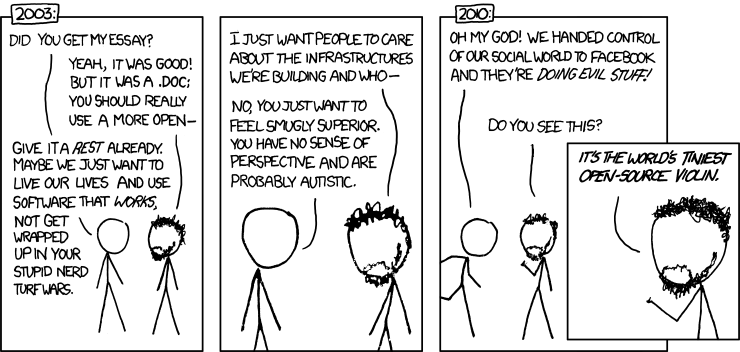
I worry a lot about my tone here. As I recently found out when reading a book on obesity, it's sadly easy to dismiss those presenting information and ideas about something as, "Oh, they're one of those type of people. That explains why they would say that." It would be so easy to end up being that "smugly superior" guy who'll criticize folk for having different views on technology or not knowing as much as he does about computers. As the comic below illustrates thouygh, sooner or later we'll be uncomfortable with how the technology we use works, and if unless we develop the appropriate infrastructure we'll be unable to change it.

A central authority will control every aspect possible.or
As much as possible will be made available in its entirety for public inspection and involvement.With that in mind consider this: are you more willing to use Apple or Linux computers? I know, I know "It just works." "I'm not a 'techie,' and don't want to have to deal with all that complicated stuff" "The way the little book opens is just so cute." I've heard it all before. I recognize that Apple has abstracted more of the functions for the user and produced very powerful, stable, efficient (though you wouldn't know if from their pricing) technology solutions, but you're missing the point. I don't want to talk about Apple per se. I want to talk about the choices we make, especially in technology.
Our choice in technology tends to be surprisingly shallow when we consider the depth of the effect technology has on us. We decide based on what looks nice, has the coolest features, or sometimes (usually if we're a little more informed) runs well and has the most processing power. For something that is so rapidly changing the way we interact, work, and quite arguably think this seems like pretty arbitrary criteria. Will it cause me to seek large amounts of less intimate relationships more efficiently? Will I ponder issues less in favor of looking up a quick and easy answer from a third party source in the most sleek and stylish way? These are the kind of questions we're asking, when we could be asking ourselves questions like, "Will I be engaging in and contributing to a infrastructure that promotes openness and individual freedom?"
If I may be candid for a moment let me admit my smug tech nerd ways. I used to be a little annoyed, mostly due to the immaturity one has early in life that others know different things than you do, when people didn't know how a computer's file system worked, the difference between a program and a text file, or why they couldn't get on the internet. I'm quickly becoming less annoyed by these people, but that annoyance is being replaced by fear.
I'm afraid because I know that market forces drive technology, and it's terrifying to see the market choose flashy, easy, and restrictive items over empowering items that might make them work a little harder. I'm afraid because working in tech support I've seen just how helpless people are when their technology breaks, how helpless many people are when it comes to fixing their technological problems, and how earnestly industry is working to make sure that problems may come up less at the expense of being fixable without being invited into a company's inner circle to error codes and access controls. I worry about living in a world where a relatively small conglomerate of programmers, advertisers, and businessmen are making sweeping decisions on how people live their lives, and the people are relatively powerless to and even uninterested in changing that.
Many are afraid of the effect technology is having on the human psyche and sociological structures. It's easy to blame the technology for this, but I feel that's misguided. If our minds or societies are becoming corrupted it's not thanks to the internet, smartphones, or video games. It's because we're using these poorly. And why wouldn't we if most of us don't know how they work at all, and only know what they do as the company making it presents that to us?
Studying mathematics and physics where most modern research is done with the aid of computers I'm perhaps blessed to have been taught in a tradition that specifically points out where computers are helpful and where our own intellect should be applied. Questions of what's computable and what isn't are addressed directly, as well as questions of the best way to compute that which we would indeed like to compute.
I worry a lot about my tone here. As I recently found out when reading a book on obesity, it's sadly easy to dismiss those presenting information and ideas about something as, "Oh, they're one of those type of people. That explains why they would say that." It would be so easy to end up being that "smugly superior" guy who'll criticize folk for having different views on technology or not knowing as much as he does about computers. As the comic below illustrates thouygh, sooner or later we'll be uncomfortable with how the technology we use works, and if unless we develop the appropriate infrastructure we'll be unable to change it.
Tuesday, June 11, 2013
The Fourth Amendment in the Information Age
In my last post I mused on the nature of data and how the information about us defines who we are. I was spurned to write this and finished off the post presenting disappoint with Verizon, my cell carrier, and their failure to protect users' privacy and respect their charge in holding data about us. Lately Verizon has been in the news for handing over call records to the NSA, so the wound has had salt thrown in it rather than had time to heal, so to speak. In my investigations into jumping ship from a company so cavalier about it's responsibility to protect who I am in the form my data I've had some interesting experiences.
I sent an email to Sprint asking if their company does anything to protect users' data and privacy. Their response was,
Both could of course be true, in fact the latter may be the cause and the former the effect. I find the latter more interesting, though. It's easy to dismiss concern with how a company protects (or more often fails to protect) our information as unfounded worry about "government conspiracies" (in fact, that's exactly who a T-Mobile salesperson ended up characterizing my concern when asking about it at a store location). While the fact that most citizens probably won't be much affected is true and the majority of people (including myself with all my seditious comments coming out on this blog) aren't interesting, influential, or dangerous enough for the government to take the effort to spy on, the issue is far from unimportant for everyone save a few security advocates, legal scholars, and tech enthusiasts.
As I pointed out in my last post we're seeing the importance of the physical diminish. The things that are important to us are increasingly in the form of data accessed in a number of different ways? As these changes in the way we communicate, work, and create emerge so the laws which will govern these new methods of living. And they are being changed.
"The Fourth Amendment (Amendment IV) to the United States Constitution is the part of the Bill of Rights which guards against unreasonable searches and seizures, along with requiring any warrant to be judicially sanctioned and supported by probable cause." This worked well for many years when communication took place between two people in the form of physical letters that they could keep on their property and evidence showed up as physical items that, again, could be held on someone's property. These laws are essentially being re-written as more and more of what's important to us has a digital presence.
The fourth amendment seems to grow out of the presumption of innocence. We aren't to be observed, investigated, or seized until some degree of proof of guilt can be obtained. This is what's being eroded by modern electronic surveillance. It echos the complaints by so many in gaming when considering many invasive digital rights management (DRM) systems, "I'm being treated like a criminal when I haven't done anything wrong. They're just assuming I'm going to steal things."
Privacy and the internet is always, and may always be, a thorny issue. There's many conflicting theories, ranging from the internet being a surveillance state, to the assumption of privacy which is continually being shown to be unsupported, to complex privacy policies written by lawyers and mostly ignored by users, to understanding that privacy is only there when one takes the steps to encrypt their data and secure their connections. The internet is increasingly how we live our lives-in both private and public contexts-and after fighting for our rights and freedoms in the physical world we need to take up the fight once more for cyberspace, whether that means holding elected officials accountable, suffering the inconvenience of using security software, or considering privacy and data security when selecting service providers.
I sent an email to Sprint asking if their company does anything to protect users' data and privacy. Their response was,
which I found alarmingly curt and evasive. Don't get me wrong, I wasn't expecting anything terribly profound or telling, I was expecting a sorta non-committal PR department generated canned response along the lines of, "Sprint is committed to protecting customers' data and ensuring their privacy, however we still must comply with any lawful U.S. Government agency request." There's no real way to peer behind the curtain and discern why they responded with the air of, "Oh geez I don't want to talk about this please don't make me say anything why are you doing this to me?" My speculation on the subject, which I feel such a curious response deserves, would be that either Sprint is just as uncaring when it comes to customers' data and privacy and can provide no unembarrassing response to a customer asking these type of questions, or that they are actually fearful of what might happen should they take a stand.Sprint as a company is not commenting on this report. We do not haveany information to share, and that Sprint will not be commenting on thesubject.
Both could of course be true, in fact the latter may be the cause and the former the effect. I find the latter more interesting, though. It's easy to dismiss concern with how a company protects (or more often fails to protect) our information as unfounded worry about "government conspiracies" (in fact, that's exactly who a T-Mobile salesperson ended up characterizing my concern when asking about it at a store location). While the fact that most citizens probably won't be much affected is true and the majority of people (including myself with all my seditious comments coming out on this blog) aren't interesting, influential, or dangerous enough for the government to take the effort to spy on, the issue is far from unimportant for everyone save a few security advocates, legal scholars, and tech enthusiasts.
As I pointed out in my last post we're seeing the importance of the physical diminish. The things that are important to us are increasingly in the form of data accessed in a number of different ways? As these changes in the way we communicate, work, and create emerge so the laws which will govern these new methods of living. And they are being changed.
"The Fourth Amendment (Amendment IV) to the United States Constitution is the part of the Bill of Rights which guards against unreasonable searches and seizures, along with requiring any warrant to be judicially sanctioned and supported by probable cause." This worked well for many years when communication took place between two people in the form of physical letters that they could keep on their property and evidence showed up as physical items that, again, could be held on someone's property. These laws are essentially being re-written as more and more of what's important to us has a digital presence.
The fourth amendment seems to grow out of the presumption of innocence. We aren't to be observed, investigated, or seized until some degree of proof of guilt can be obtained. This is what's being eroded by modern electronic surveillance. It echos the complaints by so many in gaming when considering many invasive digital rights management (DRM) systems, "I'm being treated like a criminal when I haven't done anything wrong. They're just assuming I'm going to steal things."
Privacy and the internet is always, and may always be, a thorny issue. There's many conflicting theories, ranging from the internet being a surveillance state, to the assumption of privacy which is continually being shown to be unsupported, to complex privacy policies written by lawyers and mostly ignored by users, to understanding that privacy is only there when one takes the steps to encrypt their data and secure their connections. The internet is increasingly how we live our lives-in both private and public contexts-and after fighting for our rights and freedoms in the physical world we need to take up the fight once more for cyberspace, whether that means holding elected officials accountable, suffering the inconvenience of using security software, or considering privacy and data security when selecting service providers.
Thursday, May 9, 2013
Our Data is Who We Are
The physical is becoming less and less important in the modern world. Sure, there will always be a need for physical mediums (after all "There is no such thing as immaterial matter. All spirit is matter"), but information is what reigns supreme in importance. This has always been true, in many ways. As Carl Sagan said, "The beauty of a living thing is not the atoms that go into it, it's the way those atoms are put together." In another way, humanity has been marching toward this for ages; Since the invention of writing a stone could be transformed into the law of the land or God, a history of a people, or an agreement between two parties. The invention and standardization of money intensified this.
The idiom that you can find out a lot about a person by going through their trash may still be true, but it's been found that with a handful of data readily made available people can know exactly who we are (in this study 4 locational data points were enough to identify 95% of participants). While it's (probably) true that you wouldn't be you without your physical body, too often we forget that we wouldn't be who we are without our memories, habits, and interpersonal connections-all of which computers are increasingly involved in and therefore archiving.
As a Verizon wireless customer I was devastated to see this report from the Electronic Frontier Foundation surveying different companies and what measures they were taking to protect users' privacy. I've known for a while that Verizon was kind of a scumbag company, managing to continue living only because they've acquired a great deal of infrastructure. When (also scumbag, when it comes to users' data) companies like Comcast and Facebook (I'm not including Google even though many might have worries about the amount of data they collect because they did manage to collect 5 out of 6 stars in this survey, and I genuinely appreciate the company) as well as the two lower end Apple and AT&T still manage to find some way in which they can protect users' data rights are still beating out my carrier, I worry.
I'm seriously considering leaving Verizon, and would probably side with Sprint. The financial, coverage, and overall convenience implications makes me hesitate, but I really feel like making sure a company that isn't making any effort to protect my digital self shouldn't be supported by my money. I'd love to leave Comcast for the same reason, and may look into campaigning within my complex to get a different service provider. The power a service provider has in my life is unnerving, considering how important my data is to me. After all, in a very real way the data about me is who I am.
The idiom that you can find out a lot about a person by going through their trash may still be true, but it's been found that with a handful of data readily made available people can know exactly who we are (in this study 4 locational data points were enough to identify 95% of participants). While it's (probably) true that you wouldn't be you without your physical body, too often we forget that we wouldn't be who we are without our memories, habits, and interpersonal connections-all of which computers are increasingly involved in and therefore archiving.
As a Verizon wireless customer I was devastated to see this report from the Electronic Frontier Foundation surveying different companies and what measures they were taking to protect users' privacy. I've known for a while that Verizon was kind of a scumbag company, managing to continue living only because they've acquired a great deal of infrastructure. When (also scumbag, when it comes to users' data) companies like Comcast and Facebook (I'm not including Google even though many might have worries about the amount of data they collect because they did manage to collect 5 out of 6 stars in this survey, and I genuinely appreciate the company) as well as the two lower end Apple and AT&T still manage to find some way in which they can protect users' data rights are still beating out my carrier, I worry.
I'm seriously considering leaving Verizon, and would probably side with Sprint. The financial, coverage, and overall convenience implications makes me hesitate, but I really feel like making sure a company that isn't making any effort to protect my digital self shouldn't be supported by my money. I'd love to leave Comcast for the same reason, and may look into campaigning within my complex to get a different service provider. The power a service provider has in my life is unnerving, considering how important my data is to me. After all, in a very real way the data about me is who I am.
Tuesday, March 29, 2011
Better to fail with honor than to succeed without it
Just a thought I had earlier, but surprisingly profound. We focus a great deal these days on success, be it in a career, academics, or even romance. How well do we remember honor? The size of communities might be a factor. People are less likely these days to know about your character or integrity so it's easier to throw out a job title or specific qualification when making introductions. Even when true, declaring oneself honest, diligent, or kind rings hollow without the actions to back it up.
The internet is no help either, with the famed (or infamous) "anonymity" allowing people to act reprehensibly with little to no repercussions. Maybe though, the internet can one day save honor in some small way. Consider if everyone had a sort of 'master online account' (similar to google or facebook accounts). If these had a 'integrity' score on them, which was easily viewable by anyone like an ebay or amazon seller scores. After interacting with many people integrity could be averaged and scored like so many other things are these days.
The possibilities (both good and bad) of a system like this are just barely blossoming in my mind, so maybe I'll let this simmer for a while and take the idea up again. To anyone reading, what do you think about being successful vs. being honorable, or having an integrity score indelibly linked to your name through the power of the internet?
Subscribe to:
Posts (Atom)