Showing posts with label entertainment. Show all posts

Monday, June 8, 2015

Are We Ready for Post Scarcity? Part 3

So technology has brought us a new world.  The new technologies developed in the 20th and 21st centuries have created a world with changes as drastic as the invention of agriculture over 10 millenia ago.  This new world is awe inspiring in its productive capabilities.  Like the soviets upon seeing American grocery stores or backyard pools, those of us from the old worlds look in disbelief on the abundance the highly automated modern world offers.  Will that disbelief be an awestruck hopeful wonderment, or a horrified cringing at the dystopian nightmare on display?

What becomes of the human being, the individual in the post-scarcity world?  While objectively unanswerable, for now, science fiction and current trends can give us an idea.  Star Trek provides the most hopeful vision, a humanity that devotes itself to self improvement and growth, bravely venturing out to explore the universe or just starting a small restaurant to share the joy of old family recipes (like Joseph Sisko from DS9).  People engage in their passions and become the greatest captains, scientists, or chefs that they can thanks to the freedom from desire and from the struggle for the basic necessities of life.  While this optimism is one of the reasons we love Star Trek it doesn't strike us as realistic.

On the other side of the spectrum we see the 'dystopian,' or broken utopia, genre of fiction.  The lack of scarcity in information and communication enabled by the internet has made government surveillance and monitoring so easy that the protections for citizens seem to come only from law these days.  And that can easily fail, as the victory of the ACLU against ongoing programs of the NSA showed.  The NSA's activities have many shouting that, "1984 was not an instruction manual."  A conversation from the video game Deus Ex indicates another interesting, and all to realistic, future:
JC Denton: Some people just don't understand the dangers of indiscriminate surveillance
Morpheus (an AI system who is 'a prototype for a larger system'): The need to observed and understood was once satisfied by God.  Now we can implement the same functionality with data-mining algorithms.
JC Denton: Electronic surveillance hardly inspires reverence.  Perhaps fear and obedience, but not reverence.
Huxley's Brave New World gives us one vision of a post scarcity world that's also terrifying.  People are raised from conception to death to fill a certain role, with much of the population raised to lack mental faculty and drive so that they can be contented with menial jobs.  Innovation is suppressed if the rulers decide it doesn't support the economy.  The population is essentially drugged into compliance and acceptance of the system that promotes nothing but the status quo ad infinitum.  At least everyone has a job, though.

These uncomfortable futures are just fiction, for now, but sadly they seem to strike us as truer to reality.  One of the consequences of post-scarcity living is that power can evaporate.  It can also become much more concentrated.  Abuses by law enforcement that were once prevented by their sheer infeasibility now need laws in place to protect citizens (the supreme court decision on GPS tracking is a good example of this to add to the NSA's recent abuses of power).  However when laws are needed the question inevitably arises of who will write them.

The genius of American government is the idea of the powerful individual, that every citizen has strength enough to make their voice resonate in the halls of power.  The idea has caught on so strongly that it's easy to forgot how revolutionary and unthinkable this idea would be only 500 or so years ago when monarchs were the norm, and for basically all of human history before that when the strong took what they wanted without regard for whether or not the man they were taking it from cared to give it up.

The same power of technology that can eliminate scarcity could also conceivably eliminate freedom.  Corporate influence over lawmakers could barely be necessary if companies like John Deere, Apple, and Comcast continue along their trajectories.  Imagine the power the tractor company would hold if they were able to dictate whether or not their machinery were allowed to be repaired or you would just have to buy a new one to continue sowing grain.  Consider the power of a company with similar power over electronics and personal computers.  All the innovation and creativity in the world doesn't mean a thing if a company controlling the means of distribution for new products and stories can decide to refuse their service.

How can we dilute these powers, without only strengthening centralized government power, and while still providing opportunity and daily bread for the individual?  I don't know.  I have some ideas, but truly I can't say what I'd really do if I were ruler of the world, or even just the US.  What I can say is that no one else really can either.  There's a dearth of ideas and solutions floating around out there because we're not addressing the issue.

The idea of a post-scarcity economy and society is so revolutionary that it doesn't sound real.  Talking about robotics and computing replacing human beings as the driving force in the economy sounds like science fiction, despite the fact that we continually experience it as reality.  The whole issue is so massive and so out there that it's not addressed seriously in politics, and rarely in thoughtful conversation.  If this continues we'll find ourselves in a world clinging to obsolete social mores and struggling to make them fit in the modern world.  We can't let that happen, so let's think about getting ready for post-scarcity.

Monday, June 1, 2015

Are We Ready for Post Scarcity? Part 2

It's easy to romanticize scarcity when looking to address the problems that arise as it fades from the eyes of humankind.  Recent bouts in popular culture of "paleo-nostalgia" show us just how absurd our longing for "the good old days" can get.  But the good old days were never as good as we pretend they were.  The fifties had Jim Crow laws.  Pre-industrial society was awash in the filth of both the horses that pulled carriages and the humans that rode in them.  Why I should have to point out the scourges of humanity in medieval, bronze age, or stone age days is beyond me, but I'll mention crusades and inquisitions, the slavery that built the pyramids, and war among rival tribes of cave men just to be safe.

I bring this up because it's important to note that I'm not advocating we avoid creating a post scarcity world.  Precisely the opposite, I want to acknowledge that we're in the middle of doing so, and embrace the change.  To do that though, we need to be wary and accepting of the consequences.  Some of those may be unimaginable and have to be addressed as they come.  Others are more predictable, especially when we consider history.

I mentioned the abundance of food in part one.  Now consider farming, the production of that food.  Farming is remarkably different in the modern world, and it's so efficient that we can produce so much food that our primary concerns don't regard abundance.  We take abundance of food for granted, instead seeking better quality and solutions for what to do with the excess.  This has come at a price, though.

The great depression featured, "Farming communities and rural areas suffer[ing] as crop prices fell by approximately 60%." (wikipedia, citing three other sources)  The abundance and efficiency of farming is so staggering that only through heavy subsidies is agriculture profitable today.  These subsidies are so severe that Lawrence Lessig in his book Republic, Lost titles his chapter on government farming subsidies, "Why don't we have free markets?"  We recoil at the realization that government is deciding what food gets grown, and yet this might be important and beneficial to society, since we all like to eat.  Surely subsidizing agriculture is better than milk being spilled into gutters while thousands only a few hundred miles away starved, a characteristic image of the depression?

Food is one thing, it's physical and tangible.  We're all familiar with it and easily understand what it means.  Information is quite another, yet it's the next thing whose scarcity is being obliterated.  Personal computing and the internet have done a pretty good job already, once again changing the problems from availability to find-ability of information of high enough quality and relevance.

What have humans done with this?  We haven't become a society of well read polyglots that understand the conflicts between relativity and quantum mechanics as we might hope.  We're very well entertained, though.  Entertainment is just a form of information, after all.  A textbook has roughly the same form as a storybook.  With Netflix, Hulu, & Youtube,  for videos alone we can spend our entire day being entertained for probably not quite $100 a month.

This doesn't (necessarily) mean we're stupid or shallow, though.  Many of the most popular shows are sharply written character and political dramas like House of Cards, Mad Men, Breaking Bad, and Game of Thrones.  The recent revival of Carl Sagan's Cosmos series did well.  It could be argued more people are writing than ever before thanks to blogging sites like what you're reading now and maybe even social media.

OK, I'll admit I might not be buying the idea that the lack of scarcity in entertainment is improving us as a people either, but on the other hand I'm not going to dismiss it outright.  A stronger example might be video games.  The juggernaut game Minecraft is almost exclusively a creative tool rather than a traditional game.  Gaming has a strong community of "modding," or learning some basic (or in some cases extremely complex) programming tools used in a game to create a variant of that game. These variants span anything between the original game with a failure message changed from, "You died." to "Thanks, Obama!" to entirely new games built on the same graphics and gameplay engine.

In both food and entertainment we do see demand for quality now that availability is so high.  People grow from just being happy to have something to eat to wanting something that is organic, gluten-free, or maybe even something actually important.  People start paying attention to what their food is over whether or not it's there.  Likewise in entertainment we are demanding quality more and more.  We are seeking entertainment that we can, as Kevin Spacey says, "engage with...with a passion and an intimacy that a blockbuster movie could only dream of."

Bertrand Russell writes in his essay In Praise of Idleness about the odd disconnect that exists between our valuation of production and consumption.  While we admire productivity we don't highly value consumption.  Those who earn money have prestige, but not those eager to spend it.  He points out the oddity of this, particularly when we only earn money is by others' spending of it.  "We think too much of production, and too little of consumption. One result is that we attach too little importance to enjoyment and simple happiness, and that we do not judge production by the pleasure that it gives to the consumer."

Russell also alludes to the caste and class scaffolds that these attitudes seem to stem from.  He even goes so far to argue that the traditional work ethic arose largely as a tool of slave-owners and autocrats to keep their populations  content with their tyrannical rule.  If this is starting to sound like Marxist thinking to you then you're actually very clever.  A serious point of departure I must take to this essay is his praise given to the (only ten years old at the time of writing) Russian revolution and newly formed USSR.

We all know how that experiment turned out, so how can I possibly be suggesting that going at it again is a going to be a good thing?  The short answer is that I'm not.  I am arguing that an economy with abundance for humanity requiring very little input of labor from humanity is on the horizon, or even just finishing its arrival and is starting to settle in.  One of my great concerns is the way this could create a dictatorship masquerading as efforts to provide equally for all men like existed in communist Russia.  I'll delve into this a little more in part 3.

Wednesday, March 25, 2015

Are We Ready for Post Scarcity? Part 1

The abundance of the modern day is staggering.  Food alone is now requiring few man hours and producing vast amounts of product.  In about 25 years the personal computer has gone from a relatively cutting edge office device to a ubiquitous handheld one.  The amazing advances in technology will only cascade into more, and these will bring amazing blessings, conveniences, and boons to humankind.  These are gifts we should be prepared to freely receive, but like a gift of chocolate that will make us sick if eaten to quickly or heavy book that will require much reading and concentration we need to be receive these with caution and adroitness.

Let's go back to food.  One of the interesting points of contention between my brothers, me, and our grandmother is our approach and mentalities surrounding food.  Our grandma, growing up in a family that suffered through and being born shortly after the great depression, views food as a precious and scarce resource.  She often views food in terms of availability, enjoying buffets and inexpensive diners and being anxious over throwing away uneaten scraps or spoiling produce.  My brothers, and even my parents, live in the modern age and see food as abundant.  We don't like to waste food, but recognize that when the bread gets moldy it should be thrown out because it only costs a dollar or two (ten minutes of work at minimum wage) to get another loaf.  We live devoid of the "clean your plate" ethic so common in past generations.

Thank heavens for that too, as obesity and overeating are a greater health risk to us than malnutrition (though I am skeptical of the magnitude of this risk).  It's actually odd to think about health risks arising because nourishment is so easy to obtain.  Taking anatomy and physiology I've learned hundreds of ways in which a deficiency of calcium, iodine, glucose, iron, or any other number of dietary intakes cause problems.  It's bizarre to think of problems coming about simply because we have so much of those things we need and love that we run out places to put it and spend so much time and energy to keeping it all together.

Food is only the beginning of this, though.  Technology is more and more in in the reach of anyone who'd like it.  Entertainment and education is more available than ever with the internet.  And these are just the commodities being made abundant with modern technology.  Go even slightly futuristic and we have productive capabilities exploding via robotics, precious metals or gems having their scarcity destroyed by advanced chemical and materials engineering techniques, and even thought or creativity flooding the market in ways never before seen thanks to better distribution systems, or even AI and other futuristic computing creating new art.

The challenges presented by this can be staggering though.  The central one is likely motivation.  Survival and status have been the principle motivators of a person in the past.  That might have meant being the mightiest hunter in the tribe that's always well fed or the most influential business magnate on wall street who always had some opportunity waiting, but the principles been the same.  Many of us have said something like, "I really don't want to go to work today but they won't pay me if I don't so I guess I had better," and we've probably even said that with some frequency.  If we reach post scarcity we theoretically won't ever need to get paid, so what will keep us getting out of bed in the morning and off the streets?  I'll be investigating this and other ideas of a post-scarcity society and economy in part 2.

Thursday, September 25, 2014

Devon's Reading List

I had a cousin visit recently and during our conversations we noticed how I often referred to a handful of books for their valuable insights, information, and wisdom.  We decided I should collect a short list of these and so I present below the titles along with a short summary of why they're valuable.  Many of these I believe to be 'required reading' for people in certain careers or ventures of life and I'll include that in the description as well.
  • The Obesity Myth - Paul Campos : A superb examination of the weight loss industry, culture, & political machine. The book does a great job of bringing to light just how overblown the obesity problem really is and how our current culture surrounding it probably exacerbates the problem much more than it helps (i.e. a main contributor to Americans' weight may be frequent weight cycling due to going on and off diets).  Highlights are:
  1. An examination of how the weight loss industry, politicians, and much of mass media all seem to exhibit thinking patterns found in anorexics and this anorexic viewpoint (including a certain level of revulsion at fat or fatness or an obsession with monitoring our weight and diet) filters in to the public consciousness
  2. A fascinating cultural analysis of why fat seems to be one of the few remaining acceptable prejudices
  3. Some horrifying but transfixing investigations of what fat prejudice and mainstream acceptance of the obesity 'epidemic' imply for public and individual health (such as the failure to effectively regulate fen-phen and patients with serious diseases that had trouble getting treatment due to doctors jumping to obesity and diabetes).  
After mysteriously gaining weight shortly after moving to Utah (seriously my diet didn't seem to change appreciably and I was exercising the same amount to more than in Colorado) this book was also a breath of fresh air and helped me realize I didn't have to feel shame and failure for going from a size 38 to a size 40.
    • Required reading for : Those in the health field or making public policy, and probably anyone that's struggled with with weight or body image issues which I guess probably means every American.
  • Innumeracy - John Allen Paulos : A beautiful explanation of the problems facing mathematics education and awareness in the U.S.  The title itself is an excellent commentary on the issue, innumeracy being the numerical equivalent to letters' illiteracy, and the fact that one of those terms is well known and the other, well, probably had to be invented speaks volumes.  It's an eye opening work and (though hopefully after reading it you'd feel a little embarrassed to ask) it's written without using any advanced mathematics so those that might need to hear the message the most will still be able to hear it loud and clear.  I've written some of my feelings around the subject previously in this blog here and here, so I won't belabor these ideas anymore at this time except to say that this book is a great analysis of the issue with mathematics in modern U.S. culture that I find appalling and everyone else seems comfortable with.
    • Required reading for : Anyone going into education, especially elementary education as studies have shown them to be most uncomfortable with math and many of the problems individuals having arising in their early learning experiences.  Probably another one with wide enough impact on culture and society that those making public policy require a read as well.
  • The Female Brain and The Male Brain - Louann Brizendine : An intriguing description of the physical differences in neural circuits, makeup, and systems between the sexes.  I find myself quoting this work probably at least once a week as things like 'Men can't multitask' can finally be part of a deeper conversation through explanations like, 'That's because female brains have a 30% larger corpus callosum (the structure connecting the two hemispheres of the brain) and a higher density of white matter (the structures in the brain representing connections between different nerve cells).  Female brains are indeed much more capable of making connections between differing ideas and performing more functions at once as their wiring facilitates that. It also explains why they often see connections between things that men view as separate and unrelated.'  Lest you think this may be a work promoting typical gender stereotypes and sexist viewpoints note that Dr. Brizendine in an interview said she wrote the first book, The Female Brain, with the intention of giving men 'brain envy' (an analog to Freud's 'penis envy').  I suspect that didn't occur for most of the male readers, but still I can say after reading the book I have a great deal more respect and regard for the female brain as a powerful processor that, like a CPU and GPU, simply works differently than I'm used to.  I've even been known to go so far as to say that after understanding the neurology of both sexes I think the female brain is wildly better suited for the modern day and the male brain has numerous systems and circuitry that were well designed for a world a physical challenges like hunting but are mostly just burdensome in a world where challenges are usually more intellectual or in expressing and communicating with others and a community at large.
    • Required reading for : People in or entering long term relationships with the opposite sex, and probably anyone raising children as it provides a wonderful road map of neural development by gender.
  • Reality Is Broken - Jane McGonigal : I can describe the central idea of this book as 'video games (or gaming in general) have indeed become sources of very high levels of engagement recently and many people are finding the games in their life more compelling than any other aspect.  Far from an indictment of video (or other) games this is a severe indictment of managers, policy makers, teachers, and others to keep up and learn how to make life more fun and fulfilling from the principles of game design."  It really is kind of a bold idea now that I think about it, but I also think it's full of truth and power.  The book goes into what makes games so compelling in terms that elucidate just how positive and powerful they are, such as a gamer subconsciously saying "Wow, I can actually see the impact and consequences of my actions and how I'm progressing and improving," (Think experience points and level up meters).  It also provides some captivating and impressive examples of games used for a positive purpose, my favorites being McGonigal's own Super Better a game with a superhero theme that aids recovery from disease or severe injury (developed by McGonigal after being concussed), and Chore Wars a game that makes doing the household chores more rewarding (a love McGonigal's anecdote about her and her husband having to sneak quietly into the bathroom to scrub the toilet lest the other hear them and swoop in to steal the points for doing so).
    • Required reading for : Management and educators.  I worked for a little over two years in a call center tech support environment and remember being constantly bewildered at how much improvement McGonigal's principles could make to employee morale, especially in such a statistics driven job.  Parents may also benefit greatly from learning a few game design principles to implement in motivating their kids to worthwhile ventures.
  • Willpower - Roy F. Baumeister & John Tierney : A recent read that I also found full of wisdom and good advice the subtitle, Rediscovering the Greatest Human Strength, is also a decent summation.  The book tells us about the latest research into what willpower is and how it works, as well as some tips on how to develop and use it effectively. While it was an interesting and edifying read for me, the last section of the penultimate chapter and the final chapter really sealed it for me by hearkening to a few of the other books on this list. The part just before the final chapter seemed torn from the pages of Reality is Broken, bringing up how video games actually show how we strive to use willpower in meaningful ways and have the perfect systems to develop it, as gamers' willingness to play a section of a game over and over and master concepts within the game demonstrate.  The final chapter was on the greatest intended use of willpower, dieting and weight loss, and while it may just be my bias I did feel much of the chapter indicated the whole venture was misguided.  He does even say "never go on a diet" though he seems to be referring more to the idea of 'you should never go on a diet that you can't or don't intend to stay on for the rest of your life.'  As one who's always venerated self control I highly recommend this book.
    • Required reading for : Parents, teachers, or anyone in childcare though any human being can probably get something of value from this read.  I think the lessons about developing willpower are best applied to youth, and possibly most important when considering how to raise a successful child, which is why parents should definitely give this one a read.

Tuesday, April 29, 2014

Ownership in the Modern Age

We all subscribe to several services today.  Streaming video, e-books, music, and probably any other media you can think of come from a third party.  These providers are replacing the traditional physical media which end users purchased to enjoy a song or show.  I personally don't really care to buy DVDs anymore, even though I used to enjoy buying them to watch great TV shows or movies.  This prompts an interesting question; what do I own with these services?

The answer is, nothing.  This is very clear in the legal documentation of these service providers.  They own the content, we own a very limited license to rent it on an ongoing basis.  I don't own anything, and oddly I seem to be OK with this.  Is the very concept of ownership changing, possibly for the first time in human history?

Ownership was very straightforward for a long time.  An object, if I owned it, was mine and this meant only I could access and use it without having to ask permission.  This was all well and good when what we traded was objects, which was true for pretty much all of human history up until the last 50 years or so.  Information couldn't be encoded usefully into anything without directly changing the structure of that object in such a way that they were inextricably connected (writing something down changed a slab of stone to an engraved slab of stone, or paper into an ink stained paper, for instance).  Reproducing a piece of information was even harder.  In the modern age the exact opposite is true, computers take in gigabytes of information effortlessly with only minor changes to how the computer is assembled (magnetic sectors or electric cells in hard disks or solid state memory changing slightly) and this can be changed again with a simple word of instruction.  Reproducing this information to copy somewhere else or play back for our enjoyment is trivial.

What will this mean to our concept of ownership?  Especially as even the 'personal computer' gives way more and more to cell phones and tablets that store much of their media 'in the cloud,' and even the defining characteristic of whether or not it was something we had physical possession of fades away?  I'm most interested in what the rising generation will come to understand about ownership.

Traditional ownership will still apply to clothes (at least until we install the self adjusting nano-fiber network in our bodies that can become any outfit possible that's been programmed in) I guess, but books, movies, media - which is so important in shaping our culture - will start to be something that we don't own ourselves, but is doled out to us by 'service providers.'  Even the devices we view this on may continue to fall into trends of two year, yearly, or more frequent upgrades.  I would be more sanguine about these possibilities if our copyright law were more reasonable and our relationship with convenience less like an addiction.  The phrase, "It's not on netflix" already seems to be finding it's way into culture as synonymous with, "I can't get access to it."

A common piece of wisdom is that individuals are, or at least can be, intelligent but large groups are almost always lacking in reason.  This may be part of the genius of the founding fathers framing of America as a country where the individual citizen has power and the government at large is limited.  I think this is why I don't want to see traditional ownership fade away.  The less we can possess media, the less we're able to work with, exploit, and use it for our own means and the more we are at the mercy of corporations, governments, and other large groups- that may be lacking in reason - to engage with the media that informs our life and culture.

Wednesday, February 5, 2014

Why I Like to Play Pretend

I've always loved to play pretend.  As a kid the most entertaining thing I could do was imagine myself as someone different in a vastly different world.  My parents have said that in my early years a teacher once, in reference to my independent imaginings of intrigue, said something like, "I was a little worried that Devon wasn't getting along with the other kids, but then I realized he just doesn't find playing with them that interesting."  And why would I have?  What possible competition could attempts to direct the motion of a ball around a field hold to the vivid flights of fancy surging through my mind?

I still like playing pretend, but with age have changed the ways I do so.  There's writing, which is fun in it's creativity but requires quite a bit of commitment to craft something really satisfying.  It's certainly not on par with running back and forth during recess freely directing the actions of whatever amazing character I had created.  Reading is even more restrictive, and movies and television more so still.  The best way I've found to recapture that adventurous imagining of childhood, and even build on it in some ways, is through tabletop role-playing games.

Tabletop RPGs aren't known for being creative and fun, except by those who've played them.  Their reputation has sadly been horribly slandered almost since their inception. The most popular tabletop RPG, Dungeons and Dragons, was criticized in early years, like many works of fantasy such as the Harry Potter series, as being something which promoted satanism and witchcraft.  This had the unfortunate effect of causing the game's creator, Gary Gygax, to feel he shouldn't admit to being a Christian.  As he told a convention of gamers in 2007, "I was reticent to say the fact, you know, that I was a Christian, mainly because I was afraid that I would give Christianity a bad name because I did D&D. So I did, I kept my mouth shut."

The problem wasn't helped by a mother who, in my-admittedly biased by persecution and somewhat uncharitable given the involved tragedy-opinion, rather than accept the sad truths of mental illness which caused her son to commit suicide decided to crusade against Dungeons as Dragons as the evil which stole her son away from her.  The result has been a society that largely feared the game (it even seemed a little creepy to me as a youngster after I got an email, probably an ad or invitation to an online game, that talked about how to hold 'death matches' and my father mentioned it sounded like "A D&D thing," which was reasonable but devoid of the now known innocuousness of pretend in those early days of both the game and the internet), and pushed only those sufficiently unbothered by the tut-tuts of society at large to be able to enjoy the game.  This turned out to be the "nerds," and has left Dungeons and Dragons in particular and tabletop role playing in general with a stigma of silly foolishness engaged in only by those who never go outside or shower that has persisted to this day.

All this is a shame, really, because the games are quite fun and have a lot to offer.  Tabletop RPGs provide a system for cooperative story telling.  They can be similar in some ways to the games of 'pass the story' one might have played around campfires or in grade school writing classes, though a major difference is that one person takes primary control of the plot and everyone else directs the actions and dialogue of the main characters.  The game rules help with this by creating a system for directing action, resolving conflicts, and defining a character's attributes.  If you want to play a character that's particularly strong, but kinda dumb you can put this in his ability scores.  The old playground fights, of, "I shot you." "Nuh, uh, I dodged it." are resolved with attack modifiers, armor classes, and dodge skill rolls.  Players give respectful smiles and cheers to one another as they roll high numbers on dice of varied shapes, meaning that their characters have landed heavy blows on fearsome foes.

That camaraderie is another great thing about gaming.  A group of friends being creative and enjoying one another's company.  They pepper the story with details, often humorous as it's always fun to joke with friends.  Friends come together in the game world to take on great evils and seek untold riches or amazing power, and they come together in our world to have fun and tell a good story.

I wish the hobby didn't have the baggage it does, because I think it adds a lot of value to one's life and could be used for many wonderful things, but it doesn't seem like I'll ever be able to get together that church group of gaming friends where an ecclesiastical leader guides the adventures of a group of holy warriors fighting the forces of evil and striving to live the principles of their faith, the professional group of executives playing characters who are always striving to gain treasure and power but must also protect the innocent and the weak to avoid alignment penalties, nor the student group adventuring to find the secrets of the universe.  Games are a painfully under-utilized tool to motivate companionship, self-improvement, and promoting good causes.  Tabletop RPGs are another unfortunate example of this.  I'll still have fun playing though, whenever I can find a few friends that also enjoy playing games and being creative together.

Friday, November 22, 2013

Sadly, the porn must flow Part 3: Regulatory and Governmental Concerns

I've now addressed concerns with a mandatory pornography filtering system based on conceptual considerations on the nature of pornography and technical ones about how the system might work.  Now I will focus on a critique of the plan based on the governmental and regulatory considerations, as stated in the title.  A main point in my last part could be summed up as, "Don't trust your ISP to keep you safe, you're better off ensuring that on your own."  If we replace ISP with government that same idea will be found here.

America has a unique approach to government in that a fundamental value we hold is liberty, and are sensitive to the power of government to curtail this among individuals or groups.  The conflict between this and the need for law forms a basis to our society.  Whether pornographic filtering should be mandatory is another manifestation for this conflict, and I will be falling on the side of liberty as opposed to security.

The concept of safety curtailing our liberties is one hotly contested in the media with the government's efforts in the last ten years to crack down on and protect against terrorism.  This even has a more direct parallel in the field of communications with recent Snowden leaks on NSA data and metadata collection efforts that, in my own personal opinion and that of at least one court of law, violates American citizens' rights granted by the first (including and perhaps primarily the right of association) and fourth amendments.  With these already in peril, why would we want to introduce a new government mandate and increase their ability to curtail citizens' rights online?

Yes, yes, I know, "No one's rights are being curtailed, anyone can still opt in and get the content they want."  In the short view this may be true, though many of the points in my previous two essays on the subject should demonstrate ways it may also not be.  Though I'd rather not delve too deeply into the 'slippery slope' argument as it necessarily relies on speculation and unverifiable prediction, it would be prudent to mention that any law or regulation would set a precedent that our personal communication methods are something the government has every right to manage.

The proposal would grant new regulatory powers over our methods of communication.  It would be handed off to either ISPs or/and government committees and reduce choice for the individual.  While it's only a default setting that would change right now, the shame often involved in the complex issue of obscenity could easily cause this to be the societal norm, and forcing those who either held liberal views about sexuality or possibly a desire to protect their privacy and security online to be forced into an 'internet ghetto.'  Eventually these people might be lumped in with criminals and subject to greater invasion of their rights because they 'chose to use the internet in a manner recognized to reflect dangerous and deviant behavior.'

Let me explain by way of analogy.  How would you feel if car dealerships were now required to sell cars that would automatically avoid driving you anywhere where obscene or illegal activities were known to occur?  They would naturally have to standardize and define what obscene behavior was, and so a federal committee would now decide what parts of town you were allowed to drive to.  If you wanted to have full control over where you could go in the car you bought you would need to ask the dealer, and maybe they would have a special license plate for your car so that everyone else wouldn't accidentally follow you or wonder why they were having trouble getting to a place that you went to without problems.  Does that sound OK to you, or does it seem like a massive intrusion of government control in your life?

The internet is indeed a radically new method of communication.  Earlier methods often fell naturally into a pattern of self-regulation when it came to pornography.  Movies created a rating system, magazines went under the counter, TV shows had a set of standards to follow until after the watershed.  Phone lines were pretty much just as available to youngsters as much as anyone else but you needed to know what number to call and the commercials didn't go on until after the watershed, so their exposure wasn't really significant and in any event parents would get the bill later.  The internet, on the other hand, is hugely interconnected and once you're online you have access to most resources with nothing more than a name, or if you're not sure of that a search term will probably work just as well.  The industry doesn't lend itself well to self regulationas it is a personal service, the connection is to your home, connected to a vast public network.

It does lend itself easily to personal regulation, though.  In my last post I mentioned a few good and fairly easy solutions to filter pornography.  I explained my feelings that those who were unwilling to gain the technical skills to implement these shouldn't be foisting their responsibility to protect themselves on the country at large as well, but there's another aspect to this naivete I'd like to address: that pornography is a problem that technology or regulation can only slow, not stop.  It plays to the most basic human drives and desires.  This is what makes it so tempting, and destructive.

The way to fight pornography is to teach the right values, habits, and behaviors.  I admit the prevalence of pornography can make this difficult, but teaching our children and selves the truth of what pornography is is the most effective way to fight it.  We shouldn't pretend that we can shut off any exposure to it, and instead prepare ourselves and develop the mental and spiritual discipline to be strong against it when we do.  This may include a personal decision to install some sort of filter on our own networks.  Others might not even see a need for this.

Maturity comes with responsibility, taking on accountability for the way we live and the decisions we make.  I see this petition as immature, trying to abdicate the responsibility for avoiding pornography by passing it along to organizations believed to be more capable of doing so.  We must take this responsibility upon ourselves though, immense as it may seem, because immaturity and liberty cannot coexist.  The more we decide that something is too hard for us and should be handled by the government, the greater the state will become as the citizen becomes smaller and smaller.

Monday, September 30, 2013

Imagination and Knowledge

After my last post I decided I want to write another one this month, since I like to cool off and give any readers I might have a break when I go on tears about technology, law, and society.  I didn't have a good topic that I wanted to talk about, though, so I asked my wife what she thought I should write on.  She provided a one word prompt: imagination.  I decided to go with this, but having something so broad I needed to keep looking.  A few internet searches later I happened upon some Einstein quotes around, Imagination is more important than knowledge."  In that way I have I said to myself, "¿Is it?" and then I realized I had a topic for a post.

I think considering imagination and knowledge more important than one another is actually a little misguided.  They're different entities that have different purposes and bring differing benefits to a person or society.  It's like saying hammers are more important than saws or potatoes are more important than chairs.  And we can often get by with only one.  But, these are two forces that gain the greatest power when working together.

Knowledge is a foundation.   Knowledge tells us how the world and things in it work, how to do things, and how things are connected.  Imagination gives us the capability to see how these facts could be different, improved, or superseded.  But using imagination rarely can make a strong impact if we're without the knowledge to back this up.  Knowledge lets us reasonably examine the ways in which the things we imagine might play out, so that when we try to put those things we imagine into reality the chance that we're successful is higher.

My love for Star Trek was recently re-kindled by a collection of online reviews of works in the franchise and one thing that's been striking is that one of the most impressive things about the franchise was its ability to imagine the future in a very different yet very reasonable way.  Social issues such as race, ethnicity, and sex becoming less important to a team that works together.   Also, amazingly, the science of instantaneous point to point transportation, faster than light travel, and futuristic weaponry (though it was changed later, the original meaning of the term "phaser" was "photonic maser" which, while actually redundant since the microwaves a maser produces are made up of photons, points toward the laser which does indeed exist and could be weaponized).  Many of the high points of the series' are when this works to add believably and a feeling of reality to the impossible,and failures of the series often occur thanks to imagination being backed up by too little knowledge.

Tuesday, September 3, 2013

Choosing Style & Convenience Over Principles

Consider which of the following philosophies you agree with more:
A central authority will control every aspect possible.
or
As much as possible will be made available in its entirety for public inspection and involvement.
With that in mind consider this: are you more willing to use Apple or Linux computers?  I know, I know "It just works."  "I'm not a 'techie,' and don't want to have to deal with all that complicated stuff"  "The way the little book opens is just so cute."  I've heard it all before.  I recognize that Apple has abstracted more of the functions for the user and produced very powerful, stable, efficient (though you wouldn't know if from their pricing) technology solutions, but you're missing the point.  I don't want to talk about Apple per se.  I want to talk about the choices we make, especially in technology.

Our choice in technology tends to be surprisingly shallow when we consider the depth of the effect technology has on us.  We decide based on what looks nice, has the coolest features, or sometimes (usually if we're a little more informed) runs well and has the most processing power.  For something that is so rapidly changing the way we interact, work, and quite arguably think this seems like pretty arbitrary criteria.  Will it cause me to seek large amounts of less intimate relationships more efficiently?  Will I ponder issues less in favor of looking up a quick and easy answer from a third party source in the most sleek and stylish way?  These are the kind of questions we're asking, when we could be asking ourselves questions like, "Will I be engaging in and contributing to a infrastructure that promotes openness and individual freedom?"

If I may be candid for a moment let me admit my smug tech nerd ways.  I used to be a little annoyed, mostly due to the immaturity one has early in life that others know different things than you do, when people didn't know how a computer's file system worked, the difference between a program and a text file, or why they couldn't get on the internet.  I'm quickly becoming less annoyed by these people, but that annoyance is being replaced by fear.

I'm afraid because I know that market forces drive technology, and it's terrifying to see the market choose flashy, easy, and restrictive items over empowering items that might make them work a little harder.  I'm afraid because working in tech support I've seen just how helpless people are when their technology breaks, how helpless many people are when it comes to fixing their technological problems, and how earnestly industry is working to make sure that problems may come up less at the expense of being fixable without being invited into a company's inner circle to error codes and access controls.  I worry about living in a world where a relatively small conglomerate of programmers, advertisers, and businessmen are making sweeping decisions on how people live their lives, and the people are relatively powerless to and even uninterested in changing that.

Many are afraid of the effect technology is having on the human psyche and sociological structures.  It's easy to blame the technology for this, but I feel that's misguided.  If our minds or societies are becoming corrupted it's not thanks to the internet, smartphones, or video games.  It's because we're using these poorly.  And why wouldn't we if most of us don't know how they work at all, and only know what they do as the company making it presents that to us?

Studying mathematics and physics where most modern research is done with the aid of computers I'm perhaps blessed to have been taught in a tradition that specifically points out where computers are helpful and where our own intellect should be applied.  Questions of what's computable and what isn't are addressed directly, as well as questions of the best way to compute that which we would indeed like to compute.

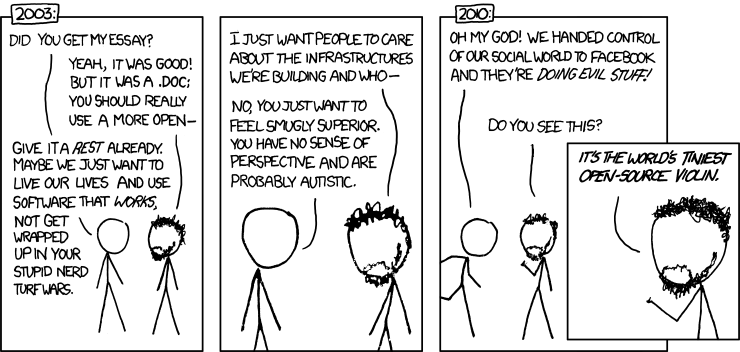
I worry a lot about my tone here.  As I recently found out when reading a book on obesity, it's sadly easy to dismiss those presenting information and ideas about something as, "Oh, they're one of those type of people.  That explains why they would say that."  It would be so easy to end up being that "smugly superior" guy who'll criticize folk for having different views on technology or not knowing as much as he does about computers.  As the comic below illustrates thouygh, sooner or later we'll be uncomfortable with how the technology we use works, and if unless we develop the appropriate infrastructure we'll be unable to change it.

Thursday, May 9, 2013

Our Data is Who We Are

 The physical is becoming less and less important in the modern world.  Sure, there will always be a need for physical mediums (after all "There is no such thing as immaterial matter. All spirit is matter"), but information is what reigns supreme in importance.  This has always been true, in many ways.  As Carl Sagan said, "The beauty of a living thing is not the atoms that go into it, it's the way those atoms are put together."  In another way, humanity has been marching toward this for ages; Since the invention of writing a stone could be transformed into the law of the land or God, a history of a people, or an agreement between two parties.  The invention and standardization of money intensified this.

The idiom that you can find out a lot about a person by going through their trash may still be true, but it's been found that with a handful of data readily made available people can know exactly who we are (in this study 4 locational data points were enough to identify 95% of participants).  While it's (probably) true that you wouldn't be you without your physical body, too often we forget that we wouldn't be who we are without our memories, habits, and interpersonal connections-all of which computers are increasingly involved in and therefore archiving.

As a Verizon wireless customer I was devastated to see this report from the Electronic Frontier Foundation surveying different companies and what measures they were taking to protect users' privacy.  I've known for a while that Verizon was kind of a scumbag company, managing to continue living only because they've acquired a great deal of infrastructure.  When (also scumbag, when it comes to users' data) companies like Comcast and Facebook (I'm not including Google even though many might have worries about the amount of data they collect because they did manage to collect 5 out of 6 stars in this survey, and I genuinely appreciate the company) as well as the two lower end Apple and AT&T still manage to find some way in which they can protect users' data rights are still beating out my carrier, I worry.

I'm seriously considering leaving Verizon, and would probably side with Sprint.  The financial, coverage, and overall convenience implications makes me hesitate, but I really feel like making sure a company that isn't making any effort to protect my digital self shouldn't be supported by my money.  I'd love to leave Comcast for the same reason, and may look into campaigning within my complex to get a different service provider.  The power a service provider has in my life is unnerving, considering how important my data is to me.  After all, in a very real way the data about me is who I am.

Thursday, November 8, 2012

Happy Friday!

I hear this exclamation every now and again, and it must be getting popular enough to have reached the public mind in general, because I just heard it on an advertisement for an internet talk show.  While I enjoy finally hitting the weekend like so many others, I'm not fond of the phrase.  Is Friday now a weekly holiday?  If so, what are we celebrating?  The answer to the second question unnerves me.

The specialized celebratory greeting definitely shows us that Friday's become some sort of weekly holiday. Holidays are nice and I think we should take whatever opportunities to celebrate that we have so that doesn't have to be a bad thing.  The question is what we're celebrating, and unfortunately the answer is straightforward.  We're happy collectively to see the end of the work week.  The fact that we're happy enough in our collective consciousness to hallow (the word holiday is derived from holy day) our escape from working each week reveals how deeply we must hate our work, and that's a much deeper problem.

Why do we hate work so much that we rejoice the way we do over the weekly liberation from it? What makes our work so unrewarding that we rejoice in such a way once it's over?  Many people today argue that that's the nature of work, that if we enjoyed something it would be play.  Mark Twain posits the idea that, "Work consists of whatever a body is OBLIGED to do, and that Play consists of whatever a body is not obliged to do."  This holds some truth, but I also feel there's something crucially missing.  We go to our jobs and trudge through the days so that they'll give us the money to pay our bills.  Sadly, this seems to be the way the world is, but it doesn't have to be so.

As discussed a little here and in Jane McGonigal's fine work Reality is Broken the world (or the US at least) is facing a (really weird) crisis.  It's a crisis of engagement.  Our entertainment has so far outstripped education, possibly face to face social interaction, and definitely work that we're having trouble caring about these things and being happy when we're involved in them anymore.  It pales that poorly to the things that entertain us.

Think about how sad it is that for so many people taking care of a virtual farm (Farmville) is more interesting and engaging than what they do normally in life.  Farming is at least traditionally viewed as a venture quintessentially representative of working hard just to subsist, and yet with the tools available to modern game designers and some imagination it's become a lot more exciting and fun that we'd rather do that than listen to a lecture in school or (for one working in retail, let's say) help someone find something in a store.

I've often worked retail, so let me use that as an example.  One of the problems is how easily we feel unrecognized in work these days.  Perhaps confounding the problem further is the "trophies for breathing" culture that's also creeping in, but it is pretty easy to feel unappreciated since the people we help we only interact with for a few minutes and our bosses are just there to tell us what we're supposed to do next.  A simple initiative a company could do to offset this for retail employees is a simple incentive system of giving employees points when they do things to further company goals (upselling, excellent customer service, efficient work during high traffic periods, etc.).  Ideally, these points would eventually be redeemable for monetary or otherwise physical rewards, but just having a consistent recognition I feel would improve the workplace.  Employees would be rewarded for sticking with a company and working hard toward company goals by having a "lifetime score" with the company that would constantly increase.

Though this seems like it would be a momentous burden on management (and, indeed, takes a degree of skill to pay close enough attention to reward points often enough, without giving away points just for breathing and making them meaningful, but also not being too stingy and creating dynamics of teacher's pet/boss's friend through the point system), it could also be a great way to simply frame managerial goals.  We're trying to increase net sales, double points for upselling this week!  The most important thing at widgets and such is customer service, examples of excellent customer service always receive at least ten points!  We know this is a stressful job, so working through the lunch rush of the day earns you 5 points!  Think of the last three phrases without the point framework in place.  You might have even heard similar things from management, but do they ring less hollow when there's a concrete form of recognition attached?

The weekend will always be nice, and we'll probably always be glad to do something else than our job for a day or two (though even this is debatable, ask the enthusiast/addict to whichever Facebook game/Online MMORPG if they've ever tweaked just a little on a vacation because they weren't "harvesting their crops" or "missing out on XP"), but it doesn't have to be a glorious liberation from the nigh on slavery of our weekly work.  We can engage people in the things they do every day if we only choose to believe that all work is worthy of engagement and make an effort to make it involving instead of just hoping that money we pay will keep our employees there.

Despite all I've said, I like the idea of a weekly holiday.  After all that's the idea of the Sabbath, and I find a great deal of worth in that.  I've even heard that, perhaps similarly to "Happy Friday" it was common among the ancient Jews to greet each other with "Shalom Sabbat" (Peaceful Sabbath).  The difference I see is that the Sabbath is deliberate and a focused effort.  It's a day we take and set apart to focus on holy things and to rest from what wearies us in the world.  It's devoting ourselves to something, rather than a reflection of the fact that we've become woefully not devoted to what we do everyday.  The holy is something that I would like us to celebrate on a weekly basis, our lack of interest in much of our day to day lives is not.

Friday, October 26, 2012

A Stab at Tech Journalism: Microsoft Surface Pricing

The price of Microsoft's new Surface tablet was recently revealed (or leaked, I'm not sure how official it was) to be $499, and the device was released today.  That's $499 without the highly touted keyboard cover and the smallest amount of storage. I'm not going to say this is a bad price point, the Surface has many features which the iPad doesn't come near to offering (like USB ports) at about the same price.  The problem for Microsoft, though, is that this may not fit the reason why people buy tablets.

Buying a tablet or a new smartphone is buying into an entire ecosystem.  Apple's "there's an app for that" marketing campaign demonstrates that people care what a device can do. Not necessarily what it's capable-hardware wise especially-of doing, but what they're setup and already ready to do. There might be many in the Linux community that enjoy writing their own software, but when it comes to consumer electronics they're a minority.  A new tablet or smartphone needs to be competitive in the app market. Google was playing catch up with android but managed to rapidly increase their available apps by creating an open market.

"But surely Microsoft doesn't have that problem, there's years worth of windows programs, right?" some of you may be saying. The answer is, wrong.  At least not on this Surface.  The other one does. The five hundred dollar Surface is the one running windows RT, which only runs the "modern" (I really wish Microsoft had showed some spine and stood by the metro moniker) style apps. These apps are full screen, launched from a grid, and ultimately not that different from the way every other tablet and smartphone operating system works.  And there's isn't that many of them.  The Surface RT includes Office 2013 when you buy it. If your an office fanatic this could sell the Surface, but I don't think that's what people are using tablets for.

Tablets aren't for productivity, they're generally recreational. Maybe Microsoft is tapping into the market in a new way, but if they're not they're selling a product for the same price with a weaker app selection.  How will windows RT do for running movies from amazon? Netflix? Youtube? Hulu? How well will windows work to play music from your favorite service? If the answer to any of these isn't as well or better than their competitors it's a tick against Microsoft and the Surface.

The other Surface, the Surface Pro, will be better as it'll be running a full fledged version of windows 8.  But this confusion is what could be truly deadly for Microsoft.  An average consumer walks into buy their Surface, figures they'll get the cheapest one because they're just using if for fun, and then is locked in with a device that doesn't run windows like they're used to.  They'll be aggravated and angry. They'll say, "Why's it called windows if it's not really windows!?"  And then if they can't find "an app for that" thing they want to do it'll further strain their patience with their brand new Surface.  They probably won't be happy if they go back to Microsoft store saying their new Surface can't do what they thought it could and an associate replies with, "Oh to do that you need the Surface Pro."

The only thing I can tell for sure is that Microsoft is taking a gamble with the Surface.  It might work out great, creating a really mobile, tablet style device that also works great for productivity and business applications.  The Surface might just end up being your real "all in one" device.  The other distinct possibility, though, is that the Surface ends up angering consumers.  With Microsoft behind in the mobile market and facing stiff competition from Apple and Google in winning the hearts and minds of future users things could be very bad if this gamble doesn't pay off.

Monday, September 3, 2012

The Rise of Video Games: Sci-Fi

I just watched a trailer for a new game coming out called Remember Me.  I see people describing it as Total Recall in a Blade Runner setting.  It looks like a great piece of science fiction: computers becoming part of who we are as humans making our memories open to manipulation, changing what we do and who we are through one electronic attack.  I have a feeling I'm really going to like it.

Last post I bemoaned the loss of good, let alone great, science fiction on TV.  It's sad to see it go, and I still hope eventually we'll turn away from our love of watching the "reality" TV dregs of entertainment and return to having something on TV that seeks to challenge and explore our existence and future, but until we do when I really want to experience that I'll have to turn to video games.

Currently I've been playing Mass Effect 3, the latest in one of my favorite series and what I'd argue may be one of the best pieces of science fiction ever written.  In my humble opinion Mass Effect can easily go toe to toe with Star Trek, Star Wars, or any of the other greats of science fiction.  It's a classic space opera with aliens, intergalactic politics and adventure, and spaceships.  It's got some fascinating science to go with the fiction, the title of the series referring to localized physical phenomenon that changes the effective mass of objects in a certain area.  It's probably the only work I've seen that mentions that lasers as a weapon could work, but will be limited to short ranges due to diffraction.

Mass Effect also carries the proud tradition of solid writing and well done characters set forth by developers Bioware.  There's an alien from a proud warrior species who's gruff and cynical like one of those proud warrior race dudes might be, but wistfully lament's his species inability to come together and rebuild themselves after being struck with a biological weapon that's reduced them to near sterility.  There's a professional, very physically attractive woman whose appearance might seem pandering to a male audience at first, but I feel reinforces the later revelations of her difficulty accepting herself as an independent human being more than her father's genetic experiment in creating the perfect offspring to carry on the family name.  There's an artificial intelligence seeking that if you prod in the right direction will fall in love with your ship's pilot.  And these are just the outstanding instances, the game is full of great stories.  You get to take part in writing some of them yourself if you play it.

I've also quite the fondness for the series Deus Ex.  Deus Ex may be the quintessential exploration of what it means when we finally begin to merge ourselves with machines.  The title itself is almost certainly a play on the phrase "deus ex machina" or "god from the machine" and likely refers to the apotheosis of humanity through human augmentation.  It plays on what it will mean for mankind when electronic surveillance becomes a part of everyday existence and communication, what will happen when physical ability can be bought and sold, and every moment of gameplay makes you wonder what we'll be able to do when our eyesight can be enhanced with a computer chip or our strength with a set of servos.  It's a game that makes one wonder deeply about the future of humanity as we hurtle toward technologies drastically changing who we are and how we interact.

Thoughts such as this are what make science fiction is a wonderful and important genre.  While it may be too expensive to hire the writers and special effects team necessary on a TV show now, video games make the perfect stage.  The games already computer generated, and so special effects are mostly just paying artists for the ideas.  Writing in video games is still an art that few can do well, but the industry is constantly learning and we've clearly already made some gems.  There's not much I like on TV these days, but there's some great things to play on the game console.

Sunday, September 2, 2012

The Fall of Television Science Fiction

I just watched an episode of Star Trek (Next Generation to be specific-¡Picard rules!) and afterwards thought about playing some more Mass Effect 3.  I actually turned off the TV and did some reading, but my mind got caught up considering the state of sci-fi these days.

I think most any fan of the genre will happily, or I suppose more like disgruntled-ly, tell you there really isn't any good sci-fi on TV anymore.  Personally I think this ended with the show Firefly, and maybe that's why it holds such a fond place in my heart-it was practically television science fiction's dying breath.  Don't get me wrong, there's been a good one or two in the last while. I liked Sarah Conner Chronicles, and Dollhouse.  I might debate whether or not Lost counts as sci-fi, but that doesn't mean it wasn't quite enjoyable.  I hear lots of praise for Fringe, though I lost interest somewhere about halfway through the second season.

Television science fiction isn't going away, for sure, but I remember the days of Star Trek, Babylon 5, Farscape, Stargate, and Sliders.  I lived in a time where I could watch something that truly imagined something outside normal human experience and embraced that concept to explore.  You have to dig for that on TV nowadays.  Of course, you have to dig for anything of remote worth these days.

I recently heard that when TV was first invented people thought it would change the world for the betterment of humanity.  TV may have been a major part of winning the cold war.  It changed the way people communicated, allowing a story to reach millions from all around the world.  People thought that this power could be harnessed to spread messages of thoughtfulness, enlightenment, and truth to better humanity.  Such a grand vision is now swallowed up in banality as we're treated to a parade of vapid celebrity voyeurism and bad parenting, lack of life skill, or legitimate mental illness freak shows.

TV may be no more than a plethora of pathetic pandering to the "lowest common denominator," but there's still great science fiction out there in literature (I listen to a weekly sci-fi short story podcast that's wonderful) and also in one of our emerging art forms, the video game.  I'm getting a little long on this post already, so I think I'll make this a two parter and express my love for video game science fiction separately later. So, ¡Tune in again for the exciting conclusion!