In college I built my own computer. It was a great experience, and I still use that computer 7 years later when writing this. Saying you built your own computer tends to earn a lot of tech savvy points with the average person, but it's really not that hard. A lot's changed since the days of Wozniak's home brew club & the Altair, and these days you can by the parts and put them together without much more difficulty than assembling a piece of Ikea furniture. If you need an upgrade later, you can open your case up & snap a piece in.
This ease is based in no small part on the standardization of the ATX & PCI standards, a set of guidelines for how hardware should be made in such a way as to be compatible with other devices. One thing that's impressed and worried me lately is the dearth of such a standard for cell phones, and the perhaps anemic attempts to create one. It's an unfortunate marker of the way technology has gone from a scientific industry with the goal of empowering individuals and humankind to a consumer industry chasing fashion and trendiness, but I'm getting ahead of myself.
People are talking a lot these days about a little thing a little, 3.5 millimeter thing. Apple decided not to include a headphone jack on their phones, Google is following suit with their latest Pixel, and the creator of the android OS also axed the jack with the Essential Phone. The last one really bugs me, because empowering the tech consumer with more choices is one of the reasons why essential was founded, and yet the most ubiquitous, easy to use, and powerful interface options was deemed unnecessary.
OK, when I started this blog I wanted to stick to bigger issues, things that effect society or even humanity. Why am I letting myself get distracted by the minutia of what's popular in cell phones these days? Well, it's because this is a symptom of a larger, much more insidious cultural disease. Wow, OK that could be overselling it, but as I've mentioned before the choice to go with something stylish or convenient instead of something which creates an empowering infrastructure is perilous.
The Essential phone has some special connectors for accessories. Motorola is making phones with attachable accessories as well, but they go the extra mile of providing a developer kit for independent companies that want to produce these. The highest level of this was the now tragically defunct Project Ara which planned to produce an entirely modular smartphone. It also had the distinction of being the only project I know of that would have released a standard that could be used by any company to produce appropriate components. If the essential accessories or moto mods take off, any other manufacturer that wants to let customers use these will have to license the specifications from essential or Motorola, and that means they probably won't proliferate anytime soon.
And thus we, the consumer, have to be content taking whatever the phone companies decide to give us. Oh, we can shop around a little for more memory here or a better camera there, but the reality is we can't really choose what we want in our phones, or how they work. A handful of tech giants makes those decisions for us. And that's not only true for phones. that's true for social networks, gaming platforms, and more. What's the more? Well, perhaps news organizations, political parties, and advertisements. This is where the insidious cultural disease part comes up. Most people have their phone on them for most of the day in 2017. We can't act like decisions about how that works being made by some team of marketers and engineers rather than individuals is OK and won't siphon away independence and freedom from the individual.
Showing posts with label tech. Show all posts
Showing posts with label tech. Show all posts
Thursday, November 2, 2017

Saturday, October 24, 2015
Trick or Treating: The Last Bastion of Neighborhood Community?
People don't know their neighbors any more. Our interactions are more and more impersonal, mediated by computers. We have fewer and fewer real communities to engage in. They're being replaced by forums and social networking groups. These things aren't as bad as people often make them out to be, but they do present problems. We're cut off from genuine interaction. It's being replaced with a type of self promotion, making it harder and harder to 'be ourselves' and be accepted for who we are. We're exposed to less diversity because we don't spend time with those whose ideas and opinions differ from us. Churches, neighborhood barbecues, and kids playing in the street used to serve these purposes. Most people don't go to church these days, I can't remember the last time I heard about a neighborhood barbecue, and we setup play dates for the kids nowadays. There's one area that still hearkens back to the days of the local community, though.
Trick or treating is a wonderful Halloween tradition that builds a neighborhood. Once a year parents and kids walk around, say hi to their neighbors, show off costumes, and share sweets. What a classic community building activity that is! Families can talk afterward about how cute the kid down the street looked dressed up like a princess, or which families in town gave out the best candy. Finally, a time when a family can discuss their neighbors and how much they enjoyed spending some time with them!
This is an important lesson for our children, too. 364 days a year we tell our kids about 'stranger danger,' but on Halloween they're finally encouraged to meet new people. They're rewarded with candy, given to them in return for wearing an amusing costume and displaying it for thirty seconds at the neighbor's door. This activity will teach them that they don't have to be suspicious and scared of every person they share the world with. They might even learn that many people are kind human beings.
Even this noble tradition is dying out, though. We're learning how to make imitation trick or treating that, like imitation food, is a pale shadow of the real thing that carries little of the original value. Church groups do 'trunk or treats' to make sure families can collect candy with kids while remaining insulated from their neighbors and any community they don't approve of. Trick or treating routes are less and less up and down the street you live on and instead are becoming visits to homes of family friends. Some people in a sickening twisting of the tradition in pursuit of efficiency and increasing returns worthy of a heartless corporation go up into the wealthy areas of town, spurning their own neighbors, because 'they give better candy.'
Let's not become that people. Let's continue to love our neighbors and even learn to enjoy their company. Let's teach our kids to build a community and meet those they share the world with. Let's go trick or treating around our neighborhood this Halloween.
Monday, June 1, 2015
Are We Ready for Post Scarcity? Part 2
It's easy to romanticize scarcity when looking to address the problems that arise as it fades from the eyes of humankind. Recent bouts in popular culture of "paleo-nostalgia" show us just how absurd our longing for "the good old days" can get. But the good old days were never as good as we pretend they were. The fifties had Jim Crow laws. Pre-industrial society was awash in the filth of both the horses that pulled carriages and the humans that rode in them. Why I should have to point out the scourges of humanity in medieval, bronze age, or stone age days is beyond me, but I'll mention crusades and inquisitions, the slavery that built the pyramids, and war among rival tribes of cave men just to be safe.
I bring this up because it's important to note that I'm not advocating we avoid creating a post scarcity world. Precisely the opposite, I want to acknowledge that we're in the middle of doing so, and embrace the change. To do that though, we need to be wary and accepting of the consequences. Some of those may be unimaginable and have to be addressed as they come. Others are more predictable, especially when we consider history.
I mentioned the abundance of food in part one. Now consider farming, the production of that food. Farming is remarkably different in the modern world, and it's so efficient that we can produce so much food that our primary concerns don't regard abundance. We take abundance of food for granted, instead seeking better quality and solutions for what to do with the excess. This has come at a price, though.
The great depression featured, "Farming communities and rural areas suffer[ing] as crop prices fell by approximately 60%." (wikipedia, citing three other sources) The abundance and efficiency of farming is so staggering that only through heavy subsidies is agriculture profitable today. These subsidies are so severe that Lawrence Lessig in his book Republic, Lost titles his chapter on government farming subsidies, "Why don't we have free markets?" We recoil at the realization that government is deciding what food gets grown, and yet this might be important and beneficial to society, since we all like to eat. Surely subsidizing agriculture is better than milk being spilled into gutters while thousands only a few hundred miles away starved, a characteristic image of the depression?
Food is one thing, it's physical and tangible. We're all familiar with it and easily understand what it means. Information is quite another, yet it's the next thing whose scarcity is being obliterated. Personal computing and the internet have done a pretty good job already, once again changing the problems from availability to find-ability of information of high enough quality and relevance.
What have humans done with this? We haven't become a society of well read polyglots that understand the conflicts between relativity and quantum mechanics as we might hope. We're very well entertained, though. Entertainment is just a form of information, after all. A textbook has roughly the same form as a storybook. With Netflix, Hulu, & Youtube, for videos alone we can spend our entire day being entertained for probably not quite $100 a month.
This doesn't (necessarily) mean we're stupid or shallow, though. Many of the most popular shows are sharply written character and political dramas like House of Cards, Mad Men, Breaking Bad, and Game of Thrones. The recent revival of Carl Sagan's Cosmos series did well. It could be argued more people are writing than ever before thanks to blogging sites like what you're reading now and maybe even social media.
OK, I'll admit I might not be buying the idea that the lack of scarcity in entertainment is improving us as a people either, but on the other hand I'm not going to dismiss it outright. A stronger example might be video games. The juggernaut game Minecraft is almost exclusively a creative tool rather than a traditional game. Gaming has a strong community of "modding," or learning some basic (or in some cases extremely complex) programming tools used in a game to create a variant of that game. These variants span anything between the original game with a failure message changed from, "You died." to "Thanks, Obama!" to entirely new games built on the same graphics and gameplay engine.
In both food and entertainment we do see demand for quality now that availability is so high. People grow from just being happy to have something to eat to wanting something that is organic, gluten-free, or maybe even something actually important. People start paying attention to what their food is over whether or not it's there. Likewise in entertainment we are demanding quality more and more. We are seeking entertainment that we can, as Kevin Spacey says, "engage with...with a passion and an intimacy that a blockbuster movie could only dream of."
Bertrand Russell writes in his essay In Praise of Idleness about the odd disconnect that exists between our valuation of production and consumption. While we admire productivity we don't highly value consumption. Those who earn money have prestige, but not those eager to spend it. He points out the oddity of this, particularly when we only earn money is by others' spending of it. "We think too much of production, and too little of consumption. One result is that we attach too little importance to enjoyment and simple happiness, and that we do not judge production by the pleasure that it gives to the consumer."
Russell also alludes to the caste and class scaffolds that these attitudes seem to stem from. He even goes so far to argue that the traditional work ethic arose largely as a tool of slave-owners and autocrats to keep their populations content with their tyrannical rule. If this is starting to sound like Marxist thinking to you then you're actually very clever. A serious point of departure I must take to this essay is his praise given to the (only ten years old at the time of writing) Russian revolution and newly formed USSR.
We all know how that experiment turned out, so how can I possibly be suggesting that going at it again is a going to be a good thing? The short answer is that I'm not. I am arguing that an economy with abundance for humanity requiring very little input of labor from humanity is on the horizon, or even just finishing its arrival and is starting to settle in. One of my great concerns is the way this could create a dictatorship masquerading as efforts to provide equally for all men like existed in communist Russia. I'll delve into this a little more in part 3.
Wednesday, March 25, 2015
Are We Ready for Post Scarcity? Part 1
The abundance of the modern day is staggering. Food alone is now requiring few man hours and producing vast amounts of product. In about 25 years the personal computer has gone from a relatively cutting edge office device to a ubiquitous handheld one. The amazing advances in technology will only cascade into more, and these will bring amazing blessings, conveniences, and boons to humankind. These are gifts we should be prepared to freely receive, but like a gift of chocolate that will make us sick if eaten to quickly or heavy book that will require much reading and concentration we need to be receive these with caution and adroitness.
Let's go back to food. One of the interesting points of contention between my brothers, me, and our grandmother is our approach and mentalities surrounding food. Our grandma, growing up in a family that suffered through and being born shortly after the great depression, views food as a precious and scarce resource. She often views food in terms of availability, enjoying buffets and inexpensive diners and being anxious over throwing away uneaten scraps or spoiling produce. My brothers, and even my parents, live in the modern age and see food as abundant. We don't like to waste food, but recognize that when the bread gets moldy it should be thrown out because it only costs a dollar or two (ten minutes of work at minimum wage) to get another loaf. We live devoid of the "clean your plate" ethic so common in past generations.
Thank heavens for that too, as obesity and overeating are a greater health risk to us than malnutrition (though I am skeptical of the magnitude of this risk). It's actually odd to think about health risks arising because nourishment is so easy to obtain. Taking anatomy and physiology I've learned hundreds of ways in which a deficiency of calcium, iodine, glucose, iron, or any other number of dietary intakes cause problems. It's bizarre to think of problems coming about simply because we have so much of those things we need and love that we run out places to put it and spend so much time and energy to keeping it all together.
Food is only the beginning of this, though. Technology is more and more in in the reach of anyone who'd like it. Entertainment and education is more available than ever with the internet. And these are just the commodities being made abundant with modern technology. Go even slightly futuristic and we have productive capabilities exploding via robotics, precious metals or gems having their scarcity destroyed by advanced chemical and materials engineering techniques, and even thought or creativity flooding the market in ways never before seen thanks to better distribution systems, or even AI and other futuristic computing creating new art.
The challenges presented by this can be staggering though. The central one is likely motivation. Survival and status have been the principle motivators of a person in the past. That might have meant being the mightiest hunter in the tribe that's always well fed or the most influential business magnate on wall street who always had some opportunity waiting, but the principles been the same. Many of us have said something like, "I really don't want to go to work today but they won't pay me if I don't so I guess I had better," and we've probably even said that with some frequency. If we reach post scarcity we theoretically won't ever need to get paid, so what will keep us getting out of bed in the morning and off the streets? I'll be investigating this and other ideas of a post-scarcity society and economy in part 2.
Saturday, February 28, 2015
Technology, cheating, and the Augmented Mind
As a student I've been taking plenty of tests lately. My university has a pretty good testing system and convenient testing centers and I'm a pretty good test taker so none of this really bothers me, but I have found the testing center policies interesting. The fact that I have to remove my hat before going in is one. Recently they've also disallowed the wearing of a wristwatch, almost certainly in response to the new smart-watch technology coming out. While this is the right thing to do, it does indicate a need for much grander changes in both the way we do things as well as our thinking, probably especially in education. Changes we are woefully unprepared for.
Let's consider the testing center again, perhaps as if you were the director of these. We made the change for smart-watches so that they won't be used for cheating. What will we do if Google Glass, or a similar project where data is displayed on a pair of glasses worn by the user, takes off and starts showing up? If that technology becomes integrated into people's prescription lenses? What about if those smart watches become smart tattoos? What about when students start having direct neural interfaces integrating computers into the brain? These problems are coming, and I think we can quickly see there's no easy solution, and maybe no solution at all to make a our current testing systems compatible with the existence of these technologies.
As my neuroscience teacher put it, most testing today is a simple demonstration of declarative memory. This is to say tests usually require a simple recalling of facts, figures, or other basic knowledge. However, the need for this to be done in the human brain is dwindling. Facts can be more easily stored, more quickly recalled, and more reliably maintained in computer systems than in nervous tissue. Why would we keep using cerebral circuits (that weren't really designed to do this in the first place) when we can use electronic ones? The go to example is memorizing phone numbers, something many of us remember doing before technology made it an exercise in pointless exertion of energy.
Lest you think this is the pie in the sky omphaloskepsis of a futurist and science fiction fan, let me relay a story I heard from one parent. He wanted to have his daughter writing letters, and specifically to do so using some specific vocabulary. Shortly after he heard his daughter speaking out loud while alone in her room writing the letter. Listening closer he realized she was using the voice recognition feature of the tablet/smartphone to simply ask for the spelling of the appropriate words. This was much to his disappointment, as he was expecting her to look the words up when writing them and learn the definition along with the spelling. That's how big a change something as simple as voice recognition is making.
A future where traditional testing is pointless seems on the horizon. How education will or even can deal with this is unclear. The problem with leaving our traditional testing is that other methods require more work to evaluate, and usually are less objective which can be a big problem for admissions tests like the MCAT. The only solution I've thought of is an increase in internships and apprentice work, but whether or not this is feasible is unclear. I know the major reason the radiology or medical laboratory programs at my school can't admit more than about 40% of applicant students is because they only have so many slots for clinical rotations available. It could be damaging to the economy to have the influx of cheap or free labor that having five interns or apprentices to every one trained employee might mean. The problem is a big one, and sadly I haven't seen it given all that much attention. Let's hope for and work toward that changing sometime soon.
Friday, November 22, 2013
Sadly, the porn must flow Part 3: Regulatory and Governmental Concerns
I've now addressed concerns with a mandatory pornography filtering system based on conceptual considerations on the nature of pornography and technical ones about how the system might work. Now I will focus on a critique of the plan based on the governmental and regulatory considerations, as stated in the title. A main point in my last part could be summed up as, "Don't trust your ISP to keep you safe, you're better off ensuring that on your own." If we replace ISP with government that same idea will be found here.
America has a unique approach to government in that a fundamental value we hold is liberty, and are sensitive to the power of government to curtail this among individuals or groups. The conflict between this and the need for law forms a basis to our society. Whether pornographic filtering should be mandatory is another manifestation for this conflict, and I will be falling on the side of liberty as opposed to security.
The concept of safety curtailing our liberties is one hotly contested in the media with the government's efforts in the last ten years to crack down on and protect against terrorism. This even has a more direct parallel in the field of communications with recent Snowden leaks on NSA data and metadata collection efforts that, in my own personal opinion and that of at least one court of law, violates American citizens' rights granted by the first (including and perhaps primarily the right of association) and fourth amendments. With these already in peril, why would we want to introduce a new government mandate and increase their ability to curtail citizens' rights online?
Yes, yes, I know, "No one's rights are being curtailed, anyone can still opt in and get the content they want." In the short view this may be true, though many of the points in my previous two essays on the subject should demonstrate ways it may also not be. Though I'd rather not delve too deeply into the 'slippery slope' argument as it necessarily relies on speculation and unverifiable prediction, it would be prudent to mention that any law or regulation would set a precedent that our personal communication methods are something the government has every right to manage.
The proposal would grant new regulatory powers over our methods of communication. It would be handed off to either ISPs or/and government committees and reduce choice for the individual. While it's only a default setting that would change right now, the shame often involved in the complex issue of obscenity could easily cause this to be the societal norm, and forcing those who either held liberal views about sexuality or possibly a desire to protect their privacy and security online to be forced into an 'internet ghetto.' Eventually these people might be lumped in with criminals and subject to greater invasion of their rights because they 'chose to use the internet in a manner recognized to reflect dangerous and deviant behavior.'
Let me explain by way of analogy. How would you feel if car dealerships were now required to sell cars that would automatically avoid driving you anywhere where obscene or illegal activities were known to occur? They would naturally have to standardize and define what obscene behavior was, and so a federal committee would now decide what parts of town you were allowed to drive to. If you wanted to have full control over where you could go in the car you bought you would need to ask the dealer, and maybe they would have a special license plate for your car so that everyone else wouldn't accidentally follow you or wonder why they were having trouble getting to a place that you went to without problems. Does that sound OK to you, or does it seem like a massive intrusion of government control in your life?
The internet is indeed a radically new method of communication. Earlier methods often fell naturally into a pattern of self-regulation when it came to pornography. Movies created a rating system, magazines went under the counter, TV shows had a set of standards to follow until after the watershed. Phone lines were pretty much just as available to youngsters as much as anyone else but you needed to know what number to call and the commercials didn't go on until after the watershed, so their exposure wasn't really significant and in any event parents would get the bill later. The internet, on the other hand, is hugely interconnected and once you're online you have access to most resources with nothing more than a name, or if you're not sure of that a search term will probably work just as well. The industry doesn't lend itself well to self regulationas it is a personal service, the connection is to your home, connected to a vast public network.
It does lend itself easily to personal regulation, though. In my last post I mentioned a few good and fairly easy solutions to filter pornography. I explained my feelings that those who were unwilling to gain the technical skills to implement these shouldn't be foisting their responsibility to protect themselves on the country at large as well, but there's another aspect to this naivete I'd like to address: that pornography is a problem that technology or regulation can only slow, not stop. It plays to the most basic human drives and desires. This is what makes it so tempting, and destructive.
The way to fight pornography is to teach the right values, habits, and behaviors. I admit the prevalence of pornography can make this difficult, but teaching our children and selves the truth of what pornography is is the most effective way to fight it. We shouldn't pretend that we can shut off any exposure to it, and instead prepare ourselves and develop the mental and spiritual discipline to be strong against it when we do. This may include a personal decision to install some sort of filter on our own networks. Others might not even see a need for this.
Maturity comes with responsibility, taking on accountability for the way we live and the decisions we make. I see this petition as immature, trying to abdicate the responsibility for avoiding pornography by passing it along to organizations believed to be more capable of doing so. We must take this responsibility upon ourselves though, immense as it may seem, because immaturity and liberty cannot coexist. The more we decide that something is too hard for us and should be handled by the government, the greater the state will become as the citizen becomes smaller and smaller.
Thursday, November 21, 2013
Sadly, the porn must flow 2 : Technical Considerations
So I've gone over the conceptual problems with a government mandated ISP based pornography filtering system and given an overview of how these systems might work. One of the problems with this kind of legislation, however, is that there are numerous technical considerations. Much like the recent SOPA bill, a pornography filtering requirement could possibly work out to be a government mandate to restructure how the internet works in the service of a specific special interest.
On the surface this seems like an overreaction, porn filters already exist so how difficult would it be for these to be implemented broadly by ISPs rather than requiring users to implement them personally. It's not, though, as scalability isn't simple. There's a reason why programs have run locally on personal machines for years but only now can be served out from a remote location to hundreds of thousands of users. There's a reason enterprise servers are different from personal computers.
Still, though, it's certainly doable. It would take a lot of work, though, and skilled programmers, network engineers, and system administrators don't work for free. That means forcing this to happen at the ISP level will be expensive. A government mandate means everyone's prices will go up. Think about if a similar resolution were to be passed for gasoline, electricity, or food. People would rightfully be incensed that either they're being forced to pay more for a service they don't want or are already using from a provider they trust and have established a good relationship.
Also, people don't often think about what their ISP is doing with their internet traffic. Usually that's because it's assumed that they shouldn't be doing anything with it apart from passing it on to the intended recipient. That's not the case, though. Your ISP is watching you, much like Google, Facebook, or other online advertising companies are and like these they plan to sell information about your habits to interested parties for some extra cash. They're also watching you as a favor to their friends in the entertainment industries to make sure that you don't "copy or share a movie, television show, or song improperly." The more I find out about the ISP industry, the less I trust them.
Knowing this we're likely to see two things happen should any sort of legislation pass from this petition: First, pornography filtering will be put in place, but thanks to a grant from the pornography industry to ISPs will make this laughably easy to circumvent. There could possibly be a sort of 'protection money' situation where ISPs block the pornography sites that don't pay up to be on their list of sites that aren't too 'extreme or hardcore.' Second, the system will be implemented with little thought to protecting those that want to avoid pornography, but as a great excuse to further other goals for the ISP.
I mentioned encrypted traffic in my last post and how this can create a problem for porn filtering systems. My feelings about ISPs give me every reason to believe that they would be happy to use porn filtering mandates to try to subvert users' efforts that are trying to remain anonymous and gain a modicum of privacy while online (such as when using a VPN service like ProXPN to hide traffic from the ISP, or connecting to a Tor node to remain anonymous). This way they could continue collecting information about you and your habits to sell to advertisers or make sure you fall in line with the entertainment industry's demands. They'd also have the power to brand anyone trying to get around these restrictions on the service they're paying for with a 'scarlet P' by saying that they had opted in to the internet with pornographic access plan.
Going back to the phrase from the petition, "Parents and individuals have to go to great lengths to install Internet filters that often don't weed out all porn," I'm not really certain what these 'great lengths' are. Installing a free program like K9 web protection on your computer, or an app on your cell phone like this web filter? Admittedly my preferred solution, OpenDNS, is a little technical but even then you don't even need to sign up and they'll still provide straight forward instructions like these on their website. Why do we feel it necessary to have the government partner with our ISPs to do this for us? If staying safe from pornography is important to us shouldn't we be willing to put an iota of effort into doing it in a way we understand and are in control of?
This leads me back to one of my original points: naivete. I recently watched a documentary on prohibition and one thing that was pointed out was that once the prohibition amendment had passed the prohibitionists had thought they'd won the war on alcohol. Anyone with a smattering of US history knows that wasn't the case, and a tacit law saying porn is to be avoided won't make it any less desired or sought after. We'll be handing over a good degree of power over our lives, remember the internet is only becoming more and more important to who we are, in exchange for avoiding something like an hour a week, at most, to install, configure, and maintain a filtering solution that fits our personal needs.
I'm writing a novel this month for National Novel Writing Month in the tradition of cyberpunk. One characteristic of the cyberpunk genre is that it features technology not as an enabling force that brings about Utopian lives for mankind, but instead becomes a force for control and oppression. There's hints of this in my novel, but one of the themes is also supposed to be that this happens because people give up their rights, their strength, and their power to others because they think it's too hard to develop the technical skills necessary to understand the systems they use. Society has fallen back into being controlled by a few select elite, but this time we chose it because math, programming, physics, engineering, and computing are hard and we'd rather enjoy ourselves while someone else did those complicated things. This petition is a sad reminder that the bleak future I'm writing should be fiction, but might not be someday.
Tuesday, September 3, 2013
Choosing Style & Convenience Over Principles
Consider which of the following philosophies you agree with more:
Our choice in technology tends to be surprisingly shallow when we consider the depth of the effect technology has on us. We decide based on what looks nice, has the coolest features, or sometimes (usually if we're a little more informed) runs well and has the most processing power. For something that is so rapidly changing the way we interact, work, and quite arguably think this seems like pretty arbitrary criteria. Will it cause me to seek large amounts of less intimate relationships more efficiently? Will I ponder issues less in favor of looking up a quick and easy answer from a third party source in the most sleek and stylish way? These are the kind of questions we're asking, when we could be asking ourselves questions like, "Will I be engaging in and contributing to a infrastructure that promotes openness and individual freedom?"
If I may be candid for a moment let me admit my smug tech nerd ways. I used to be a little annoyed, mostly due to the immaturity one has early in life that others know different things than you do, when people didn't know how a computer's file system worked, the difference between a program and a text file, or why they couldn't get on the internet. I'm quickly becoming less annoyed by these people, but that annoyance is being replaced by fear.
I'm afraid because I know that market forces drive technology, and it's terrifying to see the market choose flashy, easy, and restrictive items over empowering items that might make them work a little harder. I'm afraid because working in tech support I've seen just how helpless people are when their technology breaks, how helpless many people are when it comes to fixing their technological problems, and how earnestly industry is working to make sure that problems may come up less at the expense of being fixable without being invited into a company's inner circle to error codes and access controls. I worry about living in a world where a relatively small conglomerate of programmers, advertisers, and businessmen are making sweeping decisions on how people live their lives, and the people are relatively powerless to and even uninterested in changing that.
Many are afraid of the effect technology is having on the human psyche and sociological structures. It's easy to blame the technology for this, but I feel that's misguided. If our minds or societies are becoming corrupted it's not thanks to the internet, smartphones, or video games. It's because we're using these poorly. And why wouldn't we if most of us don't know how they work at all, and only know what they do as the company making it presents that to us?
Studying mathematics and physics where most modern research is done with the aid of computers I'm perhaps blessed to have been taught in a tradition that specifically points out where computers are helpful and where our own intellect should be applied. Questions of what's computable and what isn't are addressed directly, as well as questions of the best way to compute that which we would indeed like to compute.
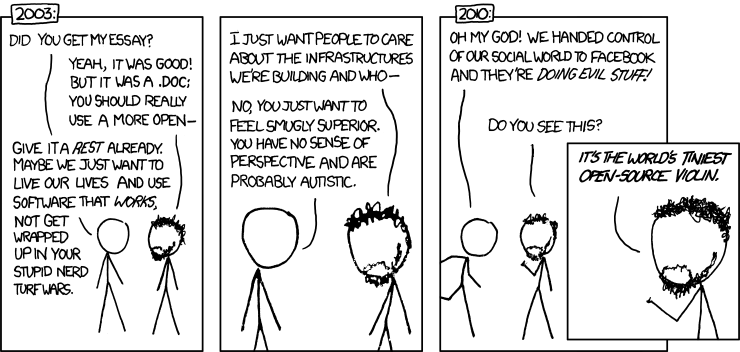
I worry a lot about my tone here. As I recently found out when reading a book on obesity, it's sadly easy to dismiss those presenting information and ideas about something as, "Oh, they're one of those type of people. That explains why they would say that." It would be so easy to end up being that "smugly superior" guy who'll criticize folk for having different views on technology or not knowing as much as he does about computers. As the comic below illustrates thouygh, sooner or later we'll be uncomfortable with how the technology we use works, and if unless we develop the appropriate infrastructure we'll be unable to change it.

A central authority will control every aspect possible.or
As much as possible will be made available in its entirety for public inspection and involvement.With that in mind consider this: are you more willing to use Apple or Linux computers? I know, I know "It just works." "I'm not a 'techie,' and don't want to have to deal with all that complicated stuff" "The way the little book opens is just so cute." I've heard it all before. I recognize that Apple has abstracted more of the functions for the user and produced very powerful, stable, efficient (though you wouldn't know if from their pricing) technology solutions, but you're missing the point. I don't want to talk about Apple per se. I want to talk about the choices we make, especially in technology.
Our choice in technology tends to be surprisingly shallow when we consider the depth of the effect technology has on us. We decide based on what looks nice, has the coolest features, or sometimes (usually if we're a little more informed) runs well and has the most processing power. For something that is so rapidly changing the way we interact, work, and quite arguably think this seems like pretty arbitrary criteria. Will it cause me to seek large amounts of less intimate relationships more efficiently? Will I ponder issues less in favor of looking up a quick and easy answer from a third party source in the most sleek and stylish way? These are the kind of questions we're asking, when we could be asking ourselves questions like, "Will I be engaging in and contributing to a infrastructure that promotes openness and individual freedom?"
If I may be candid for a moment let me admit my smug tech nerd ways. I used to be a little annoyed, mostly due to the immaturity one has early in life that others know different things than you do, when people didn't know how a computer's file system worked, the difference between a program and a text file, or why they couldn't get on the internet. I'm quickly becoming less annoyed by these people, but that annoyance is being replaced by fear.
I'm afraid because I know that market forces drive technology, and it's terrifying to see the market choose flashy, easy, and restrictive items over empowering items that might make them work a little harder. I'm afraid because working in tech support I've seen just how helpless people are when their technology breaks, how helpless many people are when it comes to fixing their technological problems, and how earnestly industry is working to make sure that problems may come up less at the expense of being fixable without being invited into a company's inner circle to error codes and access controls. I worry about living in a world where a relatively small conglomerate of programmers, advertisers, and businessmen are making sweeping decisions on how people live their lives, and the people are relatively powerless to and even uninterested in changing that.
Many are afraid of the effect technology is having on the human psyche and sociological structures. It's easy to blame the technology for this, but I feel that's misguided. If our minds or societies are becoming corrupted it's not thanks to the internet, smartphones, or video games. It's because we're using these poorly. And why wouldn't we if most of us don't know how they work at all, and only know what they do as the company making it presents that to us?
Studying mathematics and physics where most modern research is done with the aid of computers I'm perhaps blessed to have been taught in a tradition that specifically points out where computers are helpful and where our own intellect should be applied. Questions of what's computable and what isn't are addressed directly, as well as questions of the best way to compute that which we would indeed like to compute.
I worry a lot about my tone here. As I recently found out when reading a book on obesity, it's sadly easy to dismiss those presenting information and ideas about something as, "Oh, they're one of those type of people. That explains why they would say that." It would be so easy to end up being that "smugly superior" guy who'll criticize folk for having different views on technology or not knowing as much as he does about computers. As the comic below illustrates thouygh, sooner or later we'll be uncomfortable with how the technology we use works, and if unless we develop the appropriate infrastructure we'll be unable to change it.
Tuesday, June 11, 2013
The Fourth Amendment in the Information Age
In my last post I mused on the nature of data and how the information about us defines who we are. I was spurned to write this and finished off the post presenting disappoint with Verizon, my cell carrier, and their failure to protect users' privacy and respect their charge in holding data about us. Lately Verizon has been in the news for handing over call records to the NSA, so the wound has had salt thrown in it rather than had time to heal, so to speak. In my investigations into jumping ship from a company so cavalier about it's responsibility to protect who I am in the form my data I've had some interesting experiences.
I sent an email to Sprint asking if their company does anything to protect users' data and privacy. Their response was,
Both could of course be true, in fact the latter may be the cause and the former the effect. I find the latter more interesting, though. It's easy to dismiss concern with how a company protects (or more often fails to protect) our information as unfounded worry about "government conspiracies" (in fact, that's exactly who a T-Mobile salesperson ended up characterizing my concern when asking about it at a store location). While the fact that most citizens probably won't be much affected is true and the majority of people (including myself with all my seditious comments coming out on this blog) aren't interesting, influential, or dangerous enough for the government to take the effort to spy on, the issue is far from unimportant for everyone save a few security advocates, legal scholars, and tech enthusiasts.
As I pointed out in my last post we're seeing the importance of the physical diminish. The things that are important to us are increasingly in the form of data accessed in a number of different ways? As these changes in the way we communicate, work, and create emerge so the laws which will govern these new methods of living. And they are being changed.
"The Fourth Amendment (Amendment IV) to the United States Constitution is the part of the Bill of Rights which guards against unreasonable searches and seizures, along with requiring any warrant to be judicially sanctioned and supported by probable cause." This worked well for many years when communication took place between two people in the form of physical letters that they could keep on their property and evidence showed up as physical items that, again, could be held on someone's property. These laws are essentially being re-written as more and more of what's important to us has a digital presence.
The fourth amendment seems to grow out of the presumption of innocence. We aren't to be observed, investigated, or seized until some degree of proof of guilt can be obtained. This is what's being eroded by modern electronic surveillance. It echos the complaints by so many in gaming when considering many invasive digital rights management (DRM) systems, "I'm being treated like a criminal when I haven't done anything wrong. They're just assuming I'm going to steal things."
Privacy and the internet is always, and may always be, a thorny issue. There's many conflicting theories, ranging from the internet being a surveillance state, to the assumption of privacy which is continually being shown to be unsupported, to complex privacy policies written by lawyers and mostly ignored by users, to understanding that privacy is only there when one takes the steps to encrypt their data and secure their connections. The internet is increasingly how we live our lives-in both private and public contexts-and after fighting for our rights and freedoms in the physical world we need to take up the fight once more for cyberspace, whether that means holding elected officials accountable, suffering the inconvenience of using security software, or considering privacy and data security when selecting service providers.
I sent an email to Sprint asking if their company does anything to protect users' data and privacy. Their response was,
which I found alarmingly curt and evasive. Don't get me wrong, I wasn't expecting anything terribly profound or telling, I was expecting a sorta non-committal PR department generated canned response along the lines of, "Sprint is committed to protecting customers' data and ensuring their privacy, however we still must comply with any lawful U.S. Government agency request." There's no real way to peer behind the curtain and discern why they responded with the air of, "Oh geez I don't want to talk about this please don't make me say anything why are you doing this to me?" My speculation on the subject, which I feel such a curious response deserves, would be that either Sprint is just as uncaring when it comes to customers' data and privacy and can provide no unembarrassing response to a customer asking these type of questions, or that they are actually fearful of what might happen should they take a stand.Sprint as a company is not commenting on this report. We do not haveany information to share, and that Sprint will not be commenting on thesubject.
Both could of course be true, in fact the latter may be the cause and the former the effect. I find the latter more interesting, though. It's easy to dismiss concern with how a company protects (or more often fails to protect) our information as unfounded worry about "government conspiracies" (in fact, that's exactly who a T-Mobile salesperson ended up characterizing my concern when asking about it at a store location). While the fact that most citizens probably won't be much affected is true and the majority of people (including myself with all my seditious comments coming out on this blog) aren't interesting, influential, or dangerous enough for the government to take the effort to spy on, the issue is far from unimportant for everyone save a few security advocates, legal scholars, and tech enthusiasts.
As I pointed out in my last post we're seeing the importance of the physical diminish. The things that are important to us are increasingly in the form of data accessed in a number of different ways? As these changes in the way we communicate, work, and create emerge so the laws which will govern these new methods of living. And they are being changed.
"The Fourth Amendment (Amendment IV) to the United States Constitution is the part of the Bill of Rights which guards against unreasonable searches and seizures, along with requiring any warrant to be judicially sanctioned and supported by probable cause." This worked well for many years when communication took place between two people in the form of physical letters that they could keep on their property and evidence showed up as physical items that, again, could be held on someone's property. These laws are essentially being re-written as more and more of what's important to us has a digital presence.
The fourth amendment seems to grow out of the presumption of innocence. We aren't to be observed, investigated, or seized until some degree of proof of guilt can be obtained. This is what's being eroded by modern electronic surveillance. It echos the complaints by so many in gaming when considering many invasive digital rights management (DRM) systems, "I'm being treated like a criminal when I haven't done anything wrong. They're just assuming I'm going to steal things."
Privacy and the internet is always, and may always be, a thorny issue. There's many conflicting theories, ranging from the internet being a surveillance state, to the assumption of privacy which is continually being shown to be unsupported, to complex privacy policies written by lawyers and mostly ignored by users, to understanding that privacy is only there when one takes the steps to encrypt their data and secure their connections. The internet is increasingly how we live our lives-in both private and public contexts-and after fighting for our rights and freedoms in the physical world we need to take up the fight once more for cyberspace, whether that means holding elected officials accountable, suffering the inconvenience of using security software, or considering privacy and data security when selecting service providers.
Thursday, May 9, 2013
Our Data is Who We Are
The physical is becoming less and less important in the modern world. Sure, there will always be a need for physical mediums (after all "There is no such thing as immaterial matter. All spirit is matter"), but information is what reigns supreme in importance. This has always been true, in many ways. As Carl Sagan said, "The beauty of a living thing is not the atoms that go into it, it's the way those atoms are put together." In another way, humanity has been marching toward this for ages; Since the invention of writing a stone could be transformed into the law of the land or God, a history of a people, or an agreement between two parties. The invention and standardization of money intensified this.
The idiom that you can find out a lot about a person by going through their trash may still be true, but it's been found that with a handful of data readily made available people can know exactly who we are (in this study 4 locational data points were enough to identify 95% of participants). While it's (probably) true that you wouldn't be you without your physical body, too often we forget that we wouldn't be who we are without our memories, habits, and interpersonal connections-all of which computers are increasingly involved in and therefore archiving.
As a Verizon wireless customer I was devastated to see this report from the Electronic Frontier Foundation surveying different companies and what measures they were taking to protect users' privacy. I've known for a while that Verizon was kind of a scumbag company, managing to continue living only because they've acquired a great deal of infrastructure. When (also scumbag, when it comes to users' data) companies like Comcast and Facebook (I'm not including Google even though many might have worries about the amount of data they collect because they did manage to collect 5 out of 6 stars in this survey, and I genuinely appreciate the company) as well as the two lower end Apple and AT&T still manage to find some way in which they can protect users' data rights are still beating out my carrier, I worry.
I'm seriously considering leaving Verizon, and would probably side with Sprint. The financial, coverage, and overall convenience implications makes me hesitate, but I really feel like making sure a company that isn't making any effort to protect my digital self shouldn't be supported by my money. I'd love to leave Comcast for the same reason, and may look into campaigning within my complex to get a different service provider. The power a service provider has in my life is unnerving, considering how important my data is to me. After all, in a very real way the data about me is who I am.
Friday, October 26, 2012
A Stab at Tech Journalism: Microsoft Surface Pricing
The price of Microsoft's new Surface tablet was recently revealed (or leaked, I'm not sure how official it was) to be $499, and the device was released today. That's $499 without the highly touted keyboard cover and the smallest amount of storage. I'm not going to say this is a bad price point, the Surface has many features which the iPad doesn't come near to offering (like USB ports) at about the same price. The problem for Microsoft, though, is that this may not fit the reason why people buy tablets.
Buying a tablet or a new smartphone is buying into an entire ecosystem. Apple's "there's an app for that" marketing campaign demonstrates that people care what a device can do. Not necessarily what it's capable-hardware wise especially-of doing, but what they're setup and already ready to do. There might be many in the Linux community that enjoy writing their own software, but when it comes to consumer electronics they're a minority. A new tablet or smartphone needs to be competitive in the app market. Google was playing catch up with android but managed to rapidly increase their available apps by creating an open market.
"But surely Microsoft doesn't have that problem, there's years worth of windows programs, right?" some of you may be saying. The answer is, wrong. At least not on this Surface. The other one does. The five hundred dollar Surface is the one running windows RT, which only runs the "modern" (I really wish Microsoft had showed some spine and stood by the metro moniker) style apps. These apps are full screen, launched from a grid, and ultimately not that different from the way every other tablet and smartphone operating system works. And there's isn't that many of them. The Surface RT includes Office 2013 when you buy it. If your an office fanatic this could sell the Surface, but I don't think that's what people are using tablets for.
Tablets aren't for productivity, they're generally recreational. Maybe Microsoft is tapping into the market in a new way, but if they're not they're selling a product for the same price with a weaker app selection. How will windows RT do for running movies from amazon? Netflix? Youtube? Hulu? How well will windows work to play music from your favorite service? If the answer to any of these isn't as well or better than their competitors it's a tick against Microsoft and the Surface.
The other Surface, the Surface Pro, will be better as it'll be running a full fledged version of windows 8. But this confusion is what could be truly deadly for Microsoft. An average consumer walks into buy their Surface, figures they'll get the cheapest one because they're just using if for fun, and then is locked in with a device that doesn't run windows like they're used to. They'll be aggravated and angry. They'll say, "Why's it called windows if it's not really windows!?" And then if they can't find "an app for that" thing they want to do it'll further strain their patience with their brand new Surface. They probably won't be happy if they go back to Microsoft store saying their new Surface can't do what they thought it could and an associate replies with, "Oh to do that you need the Surface Pro."
The only thing I can tell for sure is that Microsoft is taking a gamble with the Surface. It might work out great, creating a really mobile, tablet style device that also works great for productivity and business applications. The Surface might just end up being your real "all in one" device. The other distinct possibility, though, is that the Surface ends up angering consumers. With Microsoft behind in the mobile market and facing stiff competition from Apple and Google in winning the hearts and minds of future users things could be very bad if this gamble doesn't pay off.
Subscribe to:
Posts (Atom)