Showing posts with label excuse. Show all posts

Tuesday, September 3, 2013

Choosing Style & Convenience Over Principles

Consider which of the following philosophies you agree with more:
A central authority will control every aspect possible.
or
As much as possible will be made available in its entirety for public inspection and involvement.
With that in mind consider this: are you more willing to use Apple or Linux computers?  I know, I know "It just works."  "I'm not a 'techie,' and don't want to have to deal with all that complicated stuff"  "The way the little book opens is just so cute."  I've heard it all before.  I recognize that Apple has abstracted more of the functions for the user and produced very powerful, stable, efficient (though you wouldn't know if from their pricing) technology solutions, but you're missing the point.  I don't want to talk about Apple per se.  I want to talk about the choices we make, especially in technology.

Our choice in technology tends to be surprisingly shallow when we consider the depth of the effect technology has on us.  We decide based on what looks nice, has the coolest features, or sometimes (usually if we're a little more informed) runs well and has the most processing power.  For something that is so rapidly changing the way we interact, work, and quite arguably think this seems like pretty arbitrary criteria.  Will it cause me to seek large amounts of less intimate relationships more efficiently?  Will I ponder issues less in favor of looking up a quick and easy answer from a third party source in the most sleek and stylish way?  These are the kind of questions we're asking, when we could be asking ourselves questions like, "Will I be engaging in and contributing to a infrastructure that promotes openness and individual freedom?"

If I may be candid for a moment let me admit my smug tech nerd ways.  I used to be a little annoyed, mostly due to the immaturity one has early in life that others know different things than you do, when people didn't know how a computer's file system worked, the difference between a program and a text file, or why they couldn't get on the internet.  I'm quickly becoming less annoyed by these people, but that annoyance is being replaced by fear.

I'm afraid because I know that market forces drive technology, and it's terrifying to see the market choose flashy, easy, and restrictive items over empowering items that might make them work a little harder.  I'm afraid because working in tech support I've seen just how helpless people are when their technology breaks, how helpless many people are when it comes to fixing their technological problems, and how earnestly industry is working to make sure that problems may come up less at the expense of being fixable without being invited into a company's inner circle to error codes and access controls.  I worry about living in a world where a relatively small conglomerate of programmers, advertisers, and businessmen are making sweeping decisions on how people live their lives, and the people are relatively powerless to and even uninterested in changing that.

Many are afraid of the effect technology is having on the human psyche and sociological structures.  It's easy to blame the technology for this, but I feel that's misguided.  If our minds or societies are becoming corrupted it's not thanks to the internet, smartphones, or video games.  It's because we're using these poorly.  And why wouldn't we if most of us don't know how they work at all, and only know what they do as the company making it presents that to us?

Studying mathematics and physics where most modern research is done with the aid of computers I'm perhaps blessed to have been taught in a tradition that specifically points out where computers are helpful and where our own intellect should be applied.  Questions of what's computable and what isn't are addressed directly, as well as questions of the best way to compute that which we would indeed like to compute.

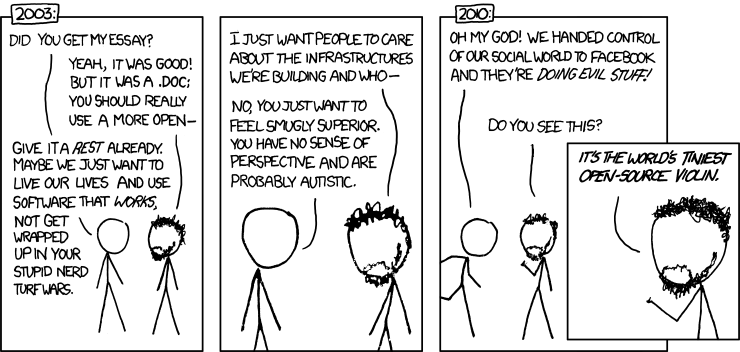
I worry a lot about my tone here.  As I recently found out when reading a book on obesity, it's sadly easy to dismiss those presenting information and ideas about something as, "Oh, they're one of those type of people.  That explains why they would say that."  It would be so easy to end up being that "smugly superior" guy who'll criticize folk for having different views on technology or not knowing as much as he does about computers.  As the comic below illustrates thouygh, sooner or later we'll be uncomfortable with how the technology we use works, and if unless we develop the appropriate infrastructure we'll be unable to change it.
Tuesday, July 31, 2012

What to write when nothing comes to mind

So I like to post at least once a month, and here I am sitting on about an hour left to August and I still haven't written a thing.  There's lots to write about, I can always launch into another mathematics and society rant, or if I'm watching my blood pressure something about computer science and beauty has been ruminating lately.  A friend put forth the interesting idea lately that computer literacy is the new literacy, and I'd like to write on that but felt oddly compelled to do some research before doing anything with that idea.  I'm engaged now and should have lots of ideas and feelings about relationships, love, and weddings.  I've even thought about doing some amateur tech journalism, but the most interesting thing I can think of now the big moves Microsoft is making, and since I'm currently working for them I'd prefer not to get into NDA territory, even though I probably wouldn't say anything that hasn't yet been said on most other tech news outlets.

So, plenty of interesting things to write, but just can't bring myself to put the words down.  Why?  Well, writing is hard.  It takes a mental effort to organize ideas and thought, and even more if an idea isn't quite yet fully formed and needs additional thought to be complete.  I got home tonight, ate some snacks for dinner while putting on some TV shows I wanted to catch up with, and then started thinking about writing.  But I wasn't really thinking about writing, I was thinking about the show I was watching, and I'm only finally banging this out by pausing the show and focusing on writing.

My mom is a six time published (and that's just the novels) author, so I've picked up a thing or two about writing.  One thing about it, which I suspect extends to any art in general, is that the most important thing is to sit down and do it.  While the romantic thought of waiting for inspiration to strike and then whipping up a masterpiece overnight in a frenzy of artistic furor may be appealing, it's just not reflective of reality.  The Sistine Chapel ceiling was painted because the pope offered a large commission, and Michelangelo signed it "Michelangelo, a sculptor" to express his feelings that he didn't consider himself a painter and would rather be working on his statue of Moses.  The Sistine ceiling is well known as one of the greatest pieces of art in the world, and I've always liked the thought that Michelangelo didn't even want to paint it.  I think we can learn a lot about how we can do great work even when we really don't want to do it.

Thursday, January 14, 2010

The Journey of a Thousand Miles...

...begins with a single step, as the proverb goes. This is true, but it's the time of year where you may be noticing something else. Two weeks ago you may have resolved to do something important over the course of this year. It may have been something big, a journey of a thousand miles per se. Hopefully you took the first step toward that around the same time, but now is the time when something starts to break your stride. That step taken oh so enthusiastically two weeks is taken less frequently. Maybe it's been replaced with something else. Maybe you just don't feel like you have the energy to keep taking it over and over anymore, but that's my point here. OK, metaphor aside I'll state my point clearly. Great things come from small and simple ones, but it's by a continual repetition of them.

Taking the perennial example of New Years resolutions, losing weight, we'll clearly get the picture. My mom talks about the "fake exercisers" at the beginning of each year. Those people who invade her Gym every January. She has nothing against people exercising, rather she's annoyed knowing her spot in the kickboxing class she loyally attends will be taken by someone who'll disappear after six weeks (to be generous). Their thousand mile journey is certainly a worth taking, but they don't actually take it. They take the first step, sure, but quit after a few hundred.

Since I am a mathematician, let's look at how many steps are in a thousand miles. 1,000 miles is 1,609 km. I am a tall guy with long legs and feel OK saying my stride is probably around one meter. Thus I would have to take one million six hundred and nine thousand steps. Realizing this it seems staggering, impossible. That first step is essentially meaningless. However, if I am diligent in taking steps, if I take one step every five seconds, let's say. I can walk almost four journeys of thousand miles over one year. Taking one step every fifteen seconds I can still walk a thousand miles over the course of a year and have a little bit of time left over to, I don't know, eat and sleep.

In summary, to reach a goal-to journey a thousand miles-one must be persistent. Consistency is far more important than enthusiasm. While the journey of a thousand miles begins with a single step, it's only finished by the willingness and discipline to keep taking steps.

Tuesday, January 27, 2009

Not excusable, but understandable

I have been thinking since for a little bit now on the title of this post. I suppose I should say that my thoughts about it might just barely crystallize here as I write them, or maybe not. It's an interesting thing to think about, and has meaning and importance, and it's about time for the monthly post here on my blog so here goes.

I think my idea here is what drives reformation. What drives one to become better? To leave bad habits and grow to be better. This is similar to my previous post on the idea of a PGF. My question here though focuses more on bad habits, or vices. I've been struggling with some of my own lately. Perhaps it may be better to say that a particular struggle has been highlighted recently, as I hope to be continually struggling with my vices and weakness always. Getting to the point, I see the poor decisions I make and I decide that they're not excusable, but sometimes understandable.

This means I seek to understand what drives me to do what my better judgment tells me not to. I look for the conditions and the reasons behind bad decisions, internal and external. I usually find them. I usually find a good explanation for why I don't do what I think I should. Knowing this empowers me to be better, to avoid those pitfalls in the future, and to build situations around and within me that will propel me to good rather than away from it.

Knowing what caused my iniquities, though, doesn't mean that they don't exist. It doesn't mean, to use my hated phrase, "I'm a good person." On the other hand, weeping and feeling sorrow for what I've done wrong won't help either. I can't live in the past, wishing I hadn't done what I've done. I can only accept my previous faults, and strive to make sure they do not become present faults.