Showing posts with label skills. Show all posts

Monday, June 8, 2015

Are We Ready for Post Scarcity? Part 3

So technology has brought us a new world.  The new technologies developed in the 20th and 21st centuries have created a world with changes as drastic as the invention of agriculture over 10 millenia ago.  This new world is awe inspiring in its productive capabilities.  Like the soviets upon seeing American grocery stores or backyard pools, those of us from the old worlds look in disbelief on the abundance the highly automated modern world offers.  Will that disbelief be an awestruck hopeful wonderment, or a horrified cringing at the dystopian nightmare on display?

What becomes of the human being, the individual in the post-scarcity world?  While objectively unanswerable, for now, science fiction and current trends can give us an idea.  Star Trek provides the most hopeful vision, a humanity that devotes itself to self improvement and growth, bravely venturing out to explore the universe or just starting a small restaurant to share the joy of old family recipes (like Joseph Sisko from DS9).  People engage in their passions and become the greatest captains, scientists, or chefs that they can thanks to the freedom from desire and from the struggle for the basic necessities of life.  While this optimism is one of the reasons we love Star Trek it doesn't strike us as realistic.

On the other side of the spectrum we see the 'dystopian,' or broken utopia, genre of fiction.  The lack of scarcity in information and communication enabled by the internet has made government surveillance and monitoring so easy that the protections for citizens seem to come only from law these days.  And that can easily fail, as the victory of the ACLU against ongoing programs of the NSA showed.  The NSA's activities have many shouting that, "1984 was not an instruction manual."  A conversation from the video game Deus Ex indicates another interesting, and all to realistic, future:
JC Denton: Some people just don't understand the dangers of indiscriminate surveillance
Morpheus (an AI system who is 'a prototype for a larger system'): The need to observed and understood was once satisfied by God.  Now we can implement the same functionality with data-mining algorithms.
JC Denton: Electronic surveillance hardly inspires reverence.  Perhaps fear and obedience, but not reverence.
Huxley's Brave New World gives us one vision of a post scarcity world that's also terrifying.  People are raised from conception to death to fill a certain role, with much of the population raised to lack mental faculty and drive so that they can be contented with menial jobs.  Innovation is suppressed if the rulers decide it doesn't support the economy.  The population is essentially drugged into compliance and acceptance of the system that promotes nothing but the status quo ad infinitum.  At least everyone has a job, though.

These uncomfortable futures are just fiction, for now, but sadly they seem to strike us as truer to reality.  One of the consequences of post-scarcity living is that power can evaporate.  It can also become much more concentrated.  Abuses by law enforcement that were once prevented by their sheer infeasibility now need laws in place to protect citizens (the supreme court decision on GPS tracking is a good example of this to add to the NSA's recent abuses of power).  However when laws are needed the question inevitably arises of who will write them.

The genius of American government is the idea of the powerful individual, that every citizen has strength enough to make their voice resonate in the halls of power.  The idea has caught on so strongly that it's easy to forgot how revolutionary and unthinkable this idea would be only 500 or so years ago when monarchs were the norm, and for basically all of human history before that when the strong took what they wanted without regard for whether or not the man they were taking it from cared to give it up.

The same power of technology that can eliminate scarcity could also conceivably eliminate freedom.  Corporate influence over lawmakers could barely be necessary if companies like John Deere, Apple, and Comcast continue along their trajectories.  Imagine the power the tractor company would hold if they were able to dictate whether or not their machinery were allowed to be repaired or you would just have to buy a new one to continue sowing grain.  Consider the power of a company with similar power over electronics and personal computers.  All the innovation and creativity in the world doesn't mean a thing if a company controlling the means of distribution for new products and stories can decide to refuse their service.

How can we dilute these powers, without only strengthening centralized government power, and while still providing opportunity and daily bread for the individual?  I don't know.  I have some ideas, but truly I can't say what I'd really do if I were ruler of the world, or even just the US.  What I can say is that no one else really can either.  There's a dearth of ideas and solutions floating around out there because we're not addressing the issue.

The idea of a post-scarcity economy and society is so revolutionary that it doesn't sound real.  Talking about robotics and computing replacing human beings as the driving force in the economy sounds like science fiction, despite the fact that we continually experience it as reality.  The whole issue is so massive and so out there that it's not addressed seriously in politics, and rarely in thoughtful conversation.  If this continues we'll find ourselves in a world clinging to obsolete social mores and struggling to make them fit in the modern world.  We can't let that happen, so let's think about getting ready for post-scarcity.

Wednesday, March 25, 2015

Are We Ready for Post Scarcity? Part 1

The abundance of the modern day is staggering.  Food alone is now requiring few man hours and producing vast amounts of product.  In about 25 years the personal computer has gone from a relatively cutting edge office device to a ubiquitous handheld one.  The amazing advances in technology will only cascade into more, and these will bring amazing blessings, conveniences, and boons to humankind.  These are gifts we should be prepared to freely receive, but like a gift of chocolate that will make us sick if eaten to quickly or heavy book that will require much reading and concentration we need to be receive these with caution and adroitness.

Let's go back to food.  One of the interesting points of contention between my brothers, me, and our grandmother is our approach and mentalities surrounding food.  Our grandma, growing up in a family that suffered through and being born shortly after the great depression, views food as a precious and scarce resource.  She often views food in terms of availability, enjoying buffets and inexpensive diners and being anxious over throwing away uneaten scraps or spoiling produce.  My brothers, and even my parents, live in the modern age and see food as abundant.  We don't like to waste food, but recognize that when the bread gets moldy it should be thrown out because it only costs a dollar or two (ten minutes of work at minimum wage) to get another loaf.  We live devoid of the "clean your plate" ethic so common in past generations.

Thank heavens for that too, as obesity and overeating are a greater health risk to us than malnutrition (though I am skeptical of the magnitude of this risk).  It's actually odd to think about health risks arising because nourishment is so easy to obtain.  Taking anatomy and physiology I've learned hundreds of ways in which a deficiency of calcium, iodine, glucose, iron, or any other number of dietary intakes cause problems.  It's bizarre to think of problems coming about simply because we have so much of those things we need and love that we run out places to put it and spend so much time and energy to keeping it all together.

Food is only the beginning of this, though.  Technology is more and more in in the reach of anyone who'd like it.  Entertainment and education is more available than ever with the internet.  And these are just the commodities being made abundant with modern technology.  Go even slightly futuristic and we have productive capabilities exploding via robotics, precious metals or gems having their scarcity destroyed by advanced chemical and materials engineering techniques, and even thought or creativity flooding the market in ways never before seen thanks to better distribution systems, or even AI and other futuristic computing creating new art.

The challenges presented by this can be staggering though.  The central one is likely motivation.  Survival and status have been the principle motivators of a person in the past.  That might have meant being the mightiest hunter in the tribe that's always well fed or the most influential business magnate on wall street who always had some opportunity waiting, but the principles been the same.  Many of us have said something like, "I really don't want to go to work today but they won't pay me if I don't so I guess I had better," and we've probably even said that with some frequency.  If we reach post scarcity we theoretically won't ever need to get paid, so what will keep us getting out of bed in the morning and off the streets?  I'll be investigating this and other ideas of a post-scarcity society and economy in part 2.

Saturday, December 27, 2014

Thirty Years

Yesterday was my thirtieth birthday. As I leave my thirtieth year of life and enter my thirty-first I reflect on the passed year.  Year thirty feels as if I've been a plane that's waited at the gate, taxied up the runway, and taken off for a new destination.  Here's the highlights:
  • Working at inthinc : I continued my job at inthinc technology solutions for the first part of the year.  This time taught me once again the importance of good management.  Our last manager was very skilled at keeping the support team of which I was a part happy and feeling valued within the company.  During the first part of the year we had no manager and a number of internal conflicts arose within the team as well as numerous difficulties arising from a lack of effective interfacing with the rest of the company.  Our new manager, when hired, eventually turned out to make promises like a politician, fail to inform us about and connect us effectively with the rest of the company, and make the talent feel undervalued. I was the third person to leave the team as the burden on our team increased and feelings of valuation decreased.  After leaving the company I continued to hear of hardships and found the company was losing money and talent at an alarming rate, though it seems to have stabilized at this point. I have a number of good friends from my time there, but am happy to have gone.
  • Returning to University : Leaving inthinc prompted an overall career change.  I had noticed that the career trajectory in technical support would take significant time to advance and might not lead to a place I really wanted to be.  Looking at what field might be related to my previous scholastic experience in physics I found that radiology is something that would probably take about as much time to train in as it would to advance in my current work, had similar job demands at higher pay, and ultimately would be more fulfilling and interesting.  I enrolled at Weber State University and started attending classes. I was reminded how much I appreciated the university atmosphere and learning new material.
  • Entering Medicine : Preparing to enter the field of radiography I've been learning about the medical field generally as well.  I trained as a phlebotomist and am making arrangements to test for my limited x-ray machine operator's license.  I have been fascinated by the challenges and nature of the medical field. There's an intriguing intimacy to healthcare that makes me feel a great deal of responsibility toward patients. I never thought that biochemistry would hold any interest for me but after studying it (in part at least) for a semester I've completely turned the corner and am engaged by protein structures and metabolic pathways.  There's clearly a lot to learn and do in this field and I'm eager to continue exploring it in year thirty one of life and beyond.

Tuesday, September 3, 2013

Choosing Style & Convenience Over Principles

Consider which of the following philosophies you agree with more:
A central authority will control every aspect possible.
or
As much as possible will be made available in its entirety for public inspection and involvement.
With that in mind consider this: are you more willing to use Apple or Linux computers?  I know, I know "It just works."  "I'm not a 'techie,' and don't want to have to deal with all that complicated stuff"  "The way the little book opens is just so cute."  I've heard it all before.  I recognize that Apple has abstracted more of the functions for the user and produced very powerful, stable, efficient (though you wouldn't know if from their pricing) technology solutions, but you're missing the point.  I don't want to talk about Apple per se.  I want to talk about the choices we make, especially in technology.

Our choice in technology tends to be surprisingly shallow when we consider the depth of the effect technology has on us.  We decide based on what looks nice, has the coolest features, or sometimes (usually if we're a little more informed) runs well and has the most processing power.  For something that is so rapidly changing the way we interact, work, and quite arguably think this seems like pretty arbitrary criteria.  Will it cause me to seek large amounts of less intimate relationships more efficiently?  Will I ponder issues less in favor of looking up a quick and easy answer from a third party source in the most sleek and stylish way?  These are the kind of questions we're asking, when we could be asking ourselves questions like, "Will I be engaging in and contributing to a infrastructure that promotes openness and individual freedom?"

If I may be candid for a moment let me admit my smug tech nerd ways.  I used to be a little annoyed, mostly due to the immaturity one has early in life that others know different things than you do, when people didn't know how a computer's file system worked, the difference between a program and a text file, or why they couldn't get on the internet.  I'm quickly becoming less annoyed by these people, but that annoyance is being replaced by fear.

I'm afraid because I know that market forces drive technology, and it's terrifying to see the market choose flashy, easy, and restrictive items over empowering items that might make them work a little harder.  I'm afraid because working in tech support I've seen just how helpless people are when their technology breaks, how helpless many people are when it comes to fixing their technological problems, and how earnestly industry is working to make sure that problems may come up less at the expense of being fixable without being invited into a company's inner circle to error codes and access controls.  I worry about living in a world where a relatively small conglomerate of programmers, advertisers, and businessmen are making sweeping decisions on how people live their lives, and the people are relatively powerless to and even uninterested in changing that.

Many are afraid of the effect technology is having on the human psyche and sociological structures.  It's easy to blame the technology for this, but I feel that's misguided.  If our minds or societies are becoming corrupted it's not thanks to the internet, smartphones, or video games.  It's because we're using these poorly.  And why wouldn't we if most of us don't know how they work at all, and only know what they do as the company making it presents that to us?

Studying mathematics and physics where most modern research is done with the aid of computers I'm perhaps blessed to have been taught in a tradition that specifically points out where computers are helpful and where our own intellect should be applied.  Questions of what's computable and what isn't are addressed directly, as well as questions of the best way to compute that which we would indeed like to compute.

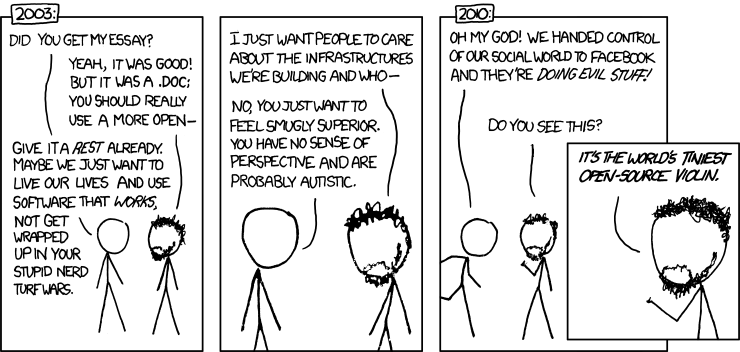
I worry a lot about my tone here.  As I recently found out when reading a book on obesity, it's sadly easy to dismiss those presenting information and ideas about something as, "Oh, they're one of those type of people.  That explains why they would say that."  It would be so easy to end up being that "smugly superior" guy who'll criticize folk for having different views on technology or not knowing as much as he does about computers.  As the comic below illustrates thouygh, sooner or later we'll be uncomfortable with how the technology we use works, and if unless we develop the appropriate infrastructure we'll be unable to change it.

Tuesday, February 10, 2009

What I learned from MMORPGs

Not much, since I don' actually play them. I do play video games when I find one I like enough to pull the time and money away from me. I had a thought recently about video game mentalities and paradigms and a major difference between the MMORPG and the kind I've played. The games I've played, mostly shooters and real time strategy, are level by level, outcome oriented games. You start a mission, play through it, and then start another one until you're done with the game. MMORPGs on the other hand only loosely follow this paradigm. Much more important, as I understand, is the in game character you make. You play the game not so much to finish a level and beat the game but to "level up" your character. Curiously, I think this is a great analogy for life and a good paradigm to live by, even if it's not the type of game I've been playing.

My types of games our outwardly oriented. Your focus is on manipulating the world around you: shooting the bad guys, destroying the enemy nuclear facility, stopping the end of the world. While these make for stories and situations I enjoy, it's not a good way to live your life. A wise word of advice is that you should not set goals for yourself based on other's agency (free will). We should be more concerned with carrying out good actions rather than the outcome of our actions. In an MMORPG is a quest is too hard and you can't get it to work out, you can abondanon it and look for other ways to gain experience. So in life we need to understand that if something isn't working out the way we want it to we can look to other things for fulfillment and joy. It is O.K. when things don't work out the way we'd hope.

"Leveling up" is something we could all stand to take a lesson from, too. Returning again to the concept of a PGF and it's derivative we should all be striving for the next level in our own personal growth. Realizing that there's always a higher level that comes with it's own rewards, or developing skills, abilities, and powers are what keep the MMORPG player playing. Likewise, developing our skills, abilities, and knowledge should keep all of us living.